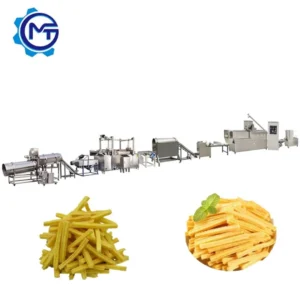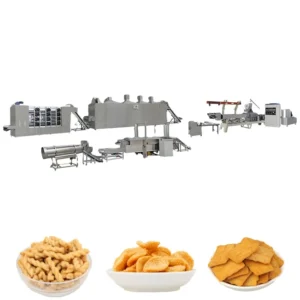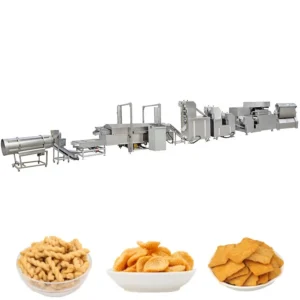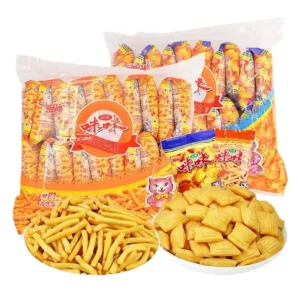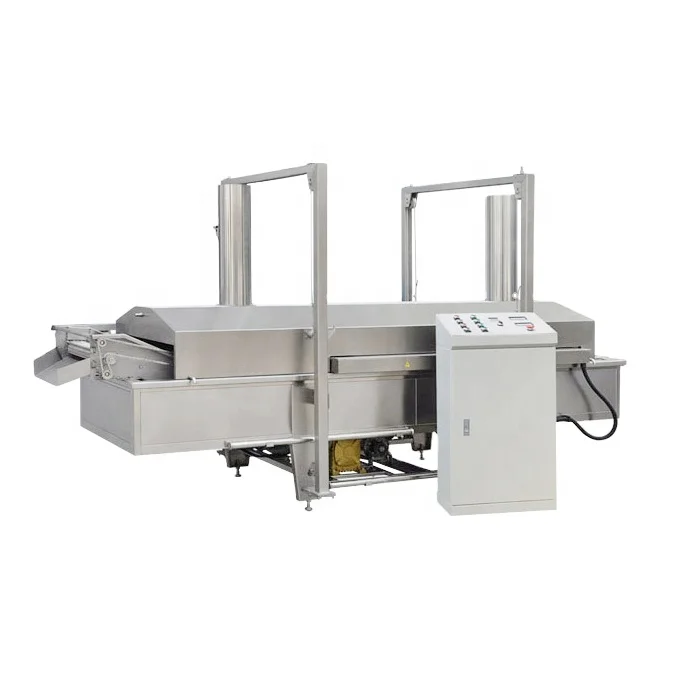
Matched Throughput Across Every Station — Sizing the fryer and flavoring drum to the extruder’s verified output prevents the bottlenecks that strand production lines at half-capacity.
Technical Specifications
| Parameter | Value |
|---|---|
| Model | MT65 / MT70 / MT85 / MT75 / MT95 |
| Product Type | Fried Puffs Snack Production Line |
| Extruder Type | Double Screw Extruder |
| Installed Power (Line) | 142 kW (MT65) / 185 kW (MT70) / 240 kW (MT85) / 245 kW (MT75) / 370 kW (MT95) |
| Actual Power Consumption | 100 kW (MT65) / 130 kW (MT70) / 180 kW (MT85) / 185 kW (MT75) / 280 kW (MT95) |
| Output Capacity | 120–150 kg/h to 800–1000 kg/h depending on model (basis to be confirmed) |
| Powder Mixer Batch Volume | 150 kg tank with 10-minute cycle time |
| Fryer Temperature Range | 0–260 °C |
| Construction Material | Stainless steel across all contact surfaces |
| Certifications | CE, ISO |
Application Suitability
| Application | Material or Output |
|---|---|
| Bugles and tortilla chips | Corn flour and wheat flour blends |
| Rice crust and sala crisps | Rice flour and starch-based formulations |
| Geometric shapes (triangles, Christmas trees) | Flour-based raw materials with specific die configurations |
| Small fish crisps and gourd snacks | Customized dough formulations through shaped dies |
Why the Fryer Rating Matters More Than the Extruder Nameplate
A fried puffs snack production line equipment for sale is only as fast as its slowest station.
I see this constantly at European trade shows: a buyer purchases a line based on the extruder’s nameplate capacity, only to discover the fryer or flavoring drum cannot keep pace. The extruder runs at full output while product piles up waiting for the oil bath, or worse, the seasoning drum creates a backlog that forces the entire line to slow down. The actual throughput becomes a fraction of what was quoted [NEED_CITE: throughput matching principles in food extrusion lines].
Station-by-Station Capacity Architecture
Every fried puffs snack production line equipment for sale should specify output ratings for each individual station. The double screw extruder forms the product through precise die configurations, but that means nothing if the downstream fryer operates at 200-300 kg/h while the extruder pushes higher volumes. Our catalogue lists the powder mixer output at 300-600 kg/h, the fryer capacity separately, and the flavor line at 400 kg/h, so buyers can verify the entire chain handles their target production rate.
Continuous Frying Temperature Control
The fryer operates across a 0-260 °C range, which covers the thermal requirements for different flour-based snack formulations. Lower temperatures suit products requiring longer residence times for moisture removal without surface burning, while higher settings handle thin-section items that need rapid expansion and crisp texture development [NEED_CITE: frying temperature profiles for expanded snacks]. Matching fryer temperature to product geometry and dough moisture content determines whether the final snack meets the crunch specification the market expects.
Screw Configuration and Die Design Logic
Five line models scale from the MT65 through the MT95, each with different installed power and actual power consumption figures. The double screw extruder’s screw configuration determines shear intensity and residence time, which directly affects starch gelatinization and expansion behavior. Die design controls the final product shape—whether triangles, bugles, or custom forms—and must be matched to the specific flour blend’s viscosity and expansion characteristics. Generic screw builds copied from unrelated applications produce the wrong texture or density.
What Happens When Stations Are Mismatched
An extruder supplied without matching fryer or coating capacity creates a permanent constraint. The line might run at nameplate capacity for the first hour, then operators notice product accumulating before the fryer or flavoring drum. They either slow the extruder down—wasting installed capacity and increasing unit cost—or accept inconsistent product quality as items spend variable time in the oil bath. Either outcome undermines the investment case [NEED_CITE: production bottleneck analysis in snack manufacturing].
Why Sourcing the Complete Line from One Supplier Changes the Equation
Screw configuration and die design are specified to your raw material and target product shape, not copied from a generic build. The in-house testing workshop runs trial production on your actual flour formulation before shipment, so product development happens before installation rather than after. Complete lines from batching to packing under one supplier means throughput is matched across every station rather than assembled from separate vendors with incompatible capacity ratings. Line layout and capacity calculation documents confirm the extruder, fryer, and flavoring stations all handle the same hourly output. Pre-sales consultation through on-site installation, commissioning, and ongoing maintenance support ensures the line performs as specified in your facility.
Documentation & Verification
- Line layout and capacity calculation confirming throughput matching between extruder, fryer, and flavoring stations
- Screw and die configuration record matched to your specific flour blend and target snack shape
- Electrical schematic with voltage and frequency confirmation for your local grid before production begins
- Factory test record and trial run report on your raw material demonstrating actual output and product quality
- Machine specification sheet with complete dimensional data and utility requirements for facility planning
Installation, Commissioning & Support
- Overall dimensions ranging from 22,000 mm to 30,000 mm length require facility planning for linear layout and access space
- Actual power consumption from 100 kW to 280 kW requires dedicated electrical circuits with appropriate breaker sizing
- Stainless steel construction throughout all machinery meets food-grade compliance and simplifies washdown procedures
- First startup includes parameter setting for fryer temperature profile and extruder screw speed matched to your formulation
- Operator training covers screw configuration changes for different product shapes and die replacement procedures
- Wear parts list identifies screws, dies, and fryer components requiring periodic replacement with reorder lead times
Moving Forward Requires Specific Production Data
To configure the right fried puffs snack production line equipment for sale, we need your target product shape and the flour formulation you plan to run. Your local voltage and frequency determine motor and control system specifications. The daily production target in kilograms tells us which model from MT65 through MT95 fits your scale, and whether a trial run on your raw material should happen before shipment.
Frequently Asked Questions
Q: How is the output capacity of each model verified, and what raw material basis is used?
A: Output capacity depends on the specific flour formulation, moisture content, and product shape being produced. We verify capacity through trial runs on your actual raw material in the testing workshop before shipment. The rated figures in the specification table assume standard conditions that may not match your formulation, which is why we test rather than rely on nameplate claims.
Q: What voltage, frequency, and control language options are available for the target market?
A: Electrical specifications are confirmed during the quotation phase based on your local grid standards. The electrical schematic documents the exact voltage and frequency configuration before production begins. Control system language options depend on the PLC or MCC system selected, and this is specified to match your operators’ requirements.
Q: How is the fryer and flavoring station sized to prevent bottlenecks with the chosen extruder model?
A: Each station in the line has a separately specified capacity rating. We match the fryer capacity and flavor line output to the extruder’s verified throughput on your material, not its theoretical maximum. The line layout and capacity calculation document shows how throughput flows through every station.
Q: Can a trial run be performed on our specific flour formulation before shipment?
A: Yes, the in-house testing workshop runs production trials on customer raw material before the line ships. This verifies that the screw configuration and die design produce the correct expansion, texture, and shape for your specific blend. The trial run report documents actual output and product quality achieved.
Q: What spare wear parts are included, and what is the reorder lead time?
A: The wear parts list identifies screws, dies, and other consumable components specific to your line configuration. Initial spare parts are typically included with the shipment. Reorder lead times depend on the specific screw configuration and die geometry required for your product shape, and are confirmed in the documentation package.