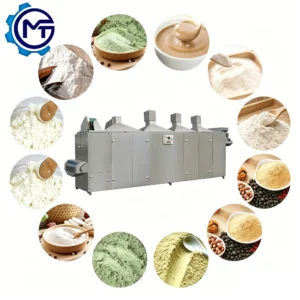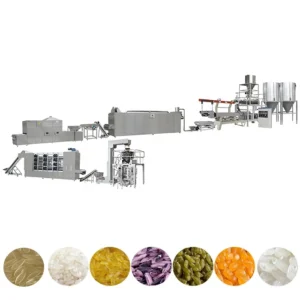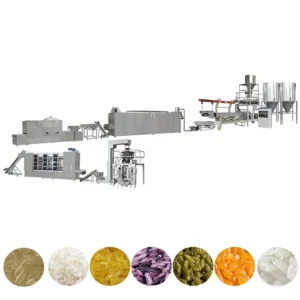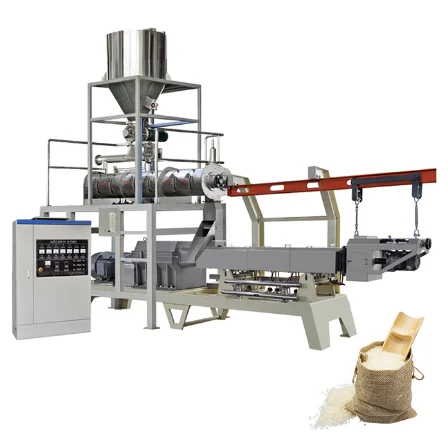
Line Throughput Matching — Every station from batching to packing is sized to the extruder’s actual output so the artificial rice processing line full equipment never bottlenecks at the dryer or cooler.
Technical Specifications
| Parameter | Value |
|---|---|
| Product Type | Artificial Rice and Nutritional Fortified Rice Extrusion Line |
| Models Available | MT65 / MT70 / MT85 / MT75 / MT95 |
| Screw Type | Twin-screw |
| Installed Power | MT65: 85 kW; MT70: 120 kW; MT85: 235 kW; MT75: 180 kW; MT95: 260 kW |
| Power Consumption | MT65: 60 kW; MT70: 85 kW; MT85: 165 kW; MT75: 135 kW; MT95: 195 kW |
| Output Capacity | MT65: 80–100 kg/h; MT70: 100–120 kg/h; MT85: 200–300 kg/h; MT75: 300–500 kg/h; MT95: 800–1000 kg/h (basis not stated in source — confirm raw material, moisture content, die configuration) |
| Overall Dimensions (L×W×H) | MT65: 28×1.2×2.2 m; MT70: 30×1.5×2.2 m; MT85: 34×3.5×4.3 m; MT75: 32×3.5×4.3 m; MT95: 36×3.5×4.3 m |
| Control System | Frequency speed control, high automation (PLC/MCC to be verified) |
| Feeding System | Single or double screw feeding, selectable based on material characteristics |
| Screw Material | Special wear-resistant technology (verify against manufacturer catalog) |
| Lubrication | Automatic lubricating and cooling system |
| Line Stations | Mixing → Extruding → Vibrating → Low-temperature Drying → Cooling → High-temperature Roasting → Cooling → Packing |
| Dryer Heating Source | Electric or gas |
| Dryer Feature | Circulation drying, frequency motor-controlled mesh belt speed |
Application Suitability
| Application | Material or Output |
|---|---|
| Artificial rice kernel production | Broken rice, rice flour, corn, starch as base ingredients |
| Nutritional fortified rice kernels | Rice and grain base with added vitamins and minerals |
| Reconstituted rice from by-products | Rice bran, millet, wheat, oats, buckwheat, bean flour |
| Grain-based nutritional supplementation programmes | Multi-grain blends formulated for institutional or government nutrition projects |
What the Nameplate Capacity Doesn’t Tell You About Your Rice Blend
Rated output means nothing when the downstream dryer cannot keep pace with the extruder.
I once watched a fortified rice extruder for sale rated at a comfortable mid-range throughput choke within the first hour of production. The buyer had specified the extruder model on nominal capacity alone, but the actual recipe included a high proportion of buckwheat and bean flour. The material expanded differently than standard rice starch, and the drying stage fell behind almost immediately. Piles of semi-dried kernels accumulated on the cooling conveyor while the extruder kept pushing product forward. The line had no throughput imbalance on paper — every machine was "rated" for the same capacity. In practice, the dryer’s belt speed and thermal profile had never been matched to that particular grain blend [NEED_CITE: throughput matching across extrusion line stations].
This is why an artificial rice processing line full equipment catalogue matters more than a single extruder spec sheet. You need to see every station — mixing, extruding, vibrating, drying, roasting, cooling, packing — and understand how each one is scaled relative to the others.
Matching Extruder Output to Dryer and Cooler Capacity
The twin-screw extruder series spanning MT65 through MT95 covers installed power tiers from 85 kW to 260 kW, each mapped to a different throughput band. When selecting a model, the downstream drying oven and cooling conveyors must handle the same mass flow rate. A circulation drying oven with frequency-controlled mesh belt speed allows the operator to adjust residence time, but only if the oven’s thermal capacity and belt length were originally specified for the extruder’s actual output on the buyer’s grain recipe.
Feeding System Selection for Blended Grain Inputs
Artificial rice and fortified rice production typically involves blending a starch base with smaller proportions of vitamins, minerals, and alternative flours. A single screw feeder may struggle with materials that bridge or segregate in the hopper, while a double screw feeder provides more consistent volumetric delivery for blends with varied particle sizes. The choice between single and double screw feeding depends entirely on the raw material flow characteristics of your specific formulation, not on the extruder model alone [NEED_CITE: feeding system selection for multi-ingredient grain blends].
How Screw Configuration Affects Kernel Density and Cooking Degree
The twin-screw design allows operators to rearrange screw elements and adjust the barrel temperature profile to control starch gelatinisation. For artificial rice kernels that must hold their shape during cooking and resist disintegration in boiling water, the degree of gelatinisation inside the barrel directly determines the final product’s structural integrity. A screw configuration optimized for pure rice flour will produce a very different kernel texture than one set up for a blend containing 20% buckwheat and added mineral premix. The die design further controls expansion ratio and kernel shape at the exit point, meaning the same extruder can produce dense, slow-cooking kernels or lighter, quick-cooking variants simply by changing the screw arrangement and die plate.
The Cost of Skipping the Line-Level Capacity Audit
When the vibrating screen after the extruder is undersized, wet extrudate clumps together before it reaches the dryer, creating uneven moisture profiles that the drying oven cannot correct. When the high-temperature roasting stage is too short for the line speed, the kernel surface fails to develop the slight caramelization that gives fortified rice its expected colour and aroma. These mismatches do not appear on any single machine’s specification sheet — they only surface during continuous production [NEED_CITE: downstream equipment bottlenecking in extrusion lines]. The result is product that looks right during the first thirty minutes and then drifts off-spec as material accumulates at the weakest station.
Why Source the Complete Catalogue Here
Every station in this artificial rice processing line full equipment range is specified under one supplier, meaning throughput calculations account for the entire sequence rather than individual machines purchased separately. Screw configuration and die design are documented against your raw material blend, not copied from a generic rice flour build. The in-house testing workshop runs your actual grain recipe before shipment, so the drying temperature profile and roasting duration are validated on real product rather than assumed from a standard recipe. Electrical schematics are confirmed for your facility’s voltage and frequency before production begins, avoiding commissioning delays on site.
Documentation & Verification
- Line layout drawing showing throughput matching across mixing, extruding, drying, roasting, cooling, and packing stations
- Machine specification sheet per model with screw configuration and die design record
- Electrical schematic with voltage, frequency, and control language confirmed to your facility
- Factory test record and trial run report on your actual grain blend before shipment
- Wear parts list identifying screws, dies, and feeder components with replacement intervals
Installation, Commissioning & Support
- Foundation and floor space planning based on the selected model’s overall dimensions, up to 36 m line length
- Dedicated electrical circuit sizing matched to installed power ranging from 85 kW to 260 kW
- Line arrives in modular station segments for sequential assembly and alignment on site
- First-run parameter setting covers screw speed, barrel temperature zones, and dryer belt frequency
- Operator training addresses feeding system changeover between single and double screw modes
- Spare screw elements and die plates supplied with initial shipment for first replacement cycle
What We Need to Configure Your Line
Share your base grain ingredients and any vitamin or mineral premix ratios so the screw configuration and feeder type can be matched to your material’s flow and expansion behaviour. Confirm your target hourly output on that specific recipe, along with your facility’s voltage and frequency. Let us know whether your workshop has space constraints that would limit the line footprint, and whether you want to send a sample batch of your raw material for a trial run before the equipment ships.
Frequently Asked Questions
Q: How do the five extruder models differ in power and footprint?
A: The MT65 starts at 85 kW installed power with a 28 m line length, suitable for smaller production scales. The MT95 reaches 260 kW installed power across a 36 m line for higher throughput. Intermediate models MT70, MT75, and MT85 fill the range between these endpoints, each with proportionally scaled dryer and cooling stations.
Q: What supporting stations follow the extruder in the line sequence?
A: After extrusion, material passes through a vibrating screen, then a low-temperature drying oven, a cooling conveyor, a high-temperature roasting stage, a second cooling section, and finally packing. Each station is sized so its throughput capacity matches the extruder model you select, preventing material backlog.
Q: What is the difference between low-temperature drying and high-temperature roasting?
A: Low-temperature drying removes bulk moisture from the extruded kernels gently to prevent surface cracking. High-temperature roasting follows later in the sequence to develop surface colour, aroma, and final texture. Skipping or shortening either stage affects kernel integrity during end-user cooking.
Q: Can the feeding system handle blended grain and mineral premixes?
A: Yes. The line offers selectable single or double screw feeding. Double screw feeding is typically chosen when the blend contains ingredients with different particle sizes or flow properties, such as a rice flour base mixed with vitamin and mineral premix, to prevent segregation and ensure uniform delivery into the extruder barrel.
Q: What heating source options exist for the dryer?
A: The circulation drying oven is available with either electric or gas heating. The choice depends on your facility’s utility infrastructure and local energy cost structure. Mesh belt speed is controlled by a frequency motor in both configurations, allowing adjustment of drying residence time.