Throughput-Matched Line Design — every station from mixing to packing is calculated against the extruder’s actual output on your raw material, eliminating the bottleneck effect that occurs when downstream dryers or coolers cannot keep pace with upstream extrusion.
Technical Specifications
| Parameter | Value |
|---|---|
| Model | MT65 / MT70 / MT75 / MT85 / MT95 |
| Product Type | Artificial Rice Production Line / Fortified Rice Kernel Extruder |
| Extruder Type | Twin-screw extruder |
| Installed Power | 85 kW (MT65) / 120 kW (MT70) / 180 kW (MT75) / 235 kW (MT85) / 260 kW (MT95) |
| Power Consumption | 60 kW (MT65) / 85 kW (MT70) / 135 kW (MT75) / 165 kW (MT85) / 195 kW (MT95) |
| Output Capacity | 80–100 kg/h (MT65, basis not stated in source) / 100–120 kg/h (MT70, basis not stated) / 300–500 kg/h (MT75, basis not stated) / 200–300 kg/h (MT85, basis not stated) / 800–1000 kg/h (MT95, basis not stated) |
| Overall Dimensions (L×W×H) | 28×1.2×2.2 m (MT65) / 30×1.5×2.2 m (MT70) / 32×3.5×4.3 m (MT75) / 34×3.5×4.3 m (MT85) / 36×3.5×4.3 m (MT95) |
| Control System | Frequency speed control |
| Screw System | Single or double screw feeding system selectable |
| Lubrication | Automatic lubricating and cooling system |
| Heating Source (Dryer) | Electric or gas |
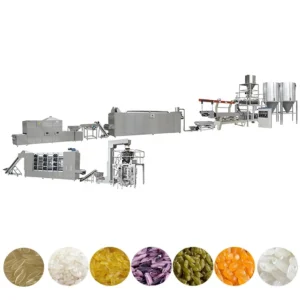
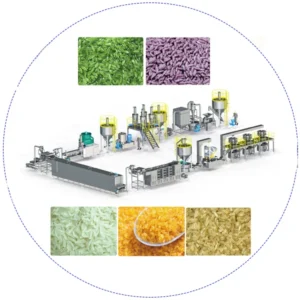
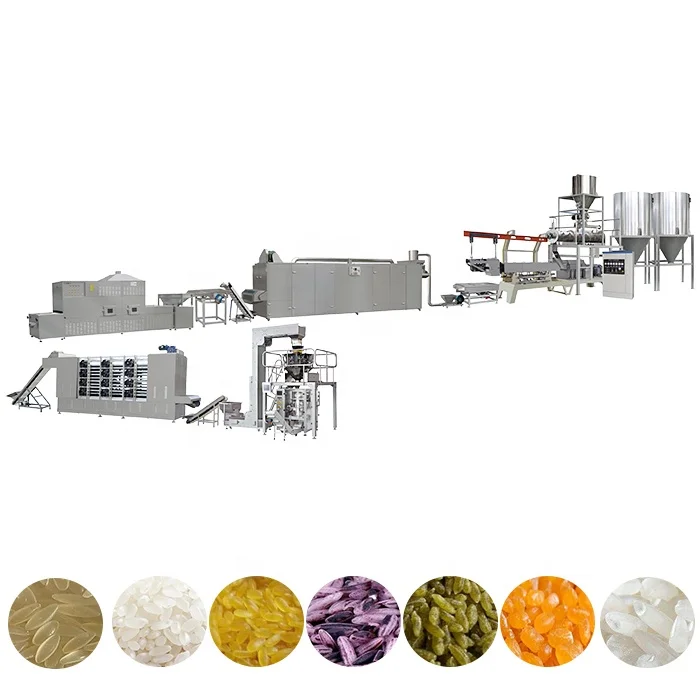
| Line Stations | Mixing → Extruding → Vibrating → Low-temperature drying → Cooling → High-temperature roasting → Cooling → Packing |
| Raw Materials | Broken rice, rice, corn, millet, wheat, oats, buckwheat, bean, starch; vitamin and mineral premix as partial ingredient |
| Certification | CE, ISO |
Application Suitability
| Application | Material or Output |
|---|---|
| Fortified rice kernel production for nutrition programs | Rice flour base with vitamin and mineral premix |
| Reconstituted rice from milling by-products | Broken rice and rice bran blended into rice-shaped kernels |
| Multi-grain rice-like products | Corn, millet, wheat, oats, buckwheat, bean-based formulations |
| Infant and nutritional food ingredient manufacturing | Starch and grain blends with micronutrient fortification |
What "Capacity Rating" Means Without Your Raw Material
A nominal output figure is meaningless until the extruder runs your specific grain blend and micronutrient premix through the actual die plate.
I learned this the hard way on a nutritional powder line years ago. We ran our factory trial on plain rice flour and everything looked stable. Then the customer’s actual recipe — loaded with whey protein isolate and a dense micronutrient premix — turned the product lumpy on site, with density swinging wildly across the batch. Two weeks of reworking the screw profile and die plate followed. That artificial rice production line equipment must be validated on the buyer’s real material, not a convenient surrogate, before the capacity number holds any weight [NEED_CITE: twin-screw extrusion behavior with high-protein and micronutrient-loaded formulations].
How Every Station Connects Across the Line
An artificial rice production line equipment system is only as reliable as its weakest throughput match. The extruder pushes product into the vibrating conveyor, which feeds the low-temperature dryer, then the cooler, the high-temperature roaster, another cooling stage, and finally packing. If the dryer belt speed or the roaster residence time cannot absorb the extruder’s actual output, product backs up or dries unevenly. Each station on this line is sized so that material flows continuously without accumulation or starvation at any transfer point.
Die Geometry and Kernel Shape Fidelity
The die plate determines whether the extruded product holds a convincing rice-kernel shape through drying and roasting. Moisture loss during low-temperature drying causes shrinkage, and the die orifice must be oversized to compensate so the final kernel matches the target dimensions. The twin-screw configuration provides the shear and residence time needed to fully gelatinise starch from broken rice, corn, or millet bases, giving the kernel enough structural integrity to survive the roasting stage without cracking [NEED_CITE: starch gelatinisation requirements in twin-screw extrusion for rice-shaped products].
Reading the Power and Capacity Table Correctly
The installed power and power consumption figures differ across the five models because motor sizing reflects barrel length, screw diameter, and the torque required to push viscous grain dough through a restrictive die. Higher installed power on the MT85 and MT95 supports the longer barrel and larger screw volume needed for greater throughput. The selectable single or double screw feeding system matters when your formulation includes a micronutrient premix at low inclusion rates — a twin-screw feeder maintains a consistent feed ratio, while a single-screw feeder suits free-flowing base materials like milled rice or corn grits. Frequency speed control on every model lets operators adjust screw speed to match different raw material viscosities without stopping the line.
The Hidden Cost of an Undersized Dryer
When the dryer cannot remove moisture fast enough, kernels reach the roasting stage with too much internal water. The high-temperature roaster then case-hardens the outside while trapping steam inside, producing kernels that crack during cooling or shatter in the packing auger. On a nutritional program contract, cracked kernels fail visual inspection and get rejected at the buyer’s warehouse. I have seen lines where the extruder was correctly specified but the dryer belt was too short for the actual throughput, and the operator had to slow the entire line down to compensate — effectively cutting real output well below the quoted capacity [NEED_CITE: moisture migration defects in extruded and dried cereal products].
Why This Line Is Built as One System
The artificial rice production line equipment here is supplied as a complete sequence rather than individual machines assembled from separate vendors. Throughput is calculated across every station so the dryer, cooler, and roaster absorb the extruder’s real output. Screw configuration and die design are specified to the buyer’s raw material formulation and target kernel shape. An in-house testing workshop runs the buyer’s actual material before shipment, catching formulation issues before they become on-site emergencies. The line supports both electric and gas heating for the dryer, accommodating different utility infrastructures across export markets.
Documentation & Verification
- Line layout showing throughput calculation at each station from mixer to packer
- Screw and die configuration record matched to your grain blend and kernel shape
- Trial run report produced on your actual raw material in the testing workshop
- Electrical schematic with voltage and frequency confirmed for your facility
- Factory test record documenting run parameters before disassembly and crating
- Operation and maintenance manual with wear parts list and replacement intervals
Installation, Commissioning & Support
- Foundation plan accounts for the line’s full length up to 36 m and vibrating station loads
- Power supply verified against the specific model’s installed power rating before cable routing
- Line ships in modular sections for assembly and alignment on your workshop floor
- First run sets screw speed, barrel temperature profile, and dryer belt speed for your material
- Operator training covers feeding system changeover between single and double screw modes
- Spare screws, dies, and mesh belt sections listed with recommended replacement schedule
Before You Send an Inquiry
To size the right model and configure the line, share your primary raw material and any micronutrient premix formulation, your target daily output, and the kernel shape or size specification your market expects. Include your facility’s voltage, frequency, and available control language so the electrical package matches from day one. If you have upstream milling or downstream packing equipment already in place, note the interface requirements so the line layout accounts for those connection points.
Frequently Asked Questions
Q: What raw material basis is used when output capacity is quoted for each model?
A: Published capacity figures are measured under specific test conditions that may not match your formulation. We run your actual grain blend and premix in our testing workshop to establish the real throughput before the line ships. The trial run report documents the achieved output so you can plan production schedules accurately.
Q: How are downstream stations sized to match the extruder?
A: Each dryer belt length, cooler airflow volume, and roaster residence time is calculated against the extruder’s confirmed output on your material. This prevents product backup at transfer points and ensures consistent moisture content through every stage of the artificial rice production line equipment sequence.
Q: What electrical and control options are available for different markets?
A: Voltage and frequency are confirmed during the specification stage to match your facility’s power supply. Frequency speed control is standard across all models, and the control interface language can be set to your operator team’s requirement before shipment to avoid commissioning delays.
Q: Which stations are included in the standard line, and what can be added?
A: The standard sequence covers mixing, extruding, vibrating, low-temperature drying, cooling, high-temperature roasting, a second cooling stage, and packing. Optional stations such as additional flavouring or coating drums can be integrated if your product specification requires surface treatment after roasting.
Q: What spare wear parts should I stock for the first year of operation?
A: Screws, die plates, and dryer mesh belt sections experience the most wear. We supply a recommended spare parts list with the operation manual, and the automatic lubricating and cooling system on the extruder extends screw life by maintaining consistent barrel temperature during continuous runs.