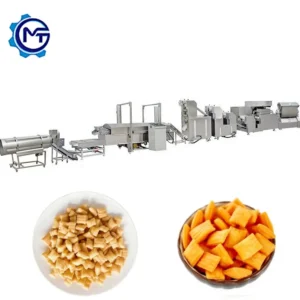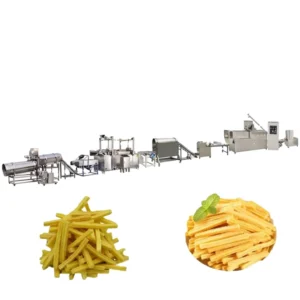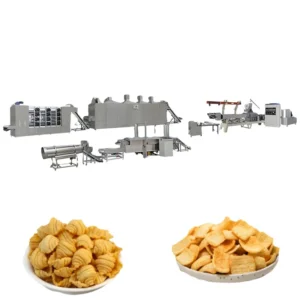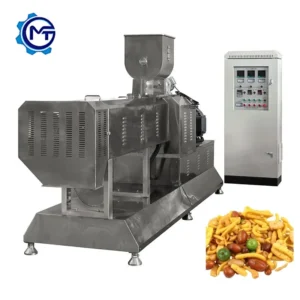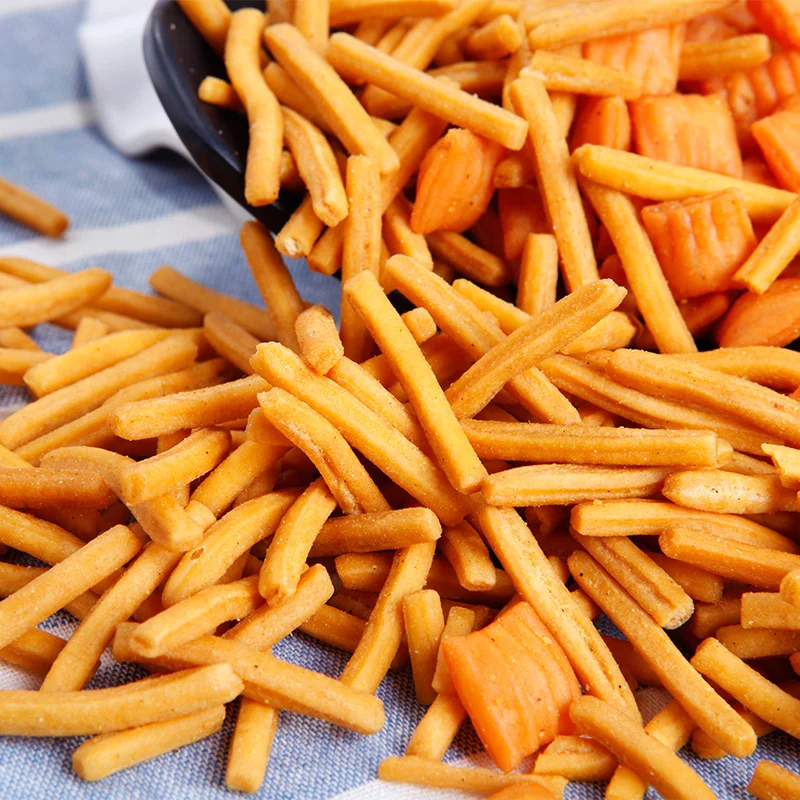
Matched-Station Design — Every cycle time from extruder through fryer to coating is verified before shipment, so no conveyor piles up with half-cooked product.
Technical Specifications
| Parameter | Value |
|---|---|
| Product Type | Automatic Continuous Deep Fryer for Snack Food Processing |
| Heating Method | Electricity or Gas (dual option) |
| Heating Tube Power | 60 kW (electric variant) |
| Drive Power | 2.6 kW |
| Voltage & Frequency | 380V / 50Hz |
| Oil Capacity | 320 L |
| Belt Type | Upper and lower double-layer mesh belt |
| Speed Control | Frequency conversion stepless speed regulation |
| Oil Filtration | Continuous oil circulation filtration system |
| Slag Discharge | Bottom-mounted automatic system |
| Lifting System | Automatic hood and mesh belt lift |
| Construction Material | Food-grade 304 stainless steel |
| Overall Dimensions (L×W×H) | 6700 × 2200 × 1200 mm |
| Net Weight | 2000 kg |
| Output Capacity | 100–1000 kg/h (basis to be confirmed) |
| Control System | PLC |
| Assembly State | Fully assembled |
Application Suitability
| Application | Material or Output |
|---|---|
| Fried extruded snack sticks | Wheat flour and corn-based dough pieces |
| Corn chips and tortilla chips | Formed masa or extruded corn pellets |
| Puffed pellet snacks | 2D/3D starch-based pellet chips |
| Wheat flour crisps | Sheeted or extruded wheat flour snacks |
| Snack line integration | Upstream extruder output matched to fryer belt speed |
What Happens When Fryer Capacity Does Not Match Extruder Output
A fryer that cannot keep pace with upstream extrusion forces operators to slow the entire line or watch product accumulate on the conveyor.
I spent years on the exhibition floor across Europe and the Americas, and the most frustrating call I ever got came from a buyer who had purchased a frying station separately from his extruder. The extruder pushed product faster than the fryer belt could carry it through the oil bath. Half-cooked snack pieces jammed the transition conveyor, and two tons of dough were scrapped before the line was shut down. The problem was not the fryer alone — it was the gap between stations that nobody had calculated. [NEED_CITE: throughput matching between extrusion and frying stations in snack processing lines] This continuous frying machine for snack production line configurations is specified only after the upstream extruder output and downstream seasoning drum speed are confirmed, so the belt loading rate and oil residence time align with what the line actually produces.
Belt Submersion and Uniform Oil Contact
The double-layer mesh belt clamps extruded snack pieces between upper and lower layers throughout the oil bath. This prevents low-density puffed pieces from floating to the surface where they would receive uneven heat exposure. The frequency conversion drive allows operators to adjust belt speed without stopping the line, tuning residence time to the specific moisture content and density of each product run. A continuous frying machine for snack production line setups must hold product geometry consistent from entry to exit, and this clamping approach addresses the floating problem that open-belt fryers cannot solve.
Oil Life and Filtration Under Continuous Load
Continuous oil circulation filtration pulls oil from the fryer sump, passes it through a screen filter to remove fine particulate and carbonized crumbs, and returns it to the heating zone. This reduces the acid value buildup that degrades oil colour and transfers off-flavours to the product. In high-volume snack operations, oil replacement represents a significant recurring cost, so extending service life between full oil changes directly affects running expense. The bottom-mounted slag discharge system removes heavier debris before it reaches the circulation pump, protecting both the pump seals and the heating elements from carbon buildup. [NEED_CITE: edible oil degradation rates in continuous deep frying operations]
Power, Heating, and Control Logic
The 60 kW electric heating variant provides rapid oil recovery when cold product enters the bath, maintaining the set frying temperature despite continuous loading. For sites where gas supply is more economical or electric capacity is limited, the gas heating option delivers equivalent thermal input through a burner array beneath the oil pan. The PLC control panel manages temperature setpoint, belt speed, filtration cycle timing, and the automatic hood lift for cleaning access. Voltage and frequency are confirmed against the buyer’s site supply before production begins — shipping a 380V/50Hz machine to a 460V/60Hz facility delays commissioning by weeks while transformers are sourced locally.
The Cost of Skipping Station-by-Station Verification
When fryer capacity is assumed rather than calculated, the consequences surface on the first production day. Product堆积 on the infeed conveyor forces emergency line stops, and repeated start-stop cycles degrade oil quality faster than continuous running. Burnt fines from stalled product contaminate the oil bath, requiring an early full drain and refill. Operators compensate by raising oil temperature, which accelerates acid value rise and shortens oil life further. The seasoning drum downstream runs empty while the fryer catches up, creating idle labour and missed shift targets. [NEED_CITE: production loss from mismatched station capacity in snack lines]
Why Source This Fryer Through the Full Equipment Range
The complete machine catalogue approach means this fryer is never quoted in isolation. Mixing, extrusion, drying, frying, coating, and packing stations are all sized against the same throughput target, so no single station becomes a bottleneck. Screw configuration and die design on the upstream extruder are matched to the same raw material that will enter this fryer, ensuring the moisture content and piece density fall within the frying parameters the belt speed and oil temperature can handle. The in-house testing workshop runs the buyer’s actual raw material through the extrusion and frying stages before shipment, confirming that the product colour, texture, and oil absorption meet specification. Pre-sales consultation covers utility planning — the 60 kW heating load and 2.6 kW drive power are verified against available site capacity before the machine enters production.
Documentation & Verification
- Line layout showing fryer position between extruder and seasoning station with matched belt speeds
- Machine specification sheet confirming voltage, frequency, and heating method for destination market
- Electrical schematic with PLC I/O map and control language confirmed before assembly
- Factory test record with oil temperature stability and belt speed range verified under load
- Machinery test report and video outgoing inspection provided before dispatch
Installation, Commissioning & Support
- 6700 × 2200 mm footprint requires level concrete floor with drainage channel for oil spill containment
- 60 kW electric heating demands dedicated circuit breaker sized for continuous thermal load
- Arrives fully assembled; position, connect utilities, fill oil, and run empty belt test
- PLC parameters set to product-specific frying time and temperature during commissioning
- Operator training covers belt speed adjustment, filtration screen cleaning, and slag discharge cycle
- Wear parts list includes mesh belt sections, heating elements, and filtration screens
What We Need to Size Your Frying Station
Provide the upstream extruder model and its verified output rate on your specific raw material so the belt loading density can be calculated. Confirm your site voltage, phase configuration, and whether electric or gas heating suits your utility cost structure. Share your workshop ceiling height and the floor space allocated between the extruder discharge and the seasoning drum infeed so the 6700 mm fryer length fits your layout without compromising maintenance access on either side.
Frequently Asked Questions
Q: How is fryer capacity matched to upstream extruder output and downstream coating line speed?
A: We calculate the belt loading rate based on extruder throughput, piece weight, and required oil residence time. The fryer belt speed is then set so that product exits at the rate the seasoning drum can accept. All three stations are confirmed in the line layout before any machine enters production.
Q: What voltage, frequency, and control panel language options are confirmed before production?
A: We confirm site voltage and phase configuration, then match the heating elements and motor windings accordingly. The PLC interface language is selected from available options based on your operator team. Electrical schematics are reviewed and signed off before assembly begins.
Q: Which heating method is recommended for my production volume and local utility cost?
A: Electric heating at 60 kW suits sites with stable power supply and lower gas infrastructure cost. Gas heating is preferred where electricity tariffs are high or grid capacity is limited. We review your local utility rates and site infrastructure before recommending one variant over the other.
Q: Can a trial fry run be performed on my actual extruded product before shipment?
A: Yes. The in-house testing workshop runs your raw material through the extruder and into the fryer, confirming product colour, oil absorption, and texture against your target specification. The trial run report is included in the shipment documentation package.