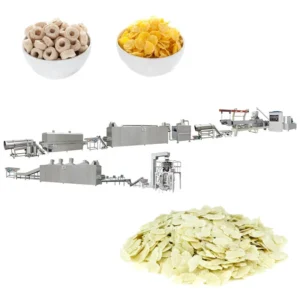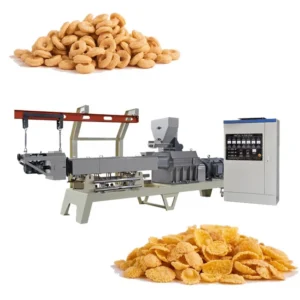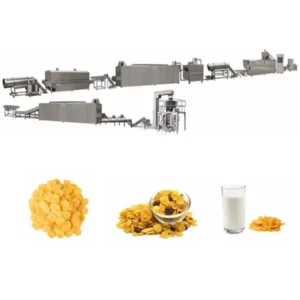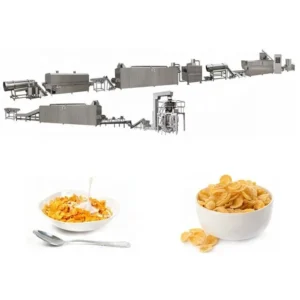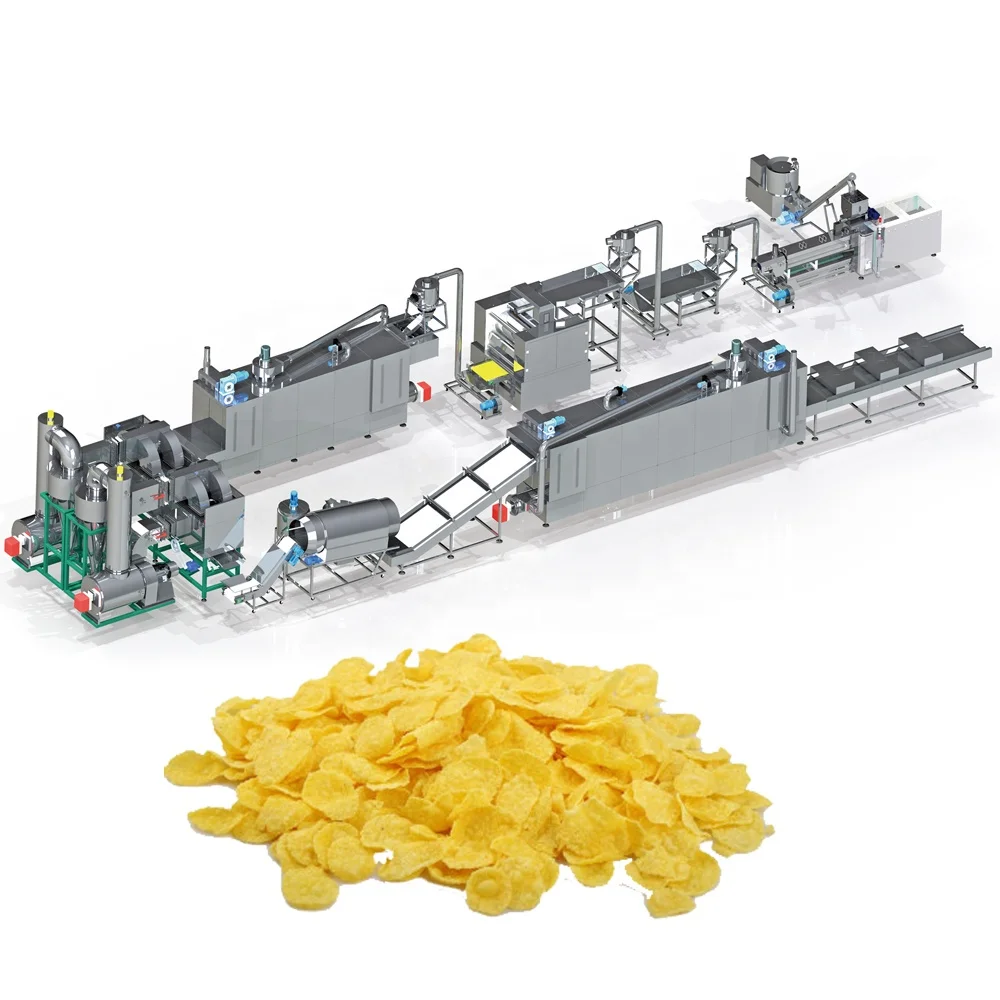
End-to-End Equipment Matching — Every station from the mixer to the coating drum is sized against the extruder output so the corn flakes production line equipment runs without bottlenecks.
Technical Specifications
| Parameter | Value |
|---|---|
| Product Type | Corn Flakes and Breakfast Cereal Production Line |
| Extruder Models Available | MT70 / MT85 / MT75 |
| Extruder Type | Twin Screw |
| MT70 Installed Power | 160 kW |
| MT70 Power Consumption | 120 kW |
| MT70 Capacity | 150–200 kg/hr (basis to be confirmed) |
| MT70 Overall Dimensions | 41 × 1.5 × 2.2 m |
| MT85 Installed Power | 190 kW |
| MT85 Power Consumption | 140 kW |
| MT85 Capacity | 300–400 kg/hr (basis to be confirmed) |
| MT85 Overall Dimensions | 43 × 1.5 × 3.2 m |
| MT75 Installed Power | 210 kW |
| MT75 Power Consumption | 150 kW |
| MT75 Capacity | 300–500 kg/hr (basis to be confirmed) |
| MT75 Overall Dimensions | 45 × 1.5 × 3.5 m |
| Control System | PLC control (flaking machinery) |
| Flaking Drive | Double motors, hydraulic system for double rollers |
| Flaking Temperature Control | Infrared sensor |
| Dryer Heating Source | Gas or Electric (configurable) |
| Roasting Oven | Hot air, vibrating pan, dual circulating fans, cyclone dust removal |
| Coating System | Double tumble melter, elevator, coating drum, spraying nozzle |
| Line Sequence | Mixing → Extrusion → Molding/Cutting → Drying → Flaking → Roasting → Coating |
| Screw Feature | Automatic lubricating and cooling function |
| Warranty | 24 months, lifetime service |
| Certification | CE, ISO |
Application Suitability
| Application | Material or Output |
|---|---|
| Sugar-coated corn flakes | Corn grits, sugar syrup glaze |
| Plain unsweetened corn flakes | Corn grits, malt extract |
| Multi-grain breakfast flakes | Wheat, oat, rice blends |
| Extruded cereal shapes | Corn, rice, wheat flour blends |
| Nutritional cereal bars | Grain base with binding syrup |
Why the Extruder Spec Sheet Is Not Enough
A breakfast cereal making machine for sale only earns its name when the dryer, flaker and roaster can actually keep up.
I once watched a buyer invest in a corn flakes extruder that performed well on its own but fed into a dryer with half the needed residence time. The flakes came out soft in the center, cracked during roasting, and the roasting oven choked on the moisture load. The entire breakfast cereal making machine for sale was rated at a certain hourly throughput, yet the actual sellable output was far lower because downstream stations were never matched to the extruder [NEED_CITE: throughput matching principles for multi-station food processing lines]. When stations are sized independently, the weakest link dictates real capacity.
Matching Every Station to the Corn Flakes Production Line Equipment
The corn flakes production line equipment listed here covers mixing, twin-screw extrusion, drying, flaking, roasting and sugar coating as a complete catalogue. Each station is documented with its own power draw, footprint and utility requirement so a buyer surveying equipment before specifying a line can see how throughput flows from one station to the next. The PLC-controlled flaking machinery uses a hydraulic double-roller system and an infrared sensor to maintain consistent flake thickness across the full belt width.
How the Roasting Oven Affects Final Flake Quality
The hot air roasting oven features a vibrating pan, high-temperature spraying tubes and two separate circulating fans that move air uniformly through the flake bed. Consistent air distribution is what produces the surface blistering and crispness buyers expect from retail corn flakes. A cyclone dust removal device captures fine particles before they can settle on later batches or contaminate the coating zone [NEED_CITE: hot air roasting parameters for breakfast cereal flakes]. Without this level of air management, flake colour and texture drift from the front of the oven to the back.
Reading the Spec Sheet for Real Production Impact
Twin-screw extrusion gives operators more control over shear and residence time compared with single-screw designs, which matters when corn grits with varying particle sizes enter the barrel. The MT70 at 160 kW installed power suits smaller batch runs, while the MT85 and MT75 at 190 kW and 210 kW respectively handle higher volume targets. Automatic lubricating and cooling on the screws prevents overheating during long shifts and extends screw life between changeovers. The hydraulic flaking rollers, driven by separate double motors, allow independent pressure adjustment — essential when switching between corn, wheat and multi-grain recipes. Moisture content at the extruder inlet directly affects expansion and downstream flake density, which is why the dryer heating source is configurable between gas and electric to match local utility costs and ambient humidity.
The Hidden Cost of Unmatched Downstream Capacity
An extruder that produces more than the flaking mill can press creates a pile-up of semi-processed product that cools below the ideal flaking temperature. Flakes then crack or shatter instead of flattening evenly, and the roasting oven receives material at inconsistent moisture levels. Buyers end up throttling the extruder down to match the weakest station, paying for capacity they can never use [NEED_CITE: bottleneck effects in sequential food extrusion lines]. This mismatch often surfaces only after installation, when raw material costs and downtime have already accumulated.
Why Source the Full Range Here
Every supporting station — dryer, flaker, roaster, coater — is catalogued alongside the extruder models so throughput can be verified end to end before a line proposal is issued. Screw configuration and die design are specified to the buyer’s raw material rather than copied from a generic build. An in-house testing workshop allows trial runs on the buyer’s actual corn grits or multi-grain blend before shipment, reducing surprises at commissioning. The PLC control platform is configurable for local voltage, frequency and operator language. Documentation covers the line layout, capacity calculation and electrical schematic so installers and contractors have what they need on day one.
Documentation & Verification
- Line layout drawing showing station sequence and throughput balance across the corn flakes line
- Machine specification sheet with screw and die configuration matched to your corn grits or grain blend
- Electrical schematic confirming voltage, frequency and control language for your market
- Factory test record and trial run report using your raw material before dispatch
- CE declaration of conformity and ISO certificate for import and regulatory filing
Installation, Commissioning & Support
- Foundation plan accounts for the 41–45 m line length and 1.5 m width of the extruder section
- Dedicated power circuit sized for up to 210 kW installed load on the MT75 model
- Modular station design allows phased arrival and sequential assembly on site
- First-run parameter setting covers barrel temperature profile, roller gap and oven airflow
- Operator training includes PLC navigation, screw changeover and hydraulic roller adjustment
- Wear parts list covers screws, dies and flaking roller shells with recommended replacement intervals
Requesting a Line Proposal
To size the corn flakes production line equipment accurately, share your target grain type, particle size distribution and moisture range at the extruder inlet. Confirm your daily or shift-based production target and available workshop floor space including ceiling height. Provide the local voltage, frequency and preferred control language so the electrical schematic matches your site conditions.
Frequently Asked Questions
Q: What capacity range is available and how is output verified against my raw material?
A: Three extruder models span a range of hourly outputs depending on recipe and moisture content. Before shipment, a trial run is conducted in the testing workshop using your actual corn grits or grain blend. The trial run report records real throughput, flake density and surface quality, so the quoted figures reflect your material rather than a generic benchmark.
Q: Which supporting stations are matched to each extruder model?
A: Each extruder model is paired with a dryer, flaking mill, roasting oven and coating system sized to handle its maximum throughput. The line layout and capacity calculation document shows the rated throughput at every station, making it clear that no single unit creates a bottleneck under normal operating conditions.
Q: What voltage, frequency and control language options are available?
A: The electrical schematic and voltage confirmation are prepared after you share your site power specifications. The PLC control platform supports multiple language options for the operator interface. Frequency and voltage are set during production so the equipment arrives ready for connection without transformers or converters.
Q: Can the line produce both sugar-coated and plain corn flakes as well as other shapes?
A: Yes. The coating system with its double tumble melter and spray nozzle can be engaged or bypassed depending on the product. By changing the extruder die and adjusting the cutting station, the same line can also produce extruded cereal shapes beyond traditional flakes, broadening your product portfolio without additional machinery.
Q: What documentation is provided with the shipment?
A: You receive a line layout drawing, machine specification sheet, screw and die configuration record, electrical schematic, trial run report on your raw material, CE declaration of conformity, ISO certificate, factory test record, operation and maintenance manual, wear parts list and packing photographs for customs clearance.