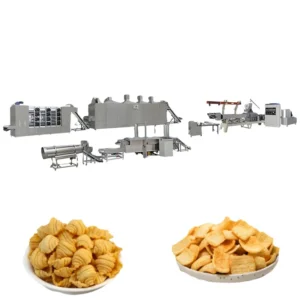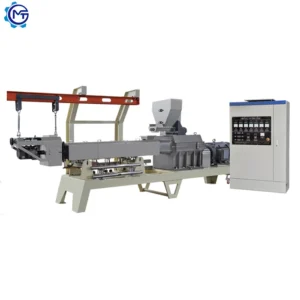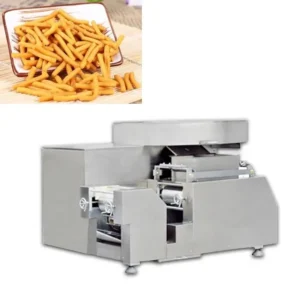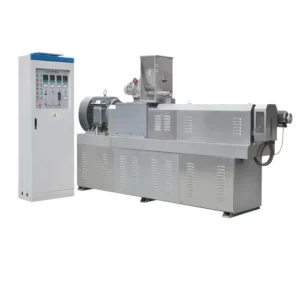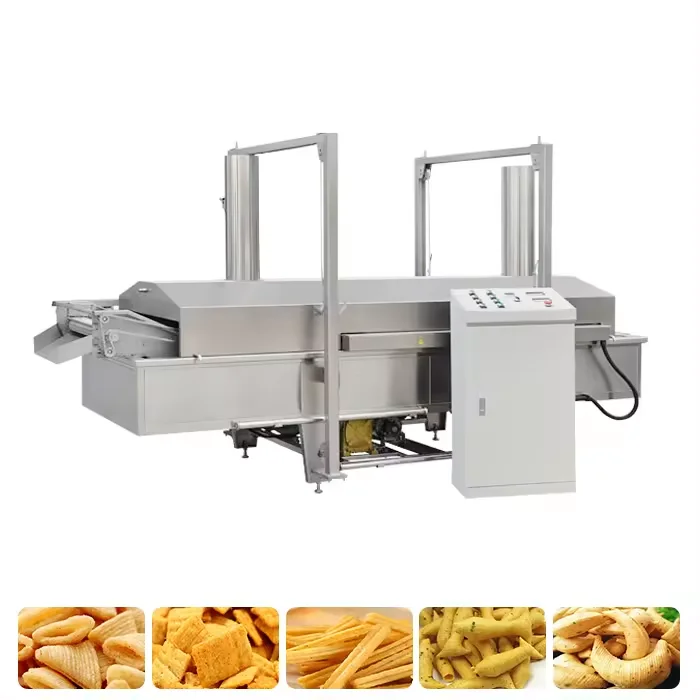
Full Equipment Range Coverage — from mixing and extrusion through frying, de-oiling, seasoning and packing, this continuous deep fryer is engineered to sit exactly where throughput balancing matters most in a complete snack line.
Technical Specifications
| Parameter | Value |
|---|---|
| Product Type | Continuous Deep Fryer for Extruded Snack Lines |
| Heating Method | Electric Heating / Gas Heating |
| Heating Tube Power | 60 kW (electric variant) |
| Oil Capacity | 320 L |
| Voltage & Frequency | 380V / 50Hz |
| Drive Power | 2.6 kW |
| Control System | PLC |
| Conveyor Type | Double-layer stainless steel mesh belt, frequency conversion stepless speed regulation |
| Oil Filtration | Continuous circulation filtration system |
| Slag Discharge | Bottom-mounted automatic system |
| Lifting System | Automatic lifting of upper hood and mesh belt |
| Construction Material | Food-grade 304 stainless steel |
| Overall Dimensions (L×W×H) | 6700 × 2200 × 1200 mm |
| Net Weight | 2000 kg |
| Output Capacity | 100–1000 kg/h (basis to be confirmed — depends on product type, moisture and pre-fry condition) |
| Assembly State | Fully assembled, skid-mounted |
| Certification | CE |
Application Suitability
| Application | Material or Output |
|---|---|
| Fried corn chip and tortilla chip lines | Corn masa, corn grits pellets, extruded corn dough |
| Salad bugle and snack pellet production | Extruded wheat, corn and potato starch pellets |
| Puffed and fried pellet snacks | 2D/3D extruded pellets, fried corn pellets |
| Breakfast and snack integration | Extruded cereal pieces requiring a fry step before coating or packing |
Why the Throughput Question Should Come Before the Quote
A Continuous Frying Machine for Snack Production Line must be sized against your extruder’s actual output on your specific recipe, not against a catalogue number.
I once watched a line stall because the fryer was quoted on a nominal capacity that assumed a lighter, drier pellet. The buyer’s recipe produced a denser extrudate that needed longer residence time in the oil, so belt speed had to drop and the fryer became the bottleneck for the entire shift. That kind of mismatch never shows up on a spec sheet — it only surfaces when the line is running. Buyers comparing quotes rarely ask how the fryer throughput was calculated against their upstream output [NEED_CITE: throughput matching between extrusion and frying stations].
Matching Oil Volume to Extruder Output
The 320 L oil capacity is one of the figures that determines whether the Continuous Frying Machine for Snack Production Line can sustain temperature stability at higher belt speeds. When cold, moist product enters the oil at a high rate, oil temperature drops. A bath that is undersized for the incoming load cannot recover fast enough, and the result is uneven colour and a greasy surface finish. This is why the fryer is never selected in isolation — its oil volume and heating power must be calculated together with the extruder’s actual kg/h output on the buyer’s recipe.
Continuous Filtration and Oil Service Life
The circulation filtration system removes fine particulate and carbonised fragments that accumulate during a frying shift. Left in the oil, these particles accelerate the rise in acid value and shorten the interval between full oil changes. Continuous filtration keeps the oil cleaner across a longer run, which matters when a snack line is producing the same SKU for an entire shift and colour consistency from the first hour to the last must be maintained [NEED_CITE: edible oil acid value degradation in continuous frying operations].
Spec Sheet Parameters That Shape Line Performance
The 60 kW heating element rating on the electric variant determines how quickly the oil recovers after a product load enters. For buyers in regions where industrial gas is cheaper or more reliable than electricity, the gas heating variant addresses a real utility constraint rather than a marketing preference. The frequency-controlled stepless belt speed lets operators adjust frying time in real time — critical when a recipe change alters the moisture content of the extrudate and the ideal residence time shifts. The 6700 mm overall length dictates the floor space between the extruder discharge and the de-oiling station downstream, which affects how the entire line layout is drawn. Food-grade 304 stainless steel construction throughout the contact zones meets the hygiene expectations of snack food buyers in regulated markets.
What Happens When Fryer Capacity Is Undersized
When the fryer is the smallest station on the line, every upstream gain is lost. The extruder may be capable of running faster, but pushing more product into an undersized oil bath drops the temperature below the threshold where proper dehydration and crust formation occur. The output looks pale, feels soft, and absorbs more oil than the product specification allows. Buyers then face the choice of running the extruder below its capability or accepting a product that fails quality checks — neither of which was priced into the project [NEED_CITE: consequences of undersized frying stations in extruded snack lines].
Why the Full Equipment Range Matters Here
The fryer does not operate alone. It sits between the extruder and the de-oiling drum, and its throughput must be balanced with both. As a supplier of complete snack lines, the equipment range covers every station from mixing and batching through extrusion, frying, de-oiling, seasoning and packing. The double-layer mesh belt prevents product from floating, which is a common problem with low-density extruded pellets. The automatic lifting system for the upper hood and mesh belt reduces the time between product changeovers, supporting lines that run multiple SKUs in a single week. Electrical schematics are confirmed with voltage and frequency for the destination country before production starts, avoiding the delays that happen when a 50 Hz machine arrives at a 60 Hz site. An in-house testing workshop allows trial runs on the buyer’s raw material before shipment, so the fryer settings are known before the line is installed.
Documentation & Verification
- Line layout drawing showing fryer position and throughput match to upstream extruder
- Electrical schematic with voltage, frequency and PLC language confirmed for destination country
- Factory test record on buyer’s extruded snack product or close equivalent before dispatch
- Machinery test report and outgoing video inspection for each unit
- Wear parts list covering mesh belt sections, heating elements and filtration consumables
- CE declaration of conformity with supporting technical file
Installation, Commissioning & Support
- Skid-mounted 2000 kg unit requires level concrete floor with drainage provision beneath the 6700 mm footprint
- 60 kW electric variant needs a dedicated circuit; gas variant requires confirmed burner pressure and supply line sizing
- Fully assembled delivery — no field welding required, only utility connections and belt tensioning
- First-run commissioning includes oil temperature profiling and belt speed calibration on buyer’s actual product
- Operator training covers PLC navigation, filtration cycle timing and automatic lifting system operation
- Spare wear parts shipment with initial order: mesh belt sections and heating elements included
What We Need to Configure Your Line
To match this fryer correctly, share the extruder model and its confirmed output on your recipe, the product format and target moisture after frying, your local voltage and frequency, and whether electric or gas heating fits your utility cost structure. If you are integrating into an existing line, tell us what stations sit upstream and downstream so we can confirm throughput balance across the full sequence.
Frequently Asked Questions
Q: How is fryer throughput matched to extruder output so the line holds its rated capacity?
A: The fryer is sized by calculating the oil volume, heating power and belt speed needed to handle the extruder’s confirmed kg/h on the buyer’s specific product and moisture level. A Continuous Frying Machine for Snack Production Line selected this way prevents the fryer from becoming the bottleneck that throttles the entire line back.
Q: Electric heating versus gas heating — which suits my utility cost and local supply?
A: The 60 kW electric variant suits sites with stable industrial power and where electricity cost per kW is competitive. Gas heating is specified where industrial gas supply is more reliable or cheaper. The choice is confirmed during the line configuration stage based on the buyer’s utility profile and local energy pricing.
Q: What voltage, frequency and PLC language options are confirmed before shipment?
A: The electrical schematic is reviewed with the buyer before production begins. Voltage, frequency and PLC interface language are locked in to match the destination country’s standards. This confirmation step prevents the delays that occur when equipment arrives on site and cannot be commissioned against local power supply.
Q: How does the continuous oil filtration system affect oil change intervals and product colour?
A: Continuous circulation filtration removes particulate and carbonised fragments that would otherwise raise the oil acid value. Cleaner oil maintains consistent colour across a full shift and extends the interval between complete oil changes, reducing per-unit frying cost on high-volume snack production runs.
Q: What spare parts are included at shipment, and what is the lead time on belt sections and heating elements?
A: The initial shipment includes a wear parts list covering mesh belt sections, heating elements and filtration consumables. Specific quantities and lead times for repeat orders are documented before dispatch so buyers can plan maintenance intervals without unplanned line stoppages.