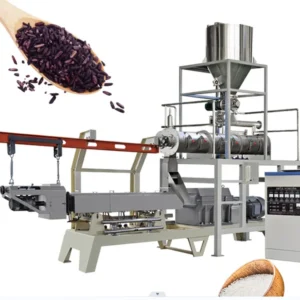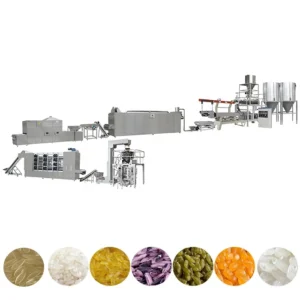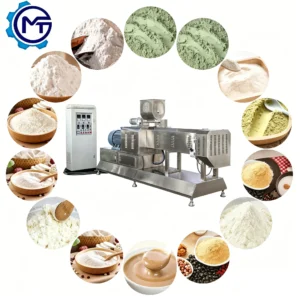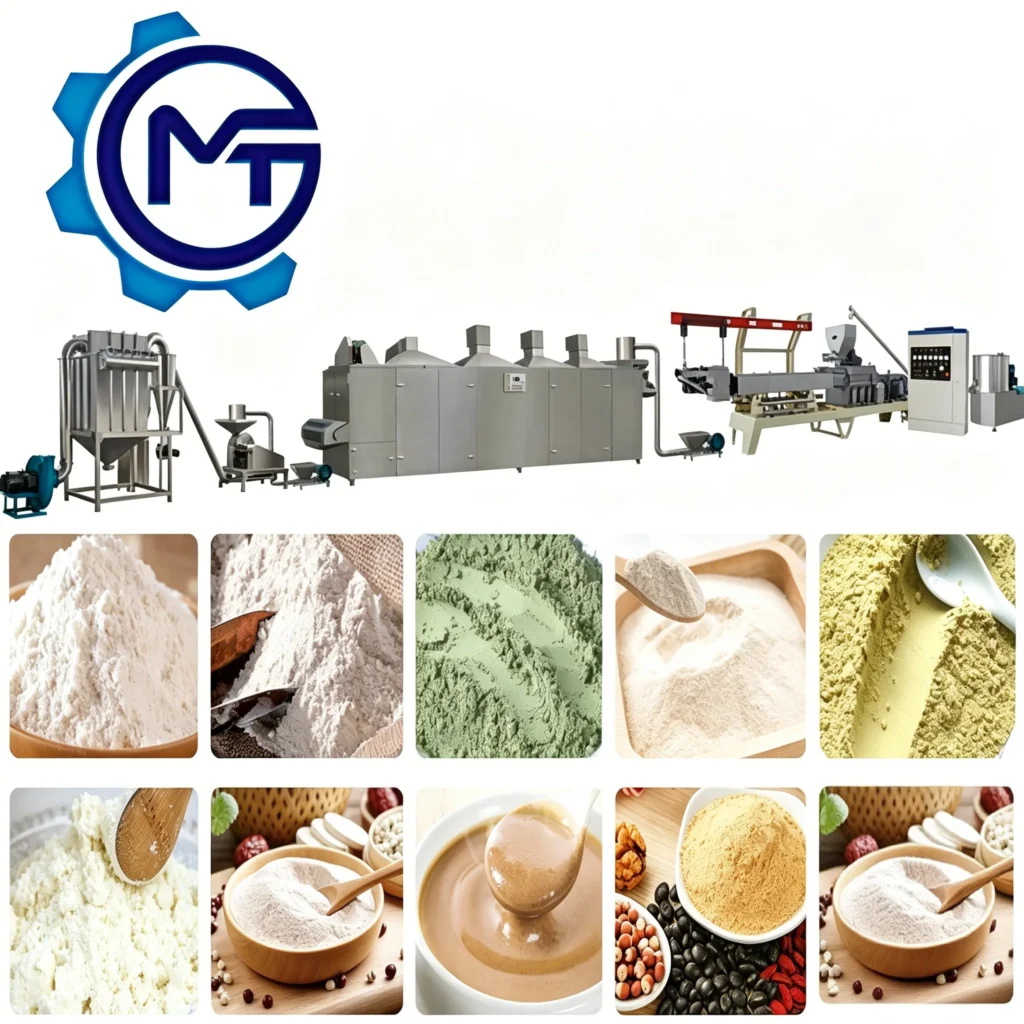
Complete Line Matching — Every station from batching to packing is specified to prevent throughput mismatches across the nutrition powder processing line, based on verified raw material behavior rather than nominal catalog ratings.
Technical Specifications
| Parameter | Value |
|---|---|
| Product Type | Nutrition Powder Processing Line |
| Output Capacity | 200-500 kg/h (basis not stated in source — confirm raw material type, moisture content and formulation) |
| Construction Material | Food-grade 304 stainless steel |
| Control System | Touch control panel with digital system |
| Heat Source Options | Electric / Gas / Steam |
| Automation Level | Fully automatic |
| Assembly State | Complete production line |
| Warranty | 1 year |
| After-Sales Service | Overseas engineer service available |
| Certification | CE |
Application Suitability
| Application | Material or Output |
|---|---|
| Baby food and infant nutrition powder | Rice, corn, beans, blended grains |
| Nutritional porridge manufacturing | Fortified grain-based powder blends |
| Fortified food programmes | Cereal and legume powder formulations |
Why "Standard Recipe" Trial Runs Miss the Real Picture
A nutrition powder processing line equipment manufacturer must test on the buyer’s actual formulation before any machine leaves the factory.
When I first helped set up a nutrition powder line in South Asia, the trial at our workshop ran perfectly on standard rice flour — smooth gelatinisation, even expansion, clean powder output. Then the customer’s real recipe arrived on site: heavy on lentils, loaded with micronutrients, and higher in fat than anything we had bench-tested. The extruder torque alarm tripped within minutes, the output turned gummy, and the line sat idle for four days while we reconfigured the screw profile and rebuilt the barrel temperature curve [NEED_CITE: impact of legume-based formulations on extrusion torque and gelatinisation]. That shutdown could have been avoided entirely if the factory test had used the customer’s own blend. A nutrition powder processing line equipment manufacturer that skips real-formulation trials is handing you a problem to solve on your own time and floor space.
How Each Station Connects Across the Line
This nutrition powder processing line covers every stage from raw material intake through final packing, so buyers can audit the full equipment catalogue before committing to a layout. The mixing station sets batch uniformity, the extrusion unit handles gelatinisation and cooking, the drying section removes residual moisture, and the packing end seals product for shelf life. Each station is listed with its throughput rating so that no single segment constrains the rest.
Balancing Throughput When Formulations Change
Grain-based nutritional powders shift in density, moisture absorption, and viscosity depending on the ratio of rice, corn, and legumes in the blend. A dryer sized for a light rice-dominant formula may fall behind when the recipe switches to heavier bean content with slower moisture release. MT Food Machinery specifies dryer capacity, conveyor speed, and cooling length against the buyer’s declared formulation range rather than a single reference recipe [NEED_CITE: dryer sizing methodology for variable grain formulations]. This approach keeps the nutrition powder processing line equipment manufacturer accountable for end-to-end balance, not just extruder output.
Reading the Specs That Actually Matter
The food-grade 304 stainless steel contact surfaces resist corrosion from acidic vitamin premixes and high-moisture grain slurries that accelerate wear on lower-grade alloys. Heat source compatibility across electric, gas, and steam means the line can adapt to whatever utility infrastructure the buyer’s facility supports — a practical concern when steam boilers are unavailable or electricity costs vary by region. The touch control panel with digital system gives operators direct access to barrel zone temperatures, screw speed, and feed rate without needing a separate PLC programming terminal. For nutrition powder lines, consistent barrel temperature control is what separates uniform gelatinisation from batch-to-batch variation in powder solubility and mouthfeel. Output capacity is listed at 200-500 kg/h, though the actual sustainable rate depends on the specific grain blend, target moisture, and particle size the buyer requires — always confirm these before treating the catalog figure as a production commitment.
The Hidden Cost of Unmatched Supporting Equipment
An extruder running at full capacity means nothing if the downstream dryer cannot keep up, forcing operators to throttle the entire line back to the slowest station. I have seen buyers pay for high-output extruders only to discover the flavouring drum or cooling conveyor was sized for a different throughput class, creating a permanent bottleneck [NEED_CITE: consequences of mismatched line station capacities in food extrusion]. On a nutrition powder line, that mismatch also risks inconsistent moisture content in the final powder, which shortens shelf life and triggers quality rejections from institutional buyers.
Why Buyers Specify Lines Through MT Food Machinery
Every supporting station — mixer, extruder, dryer, cooler, packing — is catalogued in one equipment range so buyers see the complete picture before ordering. Screw configuration and die design are matched to the buyer’s raw material and target powder density rather than copied from a generic template. The in-house testing workshop runs trial production on the customer’s actual formulation before shipment, catching torque, moisture, and texture issues early. Twin-screw expertise covers the full range from infant rice cereal to legume-heavy fortified blends. Pre-sales engineering extends through layout design, installation supervision, commissioning, and operator training on site.
Documentation & Verification
- Line layout drawing showing station footprint, utility connections, and material flow for the nutrition powder line
- Machine specification sheet listing every station with individual capacity ratings
- Screw and die configuration record matched to buyer’s grain formulation
- Electrical schematic confirming voltage, frequency, and control language for target market
- Trial run report documenting results on buyer’s actual raw material before dispatch
- CE declaration of conformity and ISO certificate for customs clearance
Installation, Commissioning & Support
- Floor plan review to confirm foundation load and utility routing for the full line footprint
- Electrical cabinet inspection to verify voltage and frequency match local grid before first power-on
- Station-by-station commissioning sequence from mixer through packing with parameter logging
- Operator training on the touch control panel covering recipe storage, alarm response, and daily cleaning
- Wear parts list covering screws, dies, and dryer belts with recommended replacement intervals
- Scheduled maintenance calendar aligned to production hours for each line station
What to Include With Your Inquiry
To configure the right nutrition powder processing line equipment manufacturer proposal, share your target formulation with raw material ratios and moisture content, required daily output in kilograms, available heat source and local voltage specification, and any particle size or solubility standard the finished powder must meet. If you have existing upstream or downstream equipment that the new line must integrate with, include those specifications as well.
Frequently Asked Questions
Q: Which supporting stations are included in the nutrition powder processing line?
A: The line covers mixing and batching, extrusion, drying, cooling, and packing stations. Each station is listed in the equipment catalogue with its individual throughput rating so buyers can verify the complete configuration before ordering and confirm that no segment is undersized relative to the extruder output.
Q: How is throughput balanced between stations to avoid bottlenecks?
A: Every station is sized against the buyer’s declared formulation and target output rather than a generic reference recipe. Dryer length, conveyor speed, and cooling capacity are calculated so that no single segment limits the rest of the line when running the buyer’s actual grain blend.
Q: What heat source options are available for the drying and extrusion sections?
A: The line supports electric, gas, and steam heat sources. The choice depends on the buyer’s facility utilities and local energy cost structure. Confirming the heat source early ensures the correct burner or heater specification is built into the dryer and barrel heating zones.
Q: Can the line handle different grain formulations without reconfiguration?
A: The screw profile, die design, and barrel temperature zones are specified to accommodate the buyer’s declared formulation range. Switching between recipes within that range is managed through the touch control panel. Formulations outside the original range may require screw element changes.
Q: What documentation is provided for customs clearance and on-site commissioning?
A: Buyers receive a CE declaration of conformity, ISO certificate, electrical schematic with voltage confirmation, trial run report on their raw material, operation and maintenance manual, and packing photographs. These documents support import clearance and guide the commissioning engineer during on-site startup.