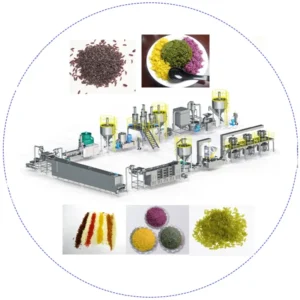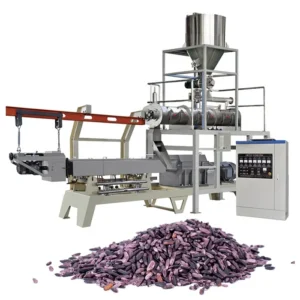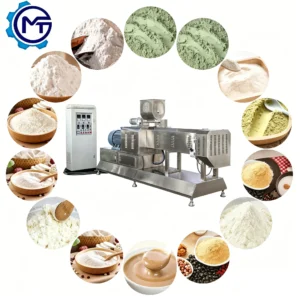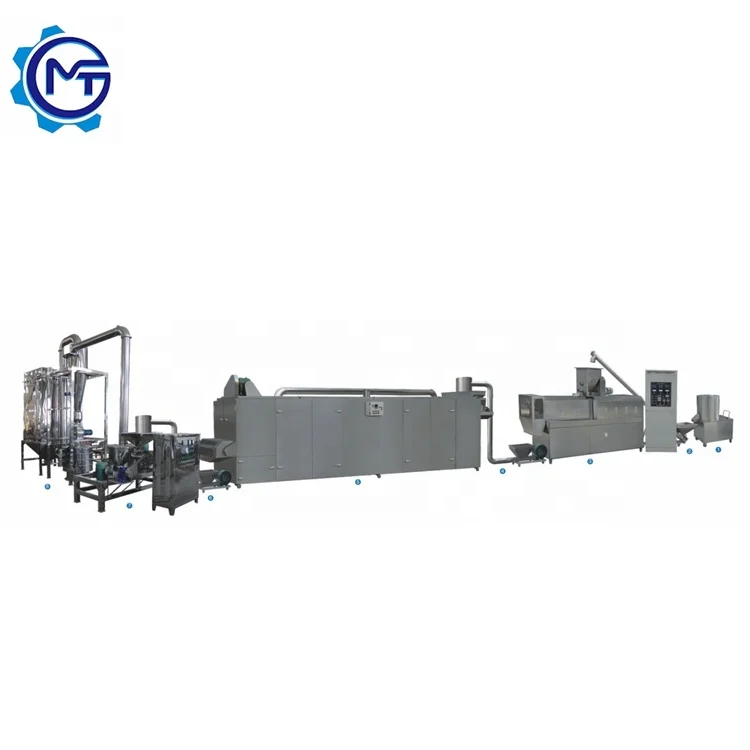
Matched Throughput — every station from batching to packing is sized against the same raw material profile, preventing the dryer or mill from choking the extruder output on your specific formulation.
Technical Specifications
| Parameter | Value |
|---|---|
| Model | MT65 / MT70 / MT85 |
| Product Type | Nutritional Powder Extrusion Production Line |
| Screw Type | Twin-screw |
| Installed Power | 66 kW (MT65) / 100 kW (MT70) / 130 kW (MT85) |
| Real Power Consumption | 50 kW (MT65) / 67 kW (MT70) / 80 kW (MT85) |
| Output Capacity | 100–150 kg/h (MT65) / 200–240 kg/h (MT70) / 400–500 kg/h (MT85) (basis not stated in source) |
| Voltage & Frequency | 380 V / 50 Hz three-phase, 220 V / 50 Hz single-phase (customizable to local voltage) |
| Machine Material | Stainless steel (all contact and frame surfaces) |
| Overall Dimensions (L×W×H) | 19,000 × 1,200 × 2,200 mm (MT65) / 21,000 × 1,500 × 2,200 mm (MT70) / 30,000 × 3,500 × 4,300 mm (MT85) |
| Control System | PLC and MCC (specification to be confirmed per line) |
| Line Stations | Mixing system → Extrusion system → Drying system → Milling system → Packing system |
| Raw Materials | Cereal flours (corn, wheat, rice, oat, soy, etc.) |
| Final Product | Instant nutritional powder |
| Standards | CE, ISO |
Application Suitability
| Application | Material or Output |
|---|---|
| Infant baby food production | Rice flour, oat flour, and milk powder blends for instant reconstitution |
| Fortified Blended Food (FBF) programmes | Corn-soya blends (CSB), wheat-soya blends for humanitarian nutrition supply |
| Samaposha and regional nutritional supplements | Multi-grain flour mixes with added vitamins and mineral premixes |
| Instant breakfast cereal powders | Corn, wheat, and oat-based flours with natural fruit or vanilla flavoring |
| Value-added grain processing | Cereal flours transformed into shelf-stable, easily digestible nutritional powders |
Why the Capacity Figure on a Nutritional Powder Processing Line Full Equipment Range Means Nothing Without Your Recipe
The rated output only holds when the raw material formulation, moisture content, and starch-to-protein ratio match the test conditions behind the number.
I have watched lines sit half-idle for weeks because the supplier quoted a capacity based on pure corn starch, and the buyer ran a high-protein, low-starch blend that simply would not gelatinise or expand at the same rate. The extruder barrel filled, the torque climbed, but the throughput dropped to a fraction of what the brochure promised. The dryer then ran with half-empty trays, and the mill cycled on and off, wasting energy on an imbalanced line [NEED_CITE: formulation impact on twin-screw extrusion throughput]. When evaluating any nutritional powder processing line full equipment range, the first question should never be "what is the max output" but rather "what is the output on my exact recipe at my target moisture level." Without that answer anchored to a trial run, every downstream station is a guess.
Station Matching Across the Nutritional Powder Processing Line Full Equipment Range
A nutritional powder processing line full equipment range is only as reliable as its weakest link between stations. If the extruder pushes material faster than the dryer can remove moisture, product backs up and degrades in the conveyor. If the milling station cannot grind the dried extrudate to the target particle size at the same rate, the packing station starves. Each model in the MT65, MT70, and MT85 range requires a dryer, mill, and packer sized to the same throughput ceiling — and that ceiling shifts depending on whether you are running a light rice-based formula or a dense soy-heavy blend.
Formulation Behaviour and Barrel Configuration
The twin-screw design allows operators to adjust screw element sequencing — mixing elements, kneading blocks, and reverse-flight sections — to control shear and residence time inside the barrel. High-protein formulations demand longer residence and more shear to achieve adequate gelatinisation, while starch-dominant blends require gentler handling to avoid over-expansion and product collapse after the die [NEED_CITE: screw configuration for varying starch-protein ratios]. The barrel temperature profile, divided into multiple independently controlled zones, must be set in coordination with the screw configuration. A mismatch between the two produces inconsistent powder density, which then shows up as variation in reconstitution behaviour — the exact complaint that triggers buyer rejections in institutional nutrition programmes.
Reading the Specifications Beyond the Nameplate
The installed power figures (66 kW for MT65, 100 kW for MT70, 130 kW for MT85) represent motor nameplate capacity, but the real power consumption numbers (50 kW, 67 kW, 80 kW respectively) reflect typical running load on standard cereal formulations. The gap between the two matters for electrical infrastructure planning — transformers, cable sizing, and breaker ratings must account for startup surge and peak torque events when viscous, high-protein dough moves through the barrel. The overall line footprint stretches from 19 meters for the MT65 configuration up to 30 meters for the MT85, which dictates workshop bay length, ceiling clearance for the dryer exhaust, and the routing of utility connections. Stainless steel contact surfaces across all stations meet food-grade hygiene expectations for infant and institutional food production, where audit requirements around material traceability are strict.
The Cost of an Undersized Dryer or Mill
When a buyer sources the extruder from one vendor and the dryer or mill from another, throughput alignment becomes the buyer’s problem. An undersized dryer leaves residual moisture in the extrudate, which then overloads the mill and produces powder above the target particle size. That powder fails reconstitution tests and gets rejected at the packing stage, forcing a full batch rework [NEED_CITE: moisture content and milling efficiency in extruded cereal processing]. The financial exposure is not just the wasted raw material — it is the delayed shipment, the penalty clauses in institutional supply contracts, and the reputational hit with procurement agencies that manage multi-year framework agreements.
Why Source the Full Range from One Manufacturer
Every station on this nutritional powder processing line full equipment range is configured by the same engineering team, so throughput calculations across mixing, extrusion, drying, milling, and packing reference a single material profile rather than separate vendor assumptions. Screw configuration and die selection are specified against the buyer’s actual formulation, not copied from a generic template. An in-house testing workshop allows trial runs on customer-supplied raw material before the line ships, catching formulation mismatches at the factory rather than during commissioning on the buyer’s floor. Pre-sales consultation covers line layout and utility planning, and the engagement continues through on-site installation, operator training, and wear parts support. Documentation is consolidated — one supplier, one set of drawings, one point of accountability for throughput disputes.
Documentation & Verification
- Line layout drawing with throughput calculation at each station matched to your formulation
- Screw and die configuration record specific to your raw material and target powder density
- Electrical schematic confirming voltage, frequency, and control panel language for your destination market
- Factory test record from trial run on your supplied raw material before shipment
- Wear parts list covering screws, dies, and milling media with reorder lead times
- CE declaration of conformity and ISO certificate for customs and regulatory clearance
Installation, Commissioning & Support
- Workshop bay length must accommodate line footprint up to 30,000 mm with clearance for dryer exhaust routing
- Dedicated three-phase circuit required at confirmed local voltage and frequency before extruder motor energization
- Line ships in modular sections for containerized transport, with assembly and alignment completed on-site
- First-run parameter setting covers barrel temperature zones, screw speed, and feed rate calibration to your recipe
- Operator training addresses screw element changes, die cleaning, and PLC interface navigation in your local language
- Wear parts stock includes replacement screw elements and die plates for the first maintenance cycle
Preparing Your Inquiry for a Nutritional Powder Processing Line Full Equipment Range
To receive a line configuration that holds up outside the brochure, share your complete raw material formulation including the starch-to-protein ratio, target moisture content at the extruder inlet, and desired powder particle size after milling. Specify your local voltage and frequency standard, the control panel language your operators need, and the workshop dimensions available for line installation. If you have an existing mixing or packing station you intend to integrate, provide its throughput rating so the new equipment can be matched to it rather than the other way around.
Frequently Asked Questions
Q: How is output capacity verified for my specific cereal formulation and moisture level?
A: Capacity is verified through a trial run in the in-house testing workshop using your supplied raw material at your target moisture content. The test records actual throughput, extrudate density, and powder particle size after milling. Results are documented in a factory test report shared before shipment, so the confirmed output reflects your recipe rather than a generic benchmark.
Q: What voltage and frequency options are available for my target market?
A: The standard configuration is 380 V / 50 Hz three-phase with 220 V / 50 Hz single-phase for auxiliary circuits. Both are customizable to match the destination country’s supply standard. The electrical schematic is confirmed during the specification stage to ensure transformers, breakers, and motor ratings align with local infrastructure before the line enters production.
Q: How do I confirm each station is sized to match the extruder throughput?
A: The line layout document includes a throughput calculation for every station — mixer batch cycle, extruder output, dryer residence time, mill capacity, and packing speed — all referenced against the same formulation and moisture profile. Buyers can review this document to verify that no station creates a bottleneck under their specific operating conditions.
Q: Can a trial run be done on my raw material before the line ships?
A: Yes, the in-house testing workshop conducts trial runs on customer-supplied raw material as a standard step before dispatch. The trial covers extrusion behavior, drying curve, and milling result. Any necessary screw configuration or die adjustments are made and documented during this phase, reducing the parameter-setting burden during on-site commissioning.
Q: What spare wear parts are included and how do I reorder them?
A: A wear parts list is provided with the line documentation, covering screw elements, die plates, and milling media. The initial set of replacements is typically shipped with the line. Reordering follows the same parts list with confirmed lead times, ensuring compatibility with your specific screw configuration and die design without sourcing from third-party suppliers.