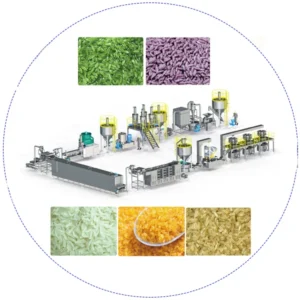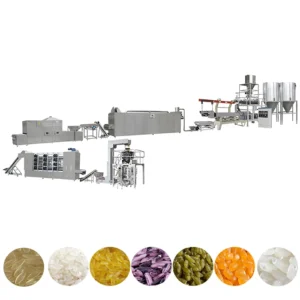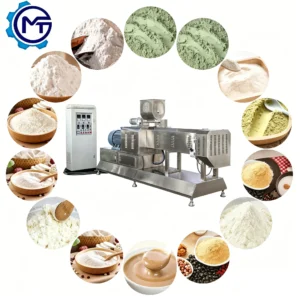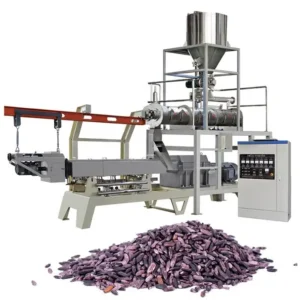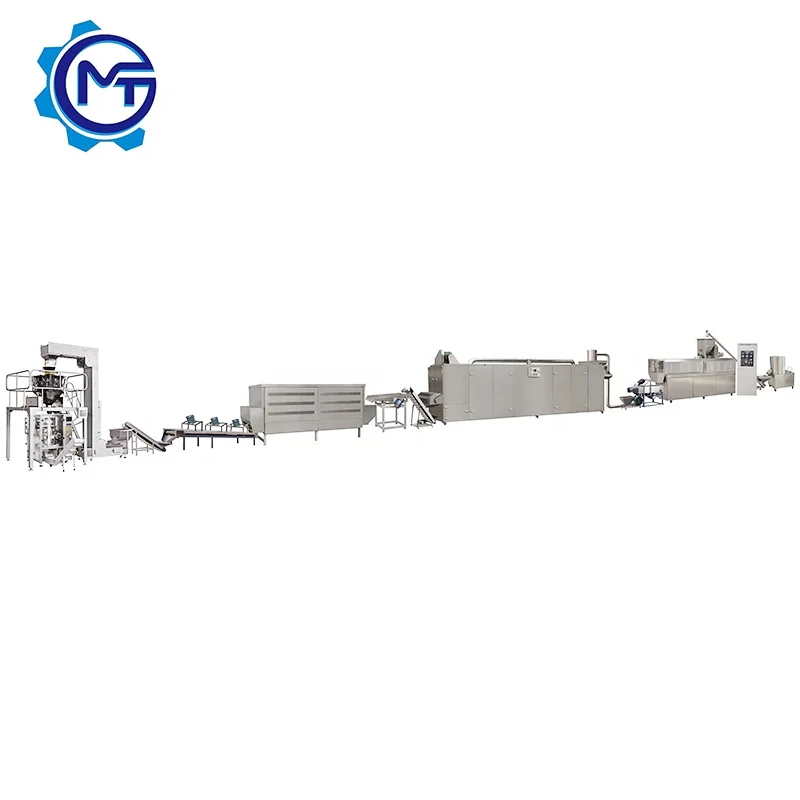
Throughput-Matched Stations — every mixer, extruder, dryer and packer on this line is sized to the same real output, calculated on your flour blend rather than a generic catalog figure.
Technical Specifications
| Parameter | Value |
|---|---|
| Product Type | Nutritional Powder Extrusion Production Line |
| Model Options | MT65 / MT70 / MT70C |
| Installed Power | 70 kW (MT65) / 90 kW (MT70) / 110 kW (MT70C) |
| Real Power Consumption | 40 kW (MT65) / 60 kW (MT70) / 90 kW (MT70C) |
| Output Capacity | 100–150 kg/h (MT65, basis to be confirmed) / 150–200 kg/h (MT70, basis to be confirmed) / 200–250 kg/h (MT70C, basis to be confirmed) |
| Overall Dimensions (L×W×H) | 22,000 × 1,200 × 2,200 mm (MT65) / 25,000 × 1,500 × 2,200 mm (MT70) / 30,000 × 3,500 × 4,300 mm (MT70C) |
| Screw Type | Twin-screw |
| Extrusion Method | High-temperature, high-pressure with instantaneous expansion |
| Line Stations | Mixing system → Twin-screw extruder → Dryer → Flavoring / Coating / Cooling / Packing |
| Control System | PLC and MCC control |
| Contact Materials | Food-grade |
| Self-cleaning Function | Yes |
| Assembly State | Complete production line |
| Standards | CE, ISO |
Application Suitability
| Application | Material or Output |
|---|---|
| Infant food and baby cereal powder | Rice flour, oat flour, multi-grain blends producing fine, instant-dispersing powder |
| Nutritional and fortified food powder | Wheat flour, corn flour, rice flour with added protein or micronutrients for retail or programme supply |
| Instant breakfast cereal powder | Raw grains converted into pre-gelatinized, shelf-stable powder requiring only hot water reconstitution |
What "150 kg/h" Really Means When Your Blend Has Oat and Whey Protein
A capacity number without a formulation attached is a guess, not a guarantee.
I spent three days in a Guangdong plant last year on a nutritional powder processing line that had tested perfectly at the factory on standard rice flour. The buyer’s actual recipe — oat flour mixed with whey protein — gelatinized at a completely different temperature window, and the first batches came out lumpy and undissolved. The extruder barrel zones and screw configuration had to be rebuilt on-site before the line could hold any meaningful output. When you review a proposal, the capacity figure should state which raw material, moisture percentage, and particle size it was measured on; otherwise it is just a catalog number waiting to disappoint you at commissioning [NEED_CITE: gelatinization temperature variance across grain and protein blends].
How the Extruder Reshapes Raw Grain Starch
The twin-screw extruder at the heart of this nutritional powder processing line equipment subjects raw grain flour to high temperature and high pressure within the barrel, then releases it through a die where instantaneous expansion occurs in under five seconds. This rapid pressure drop denatures the starch structure, converting it into a form that dissolves readily in warm water — the characteristic buyers in the infant cereal market expect. The screw configuration and barrel temperature profile are set to match the specific flour blend you intend to run, because oat starch and rice starch respond to shear and heat very differently.
Matching Dryer Capacity to Extruder Output
A common mistake on nutritional powder lines is specifying the extruder for a target throughput while the dryer runs on a fixed belt speed and heat input that cannot remove moisture fast enough. Wet, under-dried powder will clump in the packing hopper and shorten shelf life. On this line, the dryer is sized to handle the full moisture load exiting the die, and the PLC control ties dryer belt speed and zone temperatures to extruder feed rate so the two stations track together during ramp-up and shutdown [NEED_CITE: moisture content targets for shelf-stable nutritional powders].
Reading the Power and Footprint Numbers
Installed power across the three models — 70 kW, 90 kW, and 110 kW — covers the main drive motors, barrel heaters, and dryer heating elements. Real consumption is typically lower, ranging from 40 kW to 90 kW, because heaters cycle and the extruder motor rarely runs at full load once the barrel reaches steady-state temperature. The MT65 footprint at roughly 22 meters in length suits a workshop with limited bay depth, while the MT70C at 30 meters with a 3.5-meter width requires a dedicated production zone with overhead clearance to 4.3 meters for the dryer exhaust ducting. Choosing between models depends less on peak capacity and more on whether your daily volume justifies the larger footprint and higher utility draw.
The Cost of Running the Wrong Screw Combination
I have seen operators spend weeks adjusting feed rate and barrel temperatures trying to compensate for a screw configuration that was copied from a generic build. The powder density stays outside specification, the dryer cannot keep up, and the packing station receives product that does not meet the buyer’s dispersibility test. Reconfiguring the screw elements after installation means unplanned downtime and wasted raw material — costs that never appear on the original quotation but show up in the first quarter’s production report [NEED_CITE: twin-screw element configuration impact on extrudate density].
Why Procurement Here Closes the Gaps
Every station on this nutritional powder processing line equipment comes from one supplier, which means the mixer batch size, extruder throughput, dryer belt width, and packing speed are calculated as a single system rather than assembled from independent vendors who each optimize for their own machine. Screw and die configurations are specified against your actual raw material formulation, not a standard template. Before shipment, the in-house testing workshop runs your flour blend through the extruder to confirm expansion, density, and dispersibility. Electrical schematics are drawn to your plant’s voltage and frequency, and control language is set before the panels are wired. Food-grade contact materials are used throughout every station that touches the product stream.
Documentation & Verification
- Line layout with capacity calculation based on your flour blend and target powder density
- Machine specification sheet covering every station from mixer to packer
- Screw and die configuration record matched to your raw material trial
- Trial run report conducted on your actual formulation before dispatch
- Electrical schematic with voltage and frequency confirmed to your facility
- Operation and maintenance manual with wear parts list
Installation, Commissioning & Support
- Foundation plan accounts for the MT70C’s 30-meter length and 4.3-meter dryer height
- Dedicated power circuit sized to the MT70’s 90 kW installed load with voltage confirmed pre-build
- Extruder arrives with barrel sections and screw shafts separated for workshop door clearance
- First-run commissioning includes barrel temperature profiling on your specific grain formulation
- Operator training covers PLC screen navigation, screw speed adjustment, and self-cleaning cycle initiation
- Wear parts list identifies screws, dies, and seals with reorder specifications included
What to Include in Your Inquiry
To configure the right nutritional powder processing line equipment for your facility, provide the raw material types and ratios you plan to run, the target daily output in kilograms, and the available workshop length and ceiling height. Confirm your local voltage and frequency, the preferred PLC interface language, and whether you need the line to integrate with existing upstream batching or downstream packing equipment. If your formulation includes non-standard ingredients like whey protein or fiber concentrates, request a trial run on your own material before shipment.
Frequently Asked Questions
Q: How is output capacity verified before the line ships?
A: Capacity is measured during a trial run using your actual raw material blend at your specified moisture content. The resulting throughput, powder density, and dispersibility are recorded in a test report. This means the number you receive reflects your recipe, not a generic rice flour benchmark that may not apply to your formulation.
Q: How are the extruder, dryer, and packing stations throughput-matched?
A: Each station is sized during the layout phase so that the extruder output, dryer moisture removal rate, and packing speed all align at the same target throughput. No single machine is specified larger or smaller than the rest, which prevents bottlenecks and product hold-ups between stages.
Q: What electrical and control details are confirmed before commissioning?
A: Your plant voltage, frequency, and phase are confirmed before the electrical panels are built, and the PLC interface language is set to match your operators. This avoids rewiring delays or control screen miscommunication during the first week of production on your floor.
Q: Can I run a trial on my own raw material before shipment?
A: Yes. The in-house testing workshop runs your specific flour blend through the extruder and dryer to verify expansion behavior, powder texture, and moisture content. You receive the trial run report and can adjust screw configuration or barrel settings before the line leaves the factory.
Q: What spare wear parts are included with the initial delivery?
A: The shipment includes a documented list of wear parts — typically spare screw elements, die plates, and barrel seals — matched to your configuration. Replacements are available as reorder items with the same specification records, so future orders stay consistent with the original build.