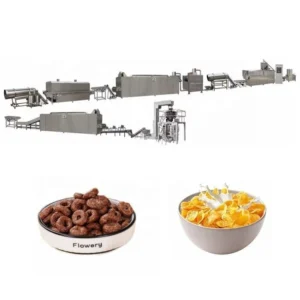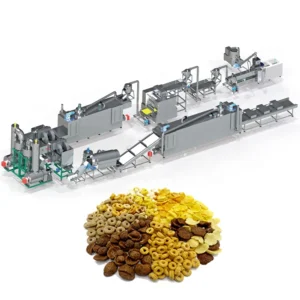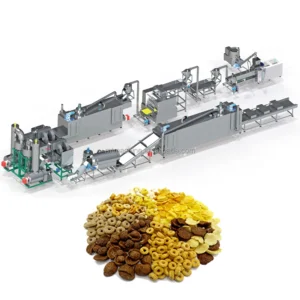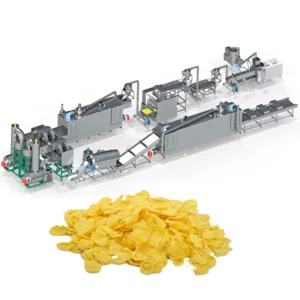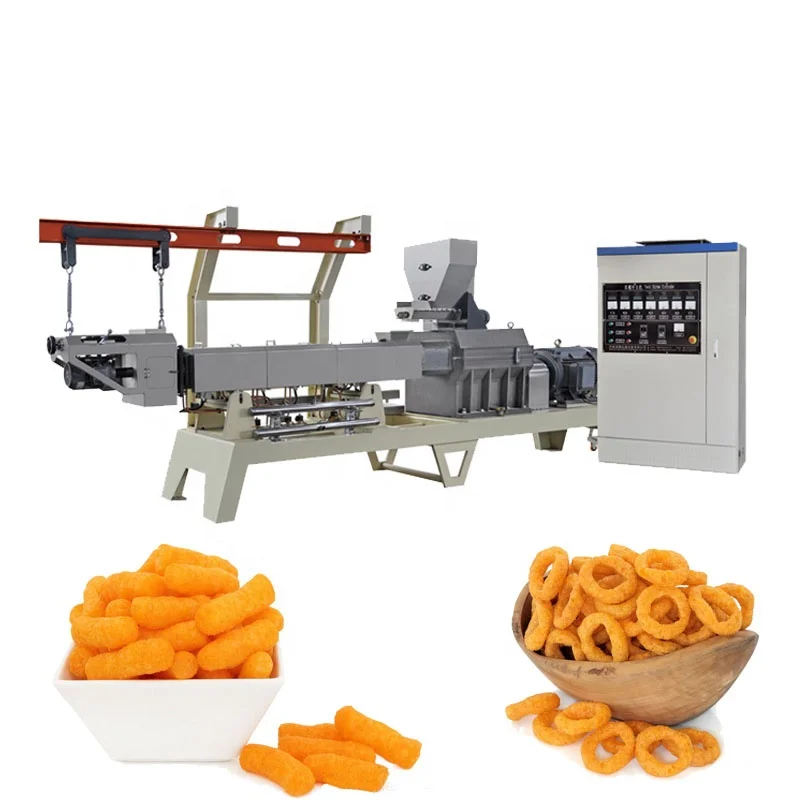
Twin-Screw Extrusion Expertise — screw configuration and die design specified to your raw material formula rather than copied from a generic breakfast cereal build, with every downstream station matched to the extruder’s actual throughput.
Technical Specifications
| Parameter | Value |
|---|---|
| Product Type | Twin Screw Corn Flakes Production Line |
| Model | MT70 / MT85 / MT75 |
| Screw Type | Twin-screw |
| Installed Power | MT70 — 160 kW; MT85 — 190 kW; MT75 — 210 kW |
| Power Consumption | MT70 — 120 kW; MT85 — 140 kW; MT75 — 150 kW |
| Output Capacity | MT70 — 150–200 kg/h (basis to be confirmed); MT85 — 300–400 kg/h (basis to be confirmed); MT75 — 300–500 kg/h (basis to be confirmed) |
| Overall Dimensions | MT70 — 41 × 1.5 × 2.2 m; MT85 — 43 × 1.5 × 3.2 m; MT75 — 45 × 1.5 × 3.5 m |
| Control System | PLC on flaking machine; MCC & PLC for complete line |
| Dryer Heating Source | Gas or Electric |
| Extruder Working Principle | Feeding, extruding, cutting, heating, gearing, controlling systems |
| Extruder Advantage | Automatic lubricating and cooling; wear-resistant screw fabrication |
| Flaking Machine | Hydraulic double-roller; dual independent motors; infrared-sensor temperature control |
| Hot Air Roasting Oven | Vibrating pan; conciliation burner; dual circulating fans; cyclone dust removal |
| Coating System | Double tumble sugar melter, elevator, coating drum, spraying nozzle |
| Basic Raw Materials | Corn, rice, wheat, oat, barley powder |
| Final Product Shapes | Natural and coated corn flakes; ball, tube, stick, ring, fruit loop, star, wheel, flower, heart |
| Line Stations (Natural) | Mixing → Extruding → Flaking → Drying → Hot Air Roasting → Cooling → Packing |
| Line Stations (Sugar Coated) | Mixing → Extruding → Flaking → Drying → Hot Air Roasting → Sugar Spraying → Sugar Coating → Drying → Cooling → Packing |
| Assembly State | Complete production line |
| Certification | CE; ISO |
Application Suitability
| Application | Material or Output |
|---|---|
| Natural corn flakes production | Corn powder with optional grain blending |
| Sugar-coated breakfast cereal | Corn, rice, or multi-grain base with sugar spray coating |
| Multi-grain flake variants | Wheat, oat, barley blended with corn or rice powder |
| Extruded cereal shapes | Ball, tube, ring, star, fruit loop via die changes |
What "Rated Output" Leaves Out on a Breakfast Cereal Production Line Equipment for Sale
A line is only as fast as its most undersized station.
I learned this the hard way early in my technical sales career. A buyer once ordered a breakfast cereal production line equipment for sale based on the extruder’s nameplate capacity, only to find the flaking station could not keep pace once real moisture levels hit the dough. Product piled up at the rollers, throughput dropped, and the plant manager called me past midnight asking why his brand-new line was already bottlenecked. The root cause was simple: each station had been quoted as an individual spec sheet rather than a matched system. [NEED_CITE: throughput matching across extrusion line stations] When the dryer, flaker, and roaster are not sized against the extruder’s actual output on your specific raw material, the numbers on paper mean very little on the factory floor.
How Station Sizing Works Across the Full Cereal Line
Every piece of breakfast cereal production line equipment for sale on this page is sized so that downstream stations absorb the extruder’s real output without queuing or starving. The twin-screw extruder pushes gelatinized dough to the flaking machine, where hydraulic double rollers with independent motors compress it to uniform thickness. The dryer and hot air roasting oven are selected with belt area and air volume matched to that flake throughput, preventing half-dried product from reaching the coating drum.
Why Raw Material Dictates Station Selection
Corn, rice, wheat, oat, and barley powders each behave differently inside the barrel — different gelatinization temperatures, different expansion ratios, different moisture release curves during drying. A breakfast cereal production line equipment for sale must account for these variables before the extruder is assembled. Screw pitch, barrel heating zones, and die geometry are specified to your formula, and the flaker roller gap is set to produce the target flake thickness from that specific dough. Skipping this step and running a generic screw configuration is one of the most common reasons new lines fail to reach nameplate output. [NEED_CITE: raw material variability in twin-screw extrusion processing]
Reading the Specs That Actually Matter
The installed power versus power consumption figures across MT70, MT85, and MT75 models reveal how much thermal and mechanical energy each extruder draws under normal running conditions. The gap between installed and consumed power indicates headroom for startup surge and heavier formulations. The overall dimensions tell you the floor space each configuration occupies — at lengths of 41 to 45 meters, the line requires careful layout planning against your building’s column spacing and utility drop points. The PLC and MCC control architecture ensures that the flaking machine’s hydraulic pressure and the roasting oven’s burner temperature communicate with the extruder’s feed rate, maintaining consistent output through automatic adjustment rather than manual intervention.
The Hidden Cost of Mismatched Supporting Equipment
An extruder running at full capacity into an undersized dryer creates wet, undercooked flakes that shatter in the roasting oven instead of crisping properly. A coating drum that cannot handle the upstream volume produces unevenly sugar-glazed product, leading to batch rejections and customer complaints. These problems do not show up during a short factory acceptance test — they surface weeks into production when the cumulative effect of small bottlenecks compounds. [NEED_CITE: bottleneck effects in continuous food processing lines] I have seen plants run an entire shift only to scrap a significant portion of output because the sugar coating system could not keep pace with a roaster that was itself oversized for the dryer feeding it.
Why Source the Complete Equipment Range from One Catalogue
Every station from the mixer to the packing head is documented in one specification set, so throughput calculations are based on real machine pairings rather than assumed compatibilities. The screw configuration and die design are specified against your raw material before production begins, not borrowed from a previous customer’s build. An in-house testing workshop allows trial runs on your actual corn or multi-grain powder before the line ships, catching expansion and flaking issues at the factory rather than in your plant. CE and ISO certification covers the integrated line, meaning electrical safety and food-contact compliance are verified across every station. Pre-sales consultation through on-site installation, commissioning, and operator training keeps the same technical team involved from first inquiry through steady-state production.
Documentation & Verification
- Line layout drawing matched to your factory footprint and extruder model
- Machine specification sheet for every station from mixer to packer
- Screw and die configuration record tied to your raw material formula
- Electrical schematic with voltage and frequency confirmation before production
- Trial run report on your actual corn or multi-grain powder
- Factory test record verifying throughput across the full line
Installation, Commissioning & Support
- Floor space planning for 41–45 meter line length with column clearance verification
- Dedicated power circuit sized to the MT75’s 210 kW installed power requirement
- MCC and PLC control commissioning with operator language confirmation
- Hydraulic flaker roller gap calibration against your target flake thickness
- Hot air roasting oven burner tuning with cyclone dust removal system check
- Wear parts list covering screws, dies, and flaker roller surfaces
Before You Request a Quote
To size the right extruder model and downstream stations for your breakfast cereal production line equipment for sale inquiry, I need your raw material formulation with moisture targets, your intended daily output, and your workshop dimensions including ceiling height. Let me know your local voltage and frequency standard and whether your operators require a specific control language. If you are adding sugar-coated SKUs, specify the coating percentage and whether you prefer gas or electric dryer heating.
Frequently Asked Questions
Q: How do I determine which extruder model pairs with the right dryer, flaker, and roaster?
A: Start with your target output and raw material formula. Each model — MT70, MT85, MT75 — has distinct power consumption and footprint requirements that dictate which downstream stations match. We calculate throughput per station based on your specific corn, rice, or multi-grain blend, then propose a matched configuration so no single machine restricts the others.
Q: Can I order individual stations or only the complete line?
A: Each station from the mixer through the packer is available individually, though throughput matching is most reliable when the full set is specified together. If you are expanding an existing line, provide the make and capacity of your current extruder so we can size a compatible flaker, roaster, or coating system.
Q: What voltage and frequency options are available for this equipment?
A: Voltage and frequency are confirmed against your local grid standard before production begins. The PLC and MCC control panels are configured for your site’s electrical specification, and control language is set to match your operators. This avoids commissioning delays caused by incompatible power supply or unreadable HMI screens.
Q: How does installed power differ from actual power consumption across models?
A: Installed power reflects the total motor and heating capacity available, while power consumption represents typical running draw. The MT75, for instance, has 210 kW installed but consumes around 150 kW during steady operation. This headroom accommodates startup surges and heavier formulations without tripping protective circuits.
Q: Which raw materials are confirmed compatible with this line?
A: Corn, rice, wheat, oat, and barley powders are all confirmed compatible. Each material has different gelatinization and expansion characteristics that affect screw configuration, die selection, and flaker settings. We run a trial on your actual raw material in the testing workshop before shipment to verify that the chosen configuration produces your target flake texture and density.