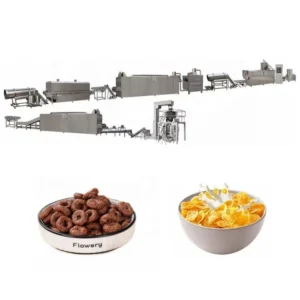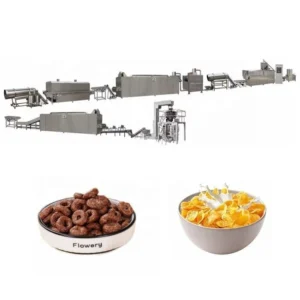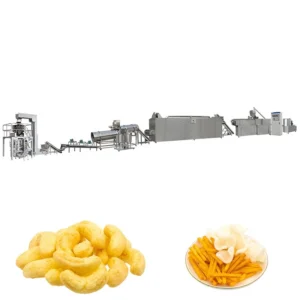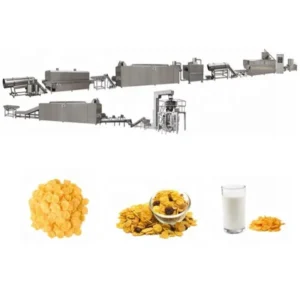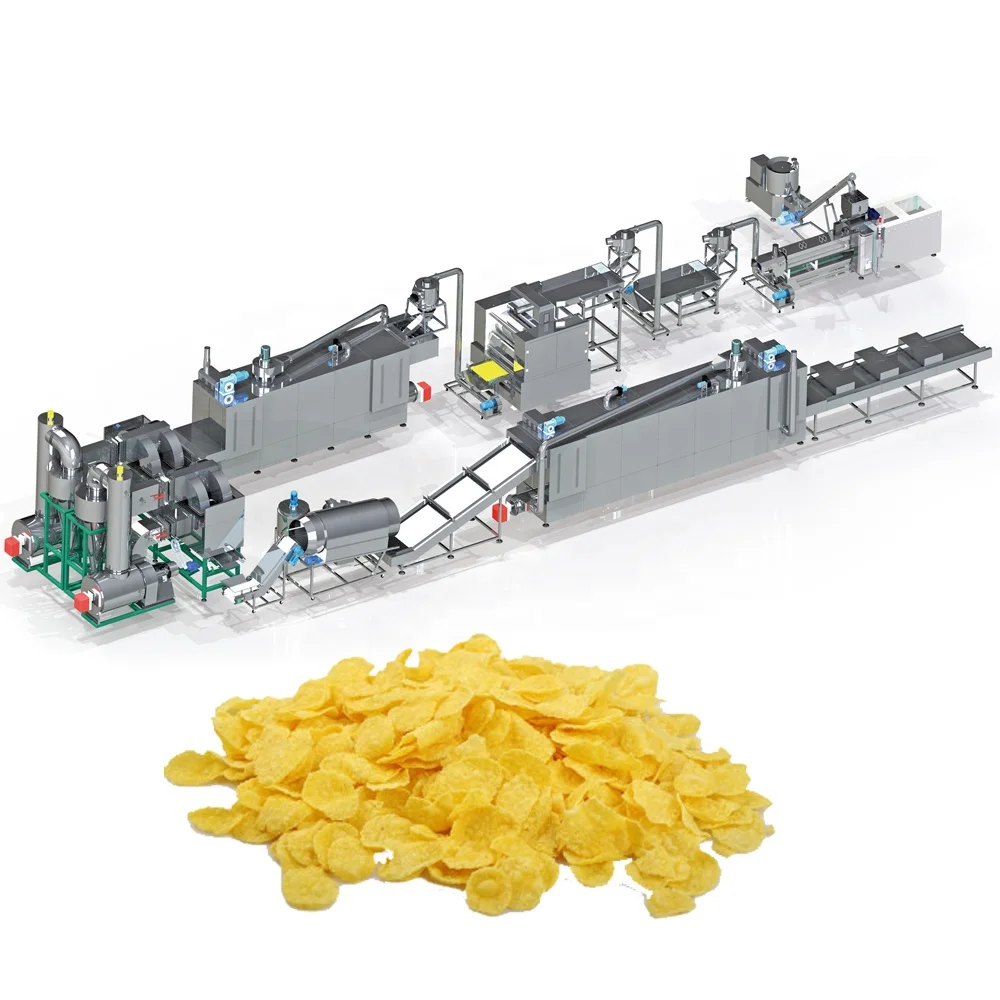
Screw and die configuration specified to buyer’s raw material — Every corn flakes production line is tested with the customer’s actual corn variety and moisture level in our in-house workshop before dispatch.
Technical Specifications
| Parameter | Value |
|---|---|
| Product Type | Corn Flakes Production Line |
| Output Capacity | Up to 750 kg/hr (basis not stated in source — confirm raw material type, moisture content, and flake thickness) |
| Production Scope | Natural corn flakes, sugar-coated flakes, various shaped breakfast cereals |
| Control System | Available with PLC or MCC control (to be confirmed based on automation requirements) |
| Motor | Robust industrial drive (rated power to be confirmed based on line configuration) |
| Layout Customization | Engineered drawings tailored to specific factory dimensions |
| Certification | CE |
Application Suitability
| Application | Material or Output |
|---|---|
| Natural corn flake production | De-germed corn grits, whole corn meal |
| Sugar-coated cereal manufacturing | Flaked corn with sugar or honey glazing |
| Fortified breakfast cereal lines | Corn blended with vitamin and mineral premix |
| Multi-shaped cereal formats | Corn dough extruded through interchangeable dies |
Why the Raw Material Question Must Come Before the Capacity Number
A capacity rating means nothing if the line was never tested on the corn you actually source locally.
Too many buyers receive a corn flakes production line equipment manufacturer quotation that quotes an impressive hourly output, only to discover during commissioning that the extruder cannot maintain that throughput on their specific corn variety. The grain moisture, starch content, and particle size distribution all alter the dough rheology inside the barrel. A line set up for standard yellow corn grits at 14% moisture will behave differently when fed with high-moisture local maize or a blend that includes rice or wheat fractions. I spent years on assembly floors before moving into technical support, and the failures I remember most vividly were not mechanical — they were process mismatches that only appeared when the buyer’s actual raw material hit the hopper. [NEED_CITE: starch gelatinisation behaviour across different maize varieties and moisture levels]
Barrel Temperature Zones and Starch Gelatinisation Control
The extrusion stage is where corn flakes either succeed or fail. The barrel must deliver a precise temperature profile so that the corn starch gelatinises fully without scorching or under-cooking. On a corn flakes production line equipment manufacturer build, multiple independently controlled heating zones along the barrel allow operators to adjust the profile when switching between raw material batches. If the gelatinisation window is missed, the flakes emerge either too dense to crisp properly or too fragile to survive coating and packing.
Die Geometry and Flake Thickness Consistency
The die at the extruder discharge determines the pellet shape and size before flaking. Round, square, or star-shaped dies produce different surface-to-volume ratios, which directly influence how the flake dries and toasts downstream. An undersized die opening generates excessive back-pressure and forces the motor to work harder, while an oversized opening yields thin pellets that shatter during the flaking roll stage. Matching the die to the target flake thickness and the buyer’s market expectation is part of the pre-sales engineering conversation, not an afterthought. [NEED_CITE: die land length influence on extrudate density in cereal processing]
Line Station Sizing and Throughput Matching
A corn flakes line is only as fast as its slowest station. The extruder may be capable of a stated output, but if the rotary dryer cannot remove enough moisture in the available residence time, or if the sugar-coating drum is undersized, the entire line bottlenecks. Every supporting station — mixer, flaking roll, dryer, cooler, coating drum, and packing conveyor — must be specified against the extruder’s verified throughput on the buyer’s specific recipe. When stations are sourced from separate vendors without a single engineering authority, gaps emerge that only surface during full-line commissioning.
The Cost of Skipping the Trial Run
Lines that ship without a factory trial run on the buyer’s actual corn arrive with unvalidated parameters. The operator then spends weeks on-site adjusting screw speed, barrel temperature, and moisture addition to find a workable window. During that period, raw material waste accumulates, energy consumption spikes, and the packing line sits idle waiting for product that meets specification. In some projects I supported in Southeast Asia, the commissioning delay extended into months because the raw material sourced locally differed significantly from the standard test medium used at the factory. [NEED_CITE: industrial commissioning delays caused by raw material variation]
Why Buyers Choose This Line Build
The complete corn flakes production line is supplied under one engineering authority, so throughput is matched across every station from batching to packing rather than assembled from separate vendors. Screw configuration and die design are specified to the buyer’s corn variety and target flake density before the machine enters production. An in-house testing workshop runs trial production on the customer’s actual raw material, generating a documented parameter set that ships with the machine. The twin-screw extrusion platform covers corn flakes alongside other cereal and snack formats, giving buyers a single supplier for future line expansion. Pre-sales consultation includes factory layout engineering, utility planning, and voltage confirmation for the destination market.
Documentation & Verification
- Line layout and capacity calculation with station-by-station throughput matching for corn flakes
- Screw and die configuration record specific to buyer’s corn variety and flake thickness
- Factory trial run report on customer-supplied raw material before dispatch
- Electrical schematic with voltage and frequency confirmed for destination market
- CE declaration of conformity covering the complete line assembly
Installation, Commissioning & Support
- Factory floor plan reviewed to confirm line footprint and utility drop points before shipment
- Power supply checked against the confirmed motor rating and control panel voltage
- Extruder barrel zones and flaking roll pressure calibrated on-site using buyer’s corn
- Operator training covers screw speed, moisture addition, and die changeover procedures
- Wear parts list identifies screws, dies, and flaking roll shells with replacement intervals
- Maintenance schedule covers bearing lubrication, belt tension, and dryer airflow checks
What We Need From You to Start Engineering
To configure the corn flakes production line to your facility, we need your target corn variety and its typical moisture range, the daily output you plan to run, and your available floor area with ceiling height clearance. Please also confirm the local voltage and frequency standard, the preferred control language on the HMI, and whether you want a factory trial run on your own raw material before the line ships.
Frequently Asked Questions
Q: How is the output capacity verified for this corn flakes line?
A: The capacity is validated during an in-house trial run using the buyer’s actual corn raw material. Output varies with corn moisture, starch content, and target flake thickness, so the rated figure on the quotation is always tied to the specific material and recipe tested. We provide a documented trial report showing the verified throughput before the line ships.
Q: What screw type is recommended for corn flake extrusion?
A: Corn flake extrusion typically uses a twin-screw configuration with a moderate L:D ratio to ensure thorough starch gelatinisation at controlled shear. The exact screw profile is selected based on the buyer’s corn variety and desired flake density, and the configuration is recorded in the documentation package that ships with the machine.
Q: How do you prevent bottlenecks between the extruder and downstream stations?
A: Every supporting station — dryer, cooler, coating drum, and packing conveyor — is sized against the extruder’s verified throughput on the buyer’s recipe. A single engineering authority matches capacity across the entire line, so no individual station limits overall output.
Q: Can the line layout be adapted to an existing factory building?
A: Yes. Engineered drawings are produced based on the buyer’s factory dimensions, ceiling height, and utility entry points before the quotation is finalised. The layout accounts for material flow, maintenance access, and operator walkways around each station.
Q: What spare wear parts are included with the first shipment?
A: The initial shipment includes a documented wear parts list covering items such as screw elements, die plates, and flaking roll shells. Replacement intervals are noted, and the same parts can be reordered directly from the manufacturer to ensure fit and material specification continuity.