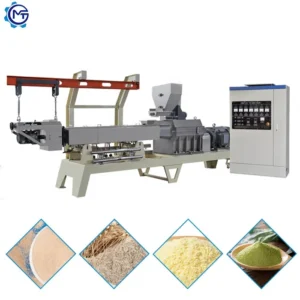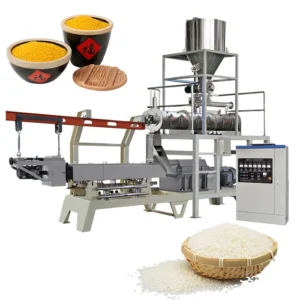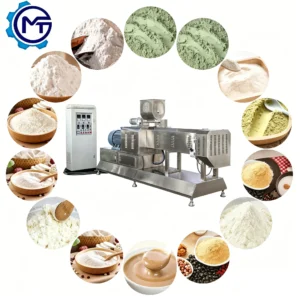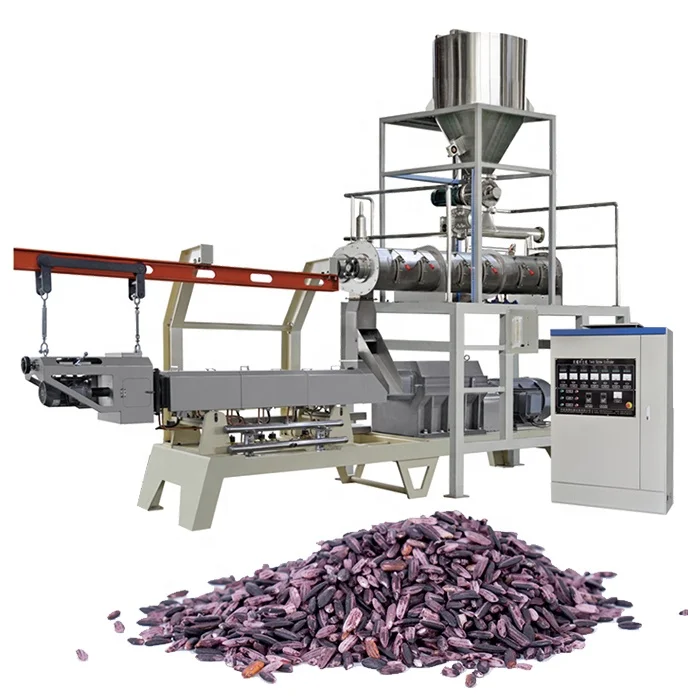
Throughput-Matched Line Integration — every station from batching to packing is balanced to your raw material, verified on our testing floor before dispatch.
Technical Specifications
| Parameter | Value |
|---|---|
| Model | MT65 |
| Product Type | Fortified Nutritional Rice Processing Line |
| Installed Power | 85 kW |
| Power Consumption | 60 kW |
| Capacity | 80-100 kg/hr (basis to be confirmed — depends on raw material and moisture content) |
| Overall Dimensions | 28 x 1.2 x 2.2 m |
| Screw Type | Twin Screw |
| Extruder Control | Frequency speed controlling, automatic lubricating and cooling |
| Drying Oven Heat Source | Electric or gas |
| Basic Materials | Broken rice, corn, millet, wheat, oats, buckwheat, bean, starch, vitamin, mineral |
| Production Procedure | Mixing, Extruding, Vibrating, Low Temperature Drying, Cooling, High Temperature Roasting, Cooling, Packing |
| Final Products | Artificial rice, fortified rice kernels |
| Assembly State | Complete line |
| Standards | CE, ISO |
Application Suitability
| Application | Material or Output |
|---|---|
| Nutrition programme supply | Fortified rice kernels blended with vitamin and mineral premix |
| Broken rice valorisation | Reconstituted artificial rice from milled broken rice and starch |
| Multigrain kernel production | Extruded kernels from corn, millet, oats and buckwheat blends |
| Infant and weaning food base | Fine-textured fortified rice for subsequent milling into powder |
| Breakfast cereal portfolio | Artificial rice added to granola or flaked cereal lines |
Why Nominal Capacity Misses the Point on Fortified Rice Lines
The real throughput question is not what the extruder can push, but what your specific premix formulation allows.
I have watched buyers compare two fortified rice processing line equipment quotations on the capacity number alone, then discover at commissioning that the line stalls when switching from plain rice flour to a mineral-heavy premix. The added micronutrients change the dough rheology inside the barrel. Shear behaviour shifts, gelatinisation temperature moves, and what ran smoothly in the factory trial suddenly produces kernels that crack during drying or taste raw when cooked [NEED_CITE: starch gelatinisation behaviour under mineral fortification loads]. A fortified rice processing line equipment rated on one formulation will not necessarily hold that output on another.
This is why every MT65 line we ship goes through a trial run on the buyer’s actual raw material blend in our testing workshop before crating. We dial in screw speed, barrel temperature zones and moisture addition against your specific grain-to-premix ratio, then document the configuration so your operators start production with proven settings.
Barrel Temperature Profiling for Grain Blends
The twin-screw extruder in this line uses multiple independently controlled heating zones along the barrel length. Each zone governs a different stage of starch conversion — initial hydration, gelatinisation peak and final expansion at the die face. When a formulation shifts from pure broken rice to a blend carrying buckwheat or bean flour, the protein and fibre fractions alter how heat transfers through the dough mass. The frequency-controlled screw speed works in tandem with these zones: slower rotation extends residence time for harder grains, while higher speed suits starch-dominant mixes. A fortified rice processing line equipment without this zoning flexibility will produce kernels with inconsistent internal structure when the recipe changes.
Die Geometry and Kernel Shape Fidelity
The die plate determines kernel length, cross-section and surface texture. For artificial rice meant to mimic natural grain, the die orifices are small and the land length is calculated to give enough back-pressure for a dense, non-puffed extrudate. If the die is too open, the kernel expands and fractures during the subsequent drying stages. We specify die geometry based on your target kernel dimensions and the viscosity of your dough at the die face [NEED_CITE: die land length and extrudate density correlation in cereal extrusion].
Reading the Power and Drying Numbers
The 85 kW installed power covers the entire line from mixer through extruder to the drying oven and cooling conveyors. Actual consumption sits around 60 kW under normal running conditions, meaning the extruder motor is not operating at its ceiling and has headroom for higher-viscosity doughs. The drying section uses a two-stage approach: low-temperature drying first removes surface moisture without case-hardening the kernel, then high-temperature roasting develops the internal structure and flavour profile. This sequence matters because rushing the first stage traps moisture inside, and the kernels split open when they later encounter boiling water. The line length of 28 metres accommodates both stages with adequate cooling conveyors between them, ensuring the product reaches packing temperature without condensation inside the bag.
The Hidden Cost of Skipping Pre-Shipment Trials
When a nutritional rice line arrives at the buyer’s facility without a prior trial on their material, the commissioning window stretches from days into weeks. Operators experiment with screw speed and barrel temperature on live product, generating scrap until the settings stabilise. In the worst cases, the screw configuration itself is wrong for the formulation — the flighting depth and kneading block arrangement suit a different material entirely, and replacement elements must be manufactured and shipped before production can begin [NEED_CITE: screw configuration mismatch and commissioning delay in extrusion projects]. All of this is avoidable when the supplier tests the buyer’s actual grain blend before the line leaves the factory.
Why Source This Line From One Supplier
Every station on the MT65 line — mixer, extruder, vibrating conveyor, low-temperature dryer, cooler, roasting oven, second cooler and packing interface — is specified together so that throughput balances across the chain. The twin-screw extruder is configured to your grain and premix data, not pulled from a generic build. An in-house testing workshop confirms screw configuration, die selection and drying profile on your raw material before shipment. Electrical schematics, control language and voltage are locked in before production starts, so there are no surprises at commissioning. The CE and ISO documentation travels with the machine, and the wear parts list covers the first replacement cycle of screws and dies.
Documentation & Verification
- Line layout drawing with capacity calculation matched to your grain and premix ratio
- Screw and die configuration record specific to your tested formulation
- Trial run report on your raw material produced in our testing workshop
- Electrical schematic with confirmed voltage, frequency and control language
- CE declaration of conformity and ISO certificate included in shipping documents
- Wear parts list with first-cycle replacement schedule
Installation, Commissioning & Support
- Foundation plan provided for the 28-metre line footprint, including load points and drainage
- 85 kW power supply requirement detailed with dedicated circuit and breaker specifications
- Line arrives in sectioned modules for phased assembly matching your factory access constraints
- First-run commissioning includes barrel temperature mapping and screw speed tuning on your material
- Operator training covers premix changeover procedures and frequency-control adjustment
- Spare screw elements and die plates supplied with recommended replacement intervals
Before You Send an Inquiry
To size the line accurately, share your base grain type and the proportion of vitamin or mineral premix you intend to add. Confirm your local voltage and frequency so we can specify the motor and heating elements correctly, and note the control language your operators prefer. If you have a target kernel dimension or a reference sample of finished artificial rice, send that as well — it shortens the die design phase considerably.
Frequently Asked Questions
Q: How is line capacity verified against my specific raw material and moisture content?
A: We run a trial in our testing workshop using your actual grain blend and premix ratio. Screw speed, barrel temperatures and moisture addition are adjusted until kernel quality meets your specification, and the achieved throughput is recorded in the trial report that ships with your line.
Q: What voltage and frequency options are available for my target market?
A: The line can be configured for different voltage and frequency standards depending on your local grid. We confirm these parameters before production begins and annotate the electrical schematic and motor nameplates accordingly, so there are no compatibility issues at installation.
Q: Can screw configuration be customised for different grain blends?
A: Yes. The twin-screw elements are modular and selected based on your material’s starch, protein and fibre content. Kneading blocks, flighting depth and element spacing are all adjusted to match the rheology of your specific formulation during the pre-shipment trial.
Q: Is a pre-shipment trial run included before factory acceptance?
A: Every line undergoes a trial on the buyer’s raw material in our testing workshop. The results, including screw configuration and process settings, are documented and provided before the equipment is packed for shipment.
Q: What spare wear parts are supplied and what is the replacement schedule?
A: The line ships with a documented wear parts list covering screw elements, die plates and seals. Replacement intervals depend on your material’s abrasiveness and running hours; we provide baseline guidance and can supply ongoing replacements as needed.