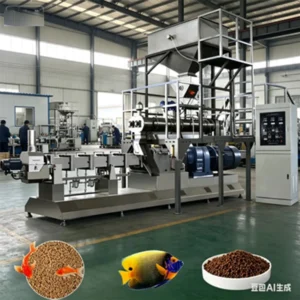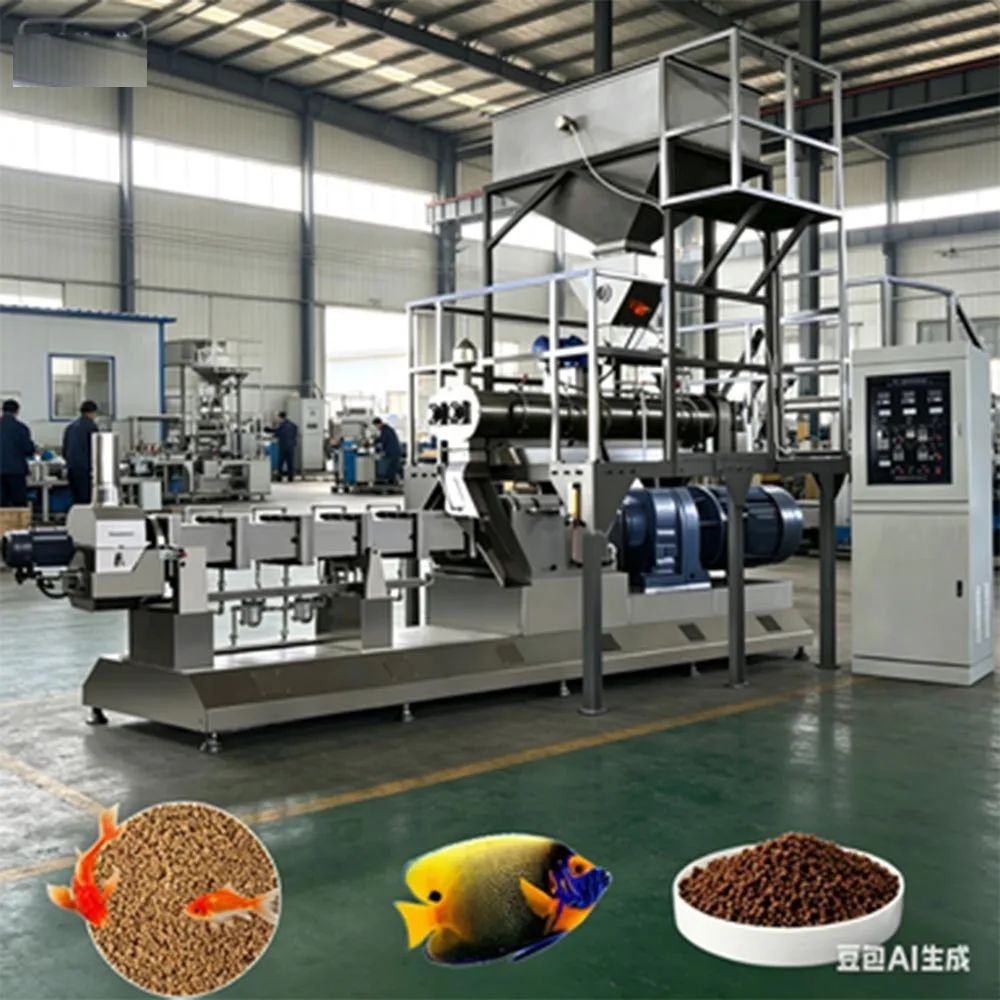
Integrated Station Matching — Every line station from feeding to pelletizing is throughput-balanced as one system, so the extruder never waits on a bottleneck upstream or downstream.
Technical Specifications
| Parameter | Value |
|---|---|
| Product Type | Twin Screw Aquatic Feed Pellet Production Line |
| Output Capacity | 500 kg/h floating fish feed pellets (basis not stated in source — confirm raw material formulation, moisture content, pellet size) |
| Pellet Size Range | 0.5 mm – 12 mm |
| Extruder Type | Twin Screw |
| Automation Level | Fully Automatic |
| Line Stations | Feeding, Mixing, Extruding, Pelletizing |
| Construction Material | Stainless Steel (main parts) |
| Control System | Simple control panel (PLC / MCC configuration to be confirmed) |
| Voltage & Frequency | To be confirmed per destination market |
| Rated Power | To be confirmed |
| Overall Dimensions | To be confirmed |
| Net Weight | To be confirmed |
Application Suitability
| Application | Material or Output |
|---|---|
| Floating fish feed for grow-out stages | Fish meal, soybean meal, corn flour, wheat middlings blended to target protein level |
| Sinking pellets for bottom-feeding species | Higher-density formulations with adjusted starch-to-protein ratios |
| Fry and fingerling starter feed | Micro-pellets down to 0.5 mm using finely ground raw material |
| Shrimp and crustacean feed | Water-stable pellets requiring extended conditioning and gelatinisation |
| Small to medium-scale continuous production | Integrated line running shift-length batches with consistent pellet geometry |
Why a Quoted Capacity Number Rarely Tells the Full Story
The output figure on a fish feed production line equipment manufacturer data sheet only matters when tied to a specific formulation, moisture level, and pellet diameter.
I spent four days in a Gulf region feed plant watching a twin-screw line produce nothing but sinking pellets when the buyer switched from a standard corn starch test recipe to his own high-fish-meal formulation. The screw speed, barrel temperature profile, and die configuration had all been set for a generic recipe that never matched the actual raw material. A 500 kg/h nameplate means very little when the screw configuration has not been matched to the buyer’s recipe, and no trial run was completed before the machine left the factory [NEED_CITE: importance of pre-shipment trial runs on buyer-specific formulations].
How the Twin-Screw Extruder Shapes Pellet Density and Float Rate
The twin-screw configuration provides two intermeshing screw shafts that generate controlled shear and residence time inside the barrel. This mechanical action gelatinises starch uniformly across the material cross-section, which directly determines whether the finished pellet floats or sinks. When a fish feed production line equipment manufacturer sets the screw profile and barrel temperature zones to match the buyer’s starch-to-protein ratio, expansion happens predictably at the die face and pellet density stays within the narrow band the market requires.
Die Geometry and the Pellet Size Range That Actually Works
Every pellet between 0.5 mm and 12 mm starts with a specific die plate hole diameter and land length. Smaller die openings increase back-pressure inside the barrel, raising shear and gelatinisation degree — essential for water-stable shrimp feed or fry starter crumbles. Larger openings lower resistance and allow higher throughput on grow-out floating pellets. The die specification must be chosen together with the screw configuration and barrel heating profile, not pulled from a generic parts catalogue [NEED_CITE: die land length and expansion ratio relationship in twin-screw extrusion].
Reading the Specs That Actually Matter for Pellet Quality
Output capacity of 500 kg/h is only meaningful against a defined formulation and pellet size; without that context, the number floats free of reality. The pellet size range of 0.5 mm to 12 mm covers fry crumbles through large grow-out pellets, but each end of that range demands a different screw profile and die plate. Stainless steel construction on main contact parts resists the corrosive salts in fish meal and allows wash-down cleaning between recipe changes. Fully automatic operation reduces the manual intervention needed during long production runs, though the control panel configuration — whether a simple interface, PLC, or full MCC — should be confirmed before electrical design begins.
What Happens When Line Stations Are Sourced Separately
When a buyer pieces together an extruder from one vendor, a dryer from another, and a coating drum from a third, throughput mismatch almost always appears at commissioning. The extruder pushes product faster than the dryer can handle, moisture content at the coating drum runs too high, and pellet surface quality suffers. This is not a hypothetical risk — it shows up on startup day when the line is supposed to run its first commercial batch [NEED_CITE: throughput balancing across extrusion line stations]. Sinking pellets, uneven coating, and rejected product are the visible symptoms of a line that was assembled rather than engineered as one system.
What a Single-Source Line Build Actually Changes
The feeding, mixing, extruding, and pelletizing stations are specified as one integrated package, so material flow rate is matched at every transfer point. Screw configuration and die design are selected against the buyer’s target pellet size and raw material formulation rather than copied from a standard build. An in-house testing workshop allows trial runs on the buyer’s actual raw material before the line ships, catching density and expansion issues while adjustments still cost hours instead of weeks. The twin-screw extrusion expertise covers floating and sinking aquatic feed across species — catfish, tilapia, shrimp — rather than treating all pellets as the same product. Pre-sales consultation, on-site installation, commissioning, and ongoing maintenance are handled by the same technical team that configured the line.
Documentation & Verification
- Line layout and capacity calculation tied to your raw material formulation and pellet specification
- Screw and die configuration record documenting the profile selected for your target density
- Trial run report produced on your actual raw material before shipment
- Electrical schematic with voltage and frequency matched to your destination market
- Operation and maintenance manual covering barrel cleaning and screw changeover procedures
- Wear parts list identifying screw elements and die plates by part number
Installation, Commissioning & Support
- Foundation load and floor space plan confirming overall dimensions and utility connection points
- Dedicated circuit specification matching confirmed voltage, frequency, and rated power requirements
- Modular station delivery with staged assembly from feeding through pelletizing to final alignment
- First-run parameter logging covering barrel temperature zones, screw speed, and die pressure
- Operator training on die changeover across the 0.5 mm to 12 mm pellet size range
- Spare screw elements and die plates supplied with the initial shipment for first replacement cycle
What to Share Before Requesting a Quotation
To size this fish feed production line equipment manufacturer offering accurately, share your raw material formulation including protein source ratios and moisture content, the target pellet diameter and whether you need floating or sinking product, and your daily production volume across shifts. Include your local voltage and frequency standard along with the preferred control language for the operator interface. If you have existing upstream milling or downstream drying equipment that must integrate, provide those station capacities so throughput can be balanced across the full line.
Frequently Asked Questions
Q: How is the 500 kg/h output capacity verified for my specific formulation?
A: The output figure is validated through a trial run using your actual raw material blend in the testing workshop before shipment. We record screw speed, barrel temperature, die pressure, and pellet density during the run, and the results are documented in a trial report. This ensures the capacity claim matches your recipe and target pellet size rather than a generic test material.
Q: Which line stations are included and is downstream capacity matched?
A: The standard configuration covers feeding, mixing, extruding, and pelletizing as one throughput-balanced system. Drying, coating, cooling, and packing stations can be added to match extruder output. Each downstream station is sized so material flow remains continuous without bottlenecking or product backlog at any transfer point.
Q: What screw configuration and die design will I receive for my target pellet?
A: The screw profile and die plate are selected based on your raw material formulation, target pellet diameter within the 0.5–12 mm range, and required density for floating or sinking behaviour. A configuration record documenting these choices is supplied with the line, allowing future reorders of identical wear parts.
Q: How are voltage, frequency, and control language confirmed before installation?
A: These details are finalised during the specification confirmation stage before production begins. The electrical schematic reflects your local supply standard, and the control interface is set to your operator’s preferred language. Any mismatch is resolved at the factory rather than discovered during commissioning on site.