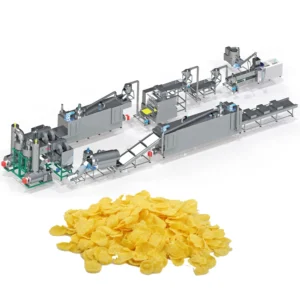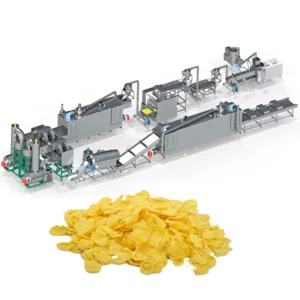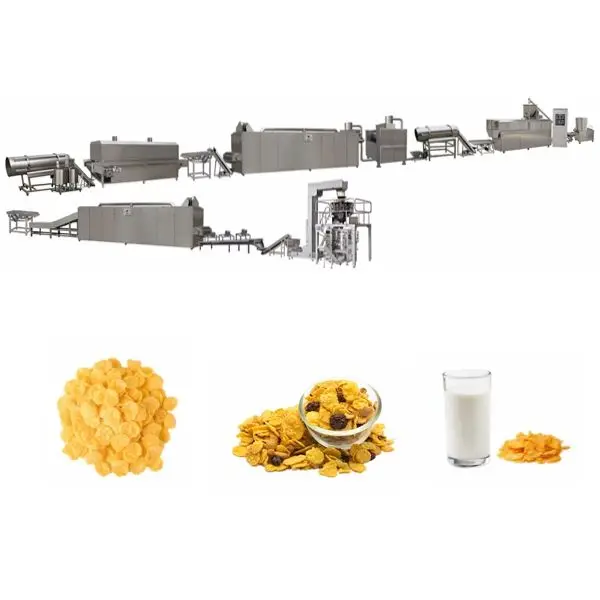
Screw Configuration Matched to Material — Every extruder die and screw profile in this breakfast cereal corn flakes machine full equipment range is specified against the buyer’s actual maize flour moisture and particle size, not a generic build.
Technical Specifications
| Parameter | Value |
|---|---|
| Product Type | Breakfast Cereal Corn Flake Production Line |
| Model | MT70 |
| Installed Power | 160 kW |
| Power Consumption | 120 kW |
| Output Capacity | 150–200 kg/h (basis not stated in source — confirm raw material and moisture) |
| Extruder Type | Twin-Screw |
| Extruder Detail Capacity | 200–300 kg/h (basis to be confirmed) |
| Control System | PLC and MCC available |
| Overall Dimensions (L×W×H) | 41 × 1.5 × 2.2 m |
| Flaking Machinery | Hydraulic double-roller, dual-motor drive, infrared sensor temperature control |
| Dryer Heating Source | Gas or electric |
| Roasting Oven | Hot air with vibrating pan, high-temperature spraying tubes, two circulating fans, cyclone dust removal |
| Coating System | Double tumble sugar melter, elevator, coating drum, spray nozzle |
| Raw Materials | Corn, rice, wheat, oat, barley powder |
| Standards | CE, ISO |
Application Suitability
| Application | Material or Output |
|---|---|
| Natural corn flake production | Corn grits and maize flour at controlled moisture |
| Sugar-coated corn flake SKUs | Corn base with sugar slurry coating |
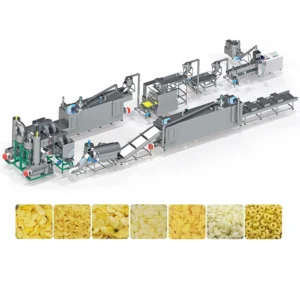
| Shaped breakfast cereals | Rice, wheat, oat, and barley blends formed into rings, balls, stars, loops, and wheels |
| Turnkey cereal line build-out | Full station integration from batching to packing |
What "150–200 kg/h" Leaves Out About Your Corn Flake Line
A rated output means nothing if the downstream dryer and roaster cannot keep pace with the extruder.
When I spent two weeks on-site at a Southeast Asian cereal plant, the flaking rollers kept cracking the edges of every piece. The extruder was running fine, but the local maize flour had a completely different particle size and moisture profile than what we used in the workshop trial. That mismatch rippled through the entire line — the flaking station was the first place it showed up, but the roaster temperature profile was also off because the flake thickness was inconsistent. A breakfast cereal corn flakes machine full equipment range must be evaluated as a chain where every station either matches the one before it or creates a bottleneck. [NEED_CITE: throughput matching between extruder, flaking, and drying stations in cereal production]
How Each Station in the Range Fits Together
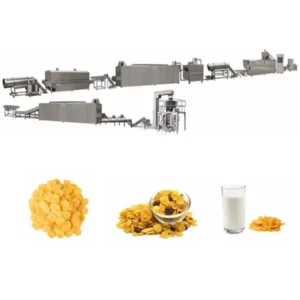
The twin-screw extruder sits at the centre of the breakfast cereal corn flakes machine full equipment range, receiving conditioned material from the mixing system and pushing it through a die that determines the initial pellet geometry. From there, the flaking machinery compresses each pellet between hydraulic double rollers with infrared temperature monitoring, producing a uniform flake thickness that the roaster can blister evenly. The hot-air roasting oven uses two separate circulating fans and a cyclone dust removal system to maintain consistent surface texture, while the sugar coating system — with its double tumble melter and spray nozzle — handles the secondary finish for coated variants before final cooling and packing.
Why Flaking Roller Control Dictates the Rest of the Line
Flaking is the stage where most cereal line failures become visible. If the roller gap or temperature drifts, flakes arrive at the roaster with uneven moisture distribution, which means some pieces blister and others remain dense and chewy. The hydraulic double-roller system on this line uses dual motors for independent roller driving, so you can fine-tune compression force on each side rather than accepting a single averaged setting. Infrared sensor temperature control keeps the roller surface within a narrow band, which matters when you are running oat or barley blends that have different gelatinisation behaviour than pure corn. [NEED_CITE: roller temperature uniformity and flake blistering consistency]
Reading the Specs That Actually Matter
The MT70 runs on a twin-screw configuration with automatic lubricating and cooling, which directly affects how long you can run between screw pull-outs for cleaning — a factor that compounds across multiple shifts. Installed power of 160 kW with 120 kW consumption indicates a meaningful reserve that keeps the motor from operating at its thermal ceiling during high-moisture runs. The overall line footprint of 41 × 1.5 × 2.2 m requires a facility with adequate ceiling clearance and linear space for the full station sequence. PLC control on the flaking machinery allows recipe storage for different flake thicknesses, while MCC integration across the line means a single control architecture from the mixer through to the packing station. Screw wear resistance and service life depend on the raw material abrasiveness — corn grits behave very differently from oat flour in terms of barrel wear, which is why the screw configuration record must be matched to your specific material before the machine leaves the workshop.
What Happens When Stations Are Mismatched
I have watched a cereal line where the extruder was specified correctly but the dryer was undersized, forcing the operator to slow the entire line to prevent wet flakes from reaching the roaster. The rated throughput was technically achievable, but only on paper. The buyer had selected the extruder based on a catalogue number and assumed the rest of the breakfast cereal corn flakes machine full equipment range would follow naturally. [NEED_CITE: downstream bottleneck consequences in extrusion-based cereal lines] When the roasting oven receives flakes that still carry excess moisture, the high-temperature spraying tubes work harder, energy consumption rises, and the surface blistering becomes patchy. That is the kind of problem you only discover during commissioning, after the line has been paid for and shipped.
Why Procurement Here Reduces Configuration Risk
Every station in this range — mixing, extruding, flaking, drying, roasting, coating, cooling, and packing — is sourced from one supplier, which means throughput calculations are done across the entire chain rather than each vendor optimising for their own machine only. The screw configuration and die design are specified against the buyer’s raw material and target product before production begins. An in-house testing workshop allows trial runs on your actual maize flour, rice blend, or oat base before shipment, so the two-week re-tuning I experienced in Southeast Asia happens in Jinan instead of on your factory floor. The roasting oven, flaking machinery, and coating system are matched to the extruder output rather than selected independently. CE and ISO documentation is provided as standard, and the electrical schematic includes voltage and frequency confirmation for your target market.
Documentation & Verification
- Line layout and capacity calculation matching every station throughput to your raw material
- Screw and die configuration record tied to your specific corn, rice, or oat blend
- Trial run report conducted on your raw material before shipment from the testing workshop
- Electrical schematic with voltage, frequency, and control language confirmed for your market
- Operation and maintenance manual covering flaking roller adjustment and roaster calibration
Installation, Commissioning & Support
- Foundation and floor space planning for the 41 m linear footprint with ceiling height check
- Dedicated power circuit sized for 160 kW installed load with voltage and frequency verification
- On-site assembly sequence from extruder through flaking, roasting, and coating stations
- First-run parameter setting for barrel temperature profile and hydraulic roller gap on your material
- Operator training on PLC recipe storage for different flake thicknesses and sugar coating ratios
- Wear parts list covering screws, dies, and flaking rollers with recommended reorder intervals
What to Include in Your Inquiry
To get a line configuration that actually matches your production target, share your raw material type and its typical moisture content, the specific flake or shaped cereal formats you plan to run, your facility dimensions and ceiling height, and the local voltage and frequency standard. If you are integrating this line with existing upstream batching or downstream packing equipment, detail those interfaces. Requesting a trial run on your raw material in the testing workshop before shipment will flag any particle size or gelatinisation issues early.
Frequently Asked Questions
Q: How is output capacity verified against my specific raw material and moisture level?
A: The MT70 is rated at 150–200 kg/h, but actual throughput depends on your raw material behaviour. Before shipment, a trial run is conducted in the testing workshop using your supplied corn, rice, or oat flour. The screw configuration, barrel temperature profile, and die selection are then adjusted based on trial results, and a documented report is provided.
Q: What supporting stations are matched to the extruder to avoid line bottlenecks?
A: The dryer capacity, roasting oven fan output, and flaking roller throughput are all calculated against the extruder’s verified output on your material. This prevents situations where one station forces the entire line to run below its potential, which is a common problem when stations are sourced from separate vendors.
Q: Which voltage, frequency, and control language options are available for my target market?
A: The electrical schematic is confirmed during the specification stage before production begins. Voltage and frequency are matched to your local grid standard, and the PLC and MCC control interface language is set according to your operator requirements. This avoids commissioning delays caused by mismatched electrical standards.
Q: Can the line produce both natural and sugar-coated corn flakes on the same extruder?
A: Yes. The MT70 extruder handles both natural and sugar-coated corn flake production, as well as shaped cereal formats such as rings, balls, stars, and loops by changing the extruder die. The sugar coating system with its double tumble melter and spray nozzle is added into the station sequence for coated variants.