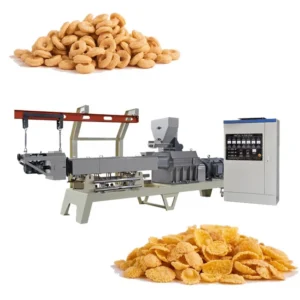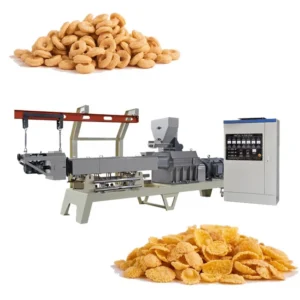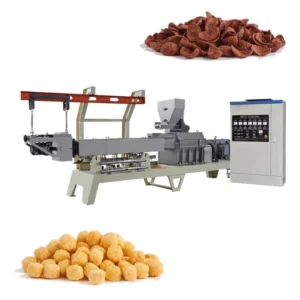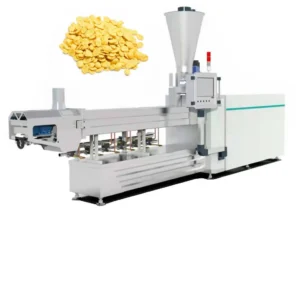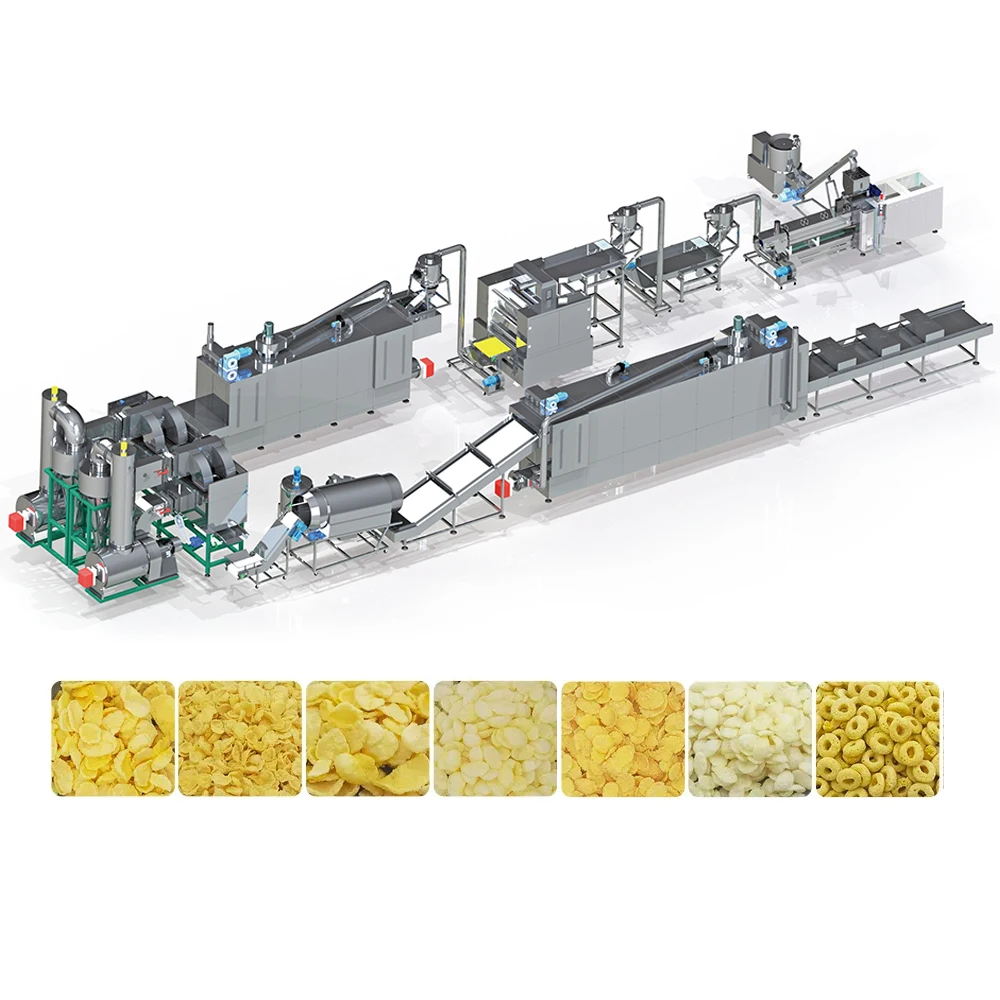
Integrated Line Synchronization — Every station from extrusion to packing is sized to hold the same throughput, so no single machine dictates your output ceiling.
Technical Specifications
| Parameter | Value |
|---|---|
| Product Type | Breakfast Cereal Corn Flake Production Line |
| Models Available | MT70 / MT85 / MT75 |
| Installed Power | 160 kW (MT70) / 190 kW (MT85) / 210 kW (MT75) |
| Power Consumption | 120 kW (MT70) / 140 kW (MT85) / 150 kW (MT75) |
| Output Capacity | 150–200 kg/h (MT70); 300–400 kg/h (MT85); 300–500 kg/h (MT75) (basis not stated in source — confirm raw material type, moisture content and product format) |
| Overall Dimensions | 41 × 1.5 × 2.2 m (MT70); 43 × 1.5 × 3.2 m (MT85); 45 × 1.5 × 3.5 m (MT75) |
| Extruder Type | Twin Screw |
| Flaking System | Hydraulic double-roller, dual independent motor drive, infrared sensor temperature control |
| Flaking Capacity | 200–300 kg/h (basis not stated in source — confirm raw material and moisture) |
| Dryer Heating Source | Gas or Electric (configurable) |
| Hot Air Roasting Oven | Vibrating pan, conciliation burner, dual circulating fans, cyclone dust removal |
| Coating System | Double tumble sugar melter, elevator, coating drum, spraying nozzle |
| Control System | PLC |
| Key Features | Automatic lubricating and cooling on extruder; wear-resistant screw process; PLC-controlled flaking; modular line layout |
| Standards | CE certified (verify per-unit declaration) |
Application Suitability
| Application | Material or Output |
|---|---|
| Natural corn flake production | Corn powder base, dried and roasted without coating |
| Sugar-coated corn flakes | Corn or multi-grain base with sugar tumble coating |
| Shaped breakfast cereals | Corn, rice, wheat, oat, barley powder — ball, tube, stick, ring, fruit loop, star, wheel, flower, heart shapes via die change |
| Multi-grain flake lines | Blends of oat, barley, wheat and rice flour |
| Fortified breakfast cereal | Grain powder premix with added nutritional ingredients |
Why Matching Downstream Capacity Prevents Line Stoppages on a Breakfast Cereal Corn Flakes Machine Full Equipment Range
A corn flake line only runs as fast as its slowest station — and the bottleneck is almost never the extruder.
When I first started laying out cereal lines, I watched a brand-new installation stall on day one. The twin-screw extruder was pushing product at full rate, but the dryer and cooling conveyor behind it could not keep pace. Material piled up at the flaking station exit, operators had to shut everything down, and the customer spent the first week chasing a problem that should have been solved on paper. That experience shaped how I approach every breakfast cereal corn flakes machine full equipment range now: calculate each station’s real throughput before anything gets built. [NEED_CITE: common causes of throughput mismatch in extrusion-based food processing lines]
Station-by-Station Throughput Alignment
Each piece of equipment in this breakfast cereal corn flakes machine full equipment range is selected so its rated capacity overlaps with adjacent stations. The twin-screw extruder feeds into a PLC-controlled flaking unit with hydraulic double rollers, and that unit discharges into a dryer sized for the same moisture removal load. When the hot air roasting oven and sugar coating drum are added downstream, their residence times and drum speeds are set to accept the continuous flow without accumulation. This is not a catalogue of separate machines — it is a calculated chain where every link carries the same load.
Flaking Precision Under Continuous Feed
The flaking machinery uses a hydraulic system to maintain consistent roller pressure on both sides, and dual independent motors prevent speed drift between the two rollers. An infrared sensor monitors roller temperature continuously, which matters because uneven heat causes the corn grits to stick or fracture instead of flattening into uniform flakes. On a line running multiple shifts, that temperature consistency directly affects flake thickness and the final bowl quality your customers expect.
Inside the Extruder and Die Configuration
The twin-screw extruder at the heart of this line handles corn, rice, wheat, oat and barley powders, and the screw configuration is matched to whichever raw material the buyer specifies. The screw is manufactured with a wear-resistant process to extend service life under continuous abrasive grain processing. Automatic lubricating and cooling functions reduce unplanned downtime during long production runs. Die selection determines whether the extrudate enters the flaking stage as a sheet, pellet or shaped piece — and the wrong die geometry will produce material the flaking rollers cannot handle uniformly. Moisture content at the extruder outlet must fall within a narrow band for the downstream dryer to work as designed. [NEED_CITE: relationship between extruder moisture output and dryer sizing in cereal production]
What Happens When Stations Are Specified in Isolation
Buying an extruder from one vendor, a dryer from another, and a coating system from a third creates gaps that do not appear until the line is running under load. The extruder may deliver product at a moisture level the dryer was not sized to handle, or the coating drum may not have enough residence time for the sugar to adhere before packing. These mismatches show up as product waste, inconsistent flake texture, and operators manually adjusting speeds to compensate. On a breakfast cereal corn flakes machine full equipment range sourced from a single supplier, those interfaces are calculated before fabrication, not discovered during commissioning. [NEED_CITE: risks of multi-vendor food line integration]
Why Procuring the Full Range From One Source Matters
The line layout is calculated from the buyer’s target output and raw material, so station capacities are matched before any machine is built. Screw configuration and die design are specified to the buyer’s actual grain formulation rather than pulled from a generic template. An in-house testing workshop runs trial production on the buyer’s raw material before shipment, catching texture or density issues early. Pre-sales engineering covers utility planning, phased installation scheduling, and operator training — so the team running the line on day one already knows the control system. Ongoing maintenance support includes wear parts supply for screws, dies, and spray nozzles.
Documentation & Verification
- Line layout drawing showing station spacing and throughput matching for your target output
- Screw and die configuration record matched to your grain formulation
- Trial run report on your raw material produced in our testing workshop before dispatch
- Electrical schematic with voltage, frequency and control language confirmed for your facility
- CE declaration of conformity for the complete line assembly
- Wear parts list with part numbers for screws, dies, flaking rollers and spray nozzles
Installation, Commissioning & Support
- Floor plan review based on line dimensions up to 45 × 1.5 × 3.5 m to confirm clearances
- Power supply confirmation for installed loads up to 210 kW with dedicated circuit requirements
- PLC control language and HMI interface set to operator preference before shipment
- First-run parameter setting on your raw material during on-site commissioning
- Operator training covering extruder screw speed, flaking roller pressure and dryer temperature profiles
- Initial spare parts kit including screws, dies and flaking roller components supplied with the line
What We Need to Configure Your Line
To build an accurate proposal, share your target product format — natural flakes, sugar-coated, or shaped pieces — along with the grain formulation you plan to run. We also need your facility voltage and frequency, available floor space and ceiling height, and whether gas or electric heating is preferred for the dryer. If you have upstream mixing or downstream packing equipment already in place, let us know the models so we can match the interfaces.
Frequently Asked Questions
Q: How do you ensure each station on the line can handle the same throughput without bottlenecks?
A: We calculate throughput at every station — extruder, flaker, dryer, roasting oven, coating drum and cooling conveyor — based on your target output and raw material. The line layout proposal shows these matched capacities, and we verify them during a trial run on your actual grain formulation before the equipment ships.
Q: What is the difference in equipment between natural corn flakes and sugar-coated corn flakes?
A: Natural corn flakes go from extruding through flaking, drying, roasting and cooling. Sugar-coated flakes add a coating system after roasting — a double tumble sugar melter, an elevator, a coating drum and a spraying nozzle — plus additional cooling time to set the sugar layer before packing.
Q: Is the extruder screw configuration customized to our raw material?
A: Yes. The screw profile and die geometry are specified based on the grain powder you plan to process — corn, rice, wheat, oat, barley or blends — and the target flake thickness and texture. This configuration is documented and can be adjusted if you introduce new formulations later.
Q: How do we choose between gas and electric heating for the dryer?
A: The choice depends on your facility’s available utilities and local energy costs. Gas heating suits plants with existing gas supply infrastructure, while electric heating works where gas lines are unavailable. We confirm the heating source during the proposal stage and design the dryer accordingly.
Q: Do you provide factory layout drawings and installation condition plans with the proposal?
A: Yes. The proposal includes a full line layout showing equipment placement, utility connection points, and space requirements based on your factory dimensions. Installation condition drawings cover floor load, power supply specifications, ventilation and drainage requirements for your site.