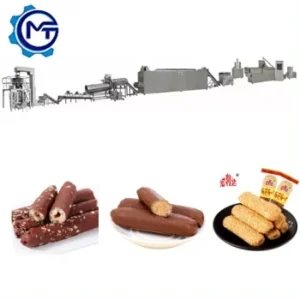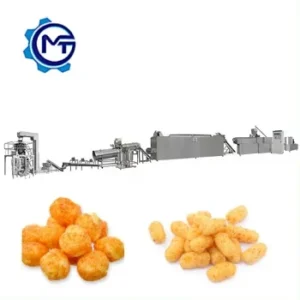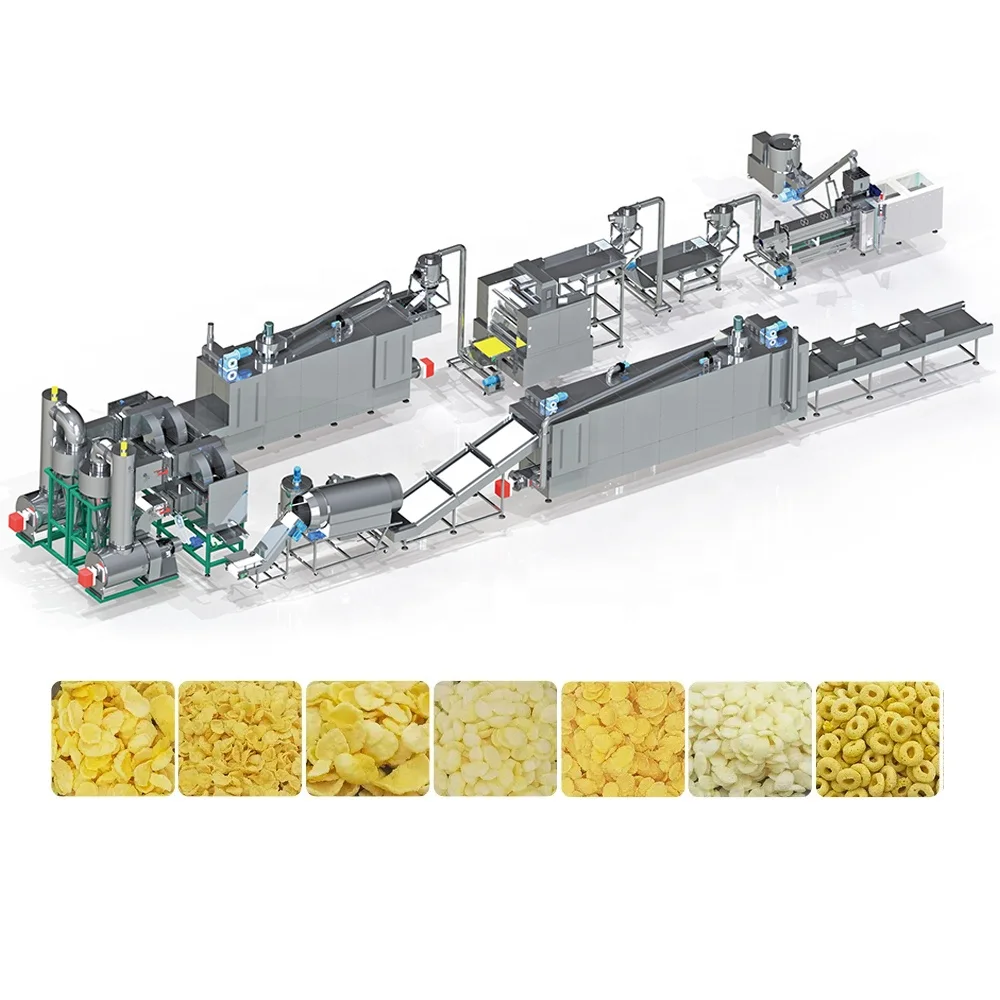
Capacity-Matched Turnkey Lines — Every station from mixer to packer is specified against the buyer’s corn or cereal formulation before build, preventing bottlenecks that occur when extruders, flakers, dryers and roasting ovens are sourced from separate vendors without throughput alignment.
Technical Specifications
| Parameter | Value |
|---|---|
| Product Type | Corn Flakes & Breakfast Cereal Production Line |
| Model | MT70 |
| Installed Power | 160 kW |
| Power Consumption | 120 kW |
| Output Capacity | 150–200 kg/h (basis not stated in source) |
| Overall Dimensions | 41 × 1.5 × 2.2 m |
| Model | MT85 |
| Installed Power | 190 kW |
| Power Consumption | 140 kW |
| Output Capacity | 300–400 kg/h (basis not stated in source) |
| Overall Dimensions | 43 × 1.5 × 3.2 m |
| Model | MT75 |
| Installed Power | 210 kW |
| Power Consumption | 150 kW |
| Output Capacity | 300–500 kg/h (basis not stated in source) |
| Overall Dimensions | 45 × 1.5 × 3.5 m |
| Screw Type | Twin-screw |
| Screw Material | Special wear-resistant alloy |
| Control System | PLC / MCC for extruder; PLC for flaking machinery |
| Flaking Machinery | Hydraulic double-roller system; dual independent motors; infrared temperature sensor |
| Dryer Heating Source | Gas or Electric (configurable) |
| Roasting Oven | Hot air roasting; conciliation burner; dual circulating fans; cyclone dust removal; vibrating pan |
| Coating System | Double-tumble sugar melting; elevator; coating drum; precision spraying nozzle |
Application Suitability
| Application | Material or Output |
|---|---|
| Natural corn flakes | Corn, rice, wheat, oat, barley powder |
| Sugar-coated corn flakes | Cereal base with sugar slurry coating |
| Extruded breakfast cereal shapes | Ball, tube, stick, ring, fruit loop, star, wheel, flower, heart via die changes |
| Puffed snack formats | Grain-based puffed snacks using extruder stations |
Why "300 kg/h" Means Nothing Without the Rest of the Line
A corn flakes production line equipment package is only as reliable as its slowest station.
I have seen too many breakfast cereal projects stall at commissioning because the extruder was rated at a certain throughput while the flaking rolls or hot-air roasting oven could not keep pace on the buyer’s actual grain mix. The numbers in a quotation often reflect ideal conditions — low-moisture corn grits, standard pellet size, ambient workshop temperatures. Switch to a higher-oil oat blend or a denser multigrain formulation, and that same extruder may hold output while the downstream dryer falls behind, creating a backlog that forces operators to throttle the entire breakfast cereal processing machine for sale back to a fraction of its nameplate speed.
When the throughput of each station is not calculated together, the line never reaches the output you paid for [NEED_CITE: turnkey line throughput matching principles]. That is why confirming the raw material profile, moisture targets, and finished flake density before any machine is built matters more than comparing installed power figures across quotations.
Matching Extruder Die Geometry to Cereal Shape Targets
The twin-screw extruder in this corn flakes production line equipment range supports multiple breakfast cereal shapes — ball, tube, stick, ring, fruit loop, star, wheel, flower, and heart — through die and mould adjustments. Changing the die alters the cross-section of the extrudate, but it also changes the pressure profile inside the barrel and the residence time of the dough. A fruit loop die with multiple small orifices creates higher shear than a single-orifice stick die, which affects starch gelatinisation and the final crunch of the roasted flake.
Specifying the die without considering the downstream flaking roll gap and roasting oven temperature profile leads to inconsistent texture across batches. Operators end up adjusting dryer settings manually to compensate, introducing variability that shows up in the finished product.
How the Flaking Station Controls Final Flake Density
The flaking machinery uses a hydraulic double-roller system driven by two independent motors, with an infrared sensor monitoring the temperature pipe. This configuration lets the rollers maintain even pressure across the full width of the cereal sheet, which directly determines flake thickness and, ultimately, how the product behaves in milk. Thicker flakes stay crisp longer but require more energy in the hot-air roasting oven to achieve the target moisture level.
If the hydraulic pressure is not matched to the extrudate moisture coming out of the dryer before the flaker, the sheet can crack or stick to the rollers [NEED_CITE: cereal flaking process parameters and roller surface adhesion]. That is why the dryer heating source — gas or electric — and the drying profile must be set in relation to the flaking station parameters, not treated as an isolated variable.
Reading the Specs Through a Process Engineer’s Lens
The installed power range across the MT70, MT85, and MT75 models spans from 160 kW to 210 kW, with actual power consumption sitting roughly 25–30% below those figures during steady operation. That gap reflects motor startup loads and peak heating demand rather than continuous draw, which matters when sizing the electrical supply for a new facility. The overall line dimensions — reaching up to 45 metres in length for the MT75 — require a workshop with adequate floor space and ceiling clearance for the dryer and roasting oven exhaust ducting.
The twin-screw design handles a broader range of grain formulations than a single-screw extruder of comparable size, particularly when recipes include higher fat or fibre content that can cause surging in single-screw barrels. The PLC and MCC control architecture separates motor control from process logic, giving operators the ability to adjust barrel temperature zones and screw speed independently. For the roasting oven, the conciliation burner and dual circulating fans work together to distribute hot air evenly across the vibrating pan, while the cyclone dust removal device captures fine particulate before it can settle on the finished cereal.
The Hidden Cost of Skipping the Pre-Roast Drying Stage
When a line is assembled from separate vendors, the dryer between the flaker and the roasting oven is sometimes undersized or omitted entirely to save budget. The result is flakes entering the roasting oven with too much residual moisture, which forces the oven to work as both a dryer and a toaster. Surface blistering becomes uneven, some flakes burn while others remain doughy, and the cyclone dust removal device loads up with charred fines that shorten filter life [NEED_CITE: cereal roasting defects caused by insufficient pre-drying].
Operators compensate by slowing the oven belt, which then becomes the line bottleneck. The extruder keeps producing, and the backed-up material loses temperature and moisture consistency before it reaches the flaker. This cascade of small deviations is what causes the texture and shelf-life complaints that buyers discover only after their first commercial shipment reaches the market.
Why Sourcing the Full Equipment Range From One Manufacturer Matters
Every station in these corn flakes lines — from the batching mixer through the twin-screw extruder, hydraulic flaker, dryer, hot-air roasting oven, sugar coating drum, cooler, and packer — is specified as a single package, so throughput is calculated across the entire chain rather than at individual machines. The screw configuration and die selection are matched to the buyer’s target grain formulation and cereal shape before production starts, not copied from a generic build sheet. An in-house testing workshop runs trial batches on the buyer’s actual raw material, generating a report that confirms texture, density, and throughput before the corn flakes production line equipment ships.
The coating system integrates double-tumble sugar melting with a dedicated elevator and precision spraying nozzle, so sugar distribution is even across the full batch rather than concentrated on flakes at the top of the drum. Electrical schematics, voltage, frequency, and control language are confirmed against the installation site requirements during the engineering phase, preventing the delays that happen when a machine arrives with the wrong motor voltage or an interface the local operators cannot read.
Documentation & Verification
- Line layout and capacity calculation matched to your grain formulation and target flake density
- Machine specification sheet with screw and die configuration record for your cereal shape
- Factory trial run report on your raw material covering throughput, texture, and moisture
- Electrical schematic with confirmed voltage, frequency, and control panel language
- CE declaration of conformity and ISO certificate for customs and local compliance
- Operation and maintenance manual with wear parts list for screws, dies, and flaker rollers
Installation, Commissioning & Support
- Floor plan showing the 41–45 m line footprint with utility connection points for gas or electric dryer
- Dedicated electrical circuit sized for 160–210 kW installed power with voltage and frequency confirmation
- Assembly sequence for extruder, flaking rolls, roasting oven, and coating drum on-site alignment
- First-run commissioning with barrel temperature profile and flaker hydraulic pressure calibrated to your recipe
- Operator training covering PLC interface navigation, die changes, and sugar coating drum adjustment
- Wear parts supply schedule for twin-screw elements, flaker rollers, and roasting oven circulating fan bearings
What to Include in Your Inquiry
To configure the right breakfast cereal processing machine for sale for your facility, share your target grain formulation or blend, the finished cereal shape and flake thickness you need, and your daily output target in kilograms. Include your workshop floor dimensions, ceiling height, and the local voltage and frequency standard so the electrical package can be specified before the quotation is issued. If you have existing upstream batching or downstream packing equipment that needs to interface with the new line, note the connection points and conveyor heights.
Frequently Asked Questions
Q: How is output capacity verified against the buyer’s actual raw material and moisture content?
A: Before shipment, the line runs a trial using the buyer’s grain formulation in the in-house testing workshop. The trial report records throughput at each station, extrudate moisture entering the flaker, flake thickness after the hydraulic rollers, and final moisture after the roasting oven. These figures confirm whether the rated capacity holds on your specific recipe or whether adjustments are needed.
Q: What voltage, frequency and control language options are available for different target markets?
A: The electrical package is configured during the engineering phase based on the installation site’s supply standard. Motors, heater elements, and the PLC/MCC panels are matched to the local voltage and frequency. The HMI language is set to the operator’s preference, and the electrical schematic reflects all confirmed values before production begins.
Q: How are the extruder screw configuration and die selected for a specific cereal shape and density target?
A: The screw profile and die orifice geometry are chosen based on the target shape — whether ball, ring, fruit loop, or star — and the grain blend’s starch and fibre content. The configuration affects shear, residence time, and expansion ratio. A trial run confirms the texture and density meet the product specification before the die and screw set is finalized for the production build.
Q: Is a trial run on the buyer’s raw material performed before shipment, and what does the report cover?
A: Yes. The testing workshop runs the buyer’s actual formulation through the extruder, flaker, dryer, and roasting oven. The report documents throughput at each station, moisture readings at key points, flake thickness measurements, roasting uniformity, and any adjustments made to barrel temperature, screw speed, or hydraulic flaker pressure to meet the target product specification.
Q: How is throughput balanced between the extruder, dryer, roasting oven and coating drum to prevent line bottlenecks?
A: Each station’s capacity is calculated against the others using the buyer’s formulation and moisture targets. The dryer residence time, roasting oven belt speed, and coating drum batch cycle are all set so that no single station forces the upstream equipment to throttle back. The line layout document shows the calculated throughput at every point for verification before the order is confirmed.