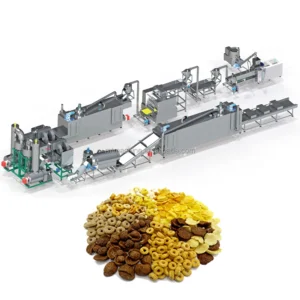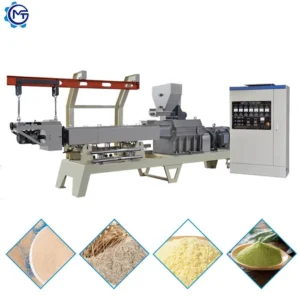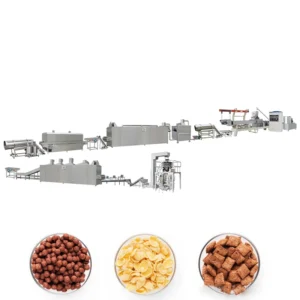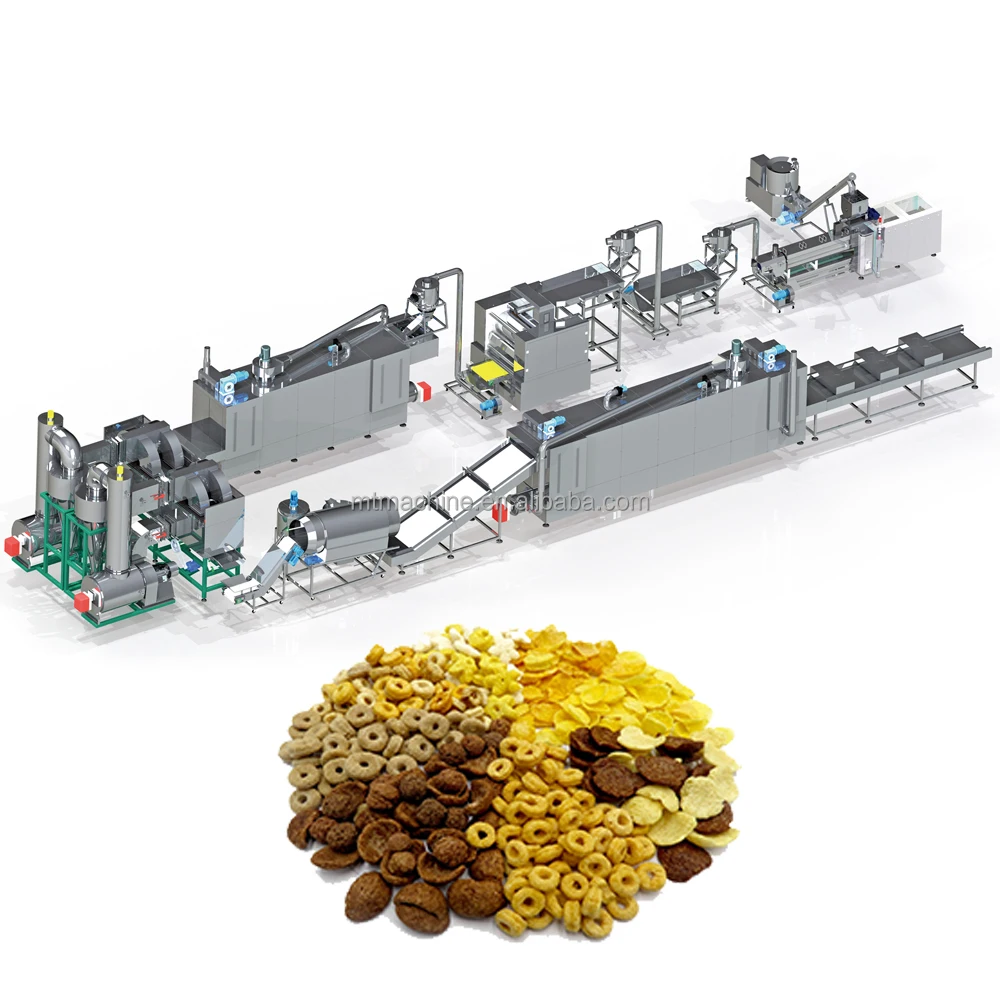
Line-Sized Matching — Every station from the mixer to the packing belt is calculated against the same throughput basis, so no single machine chokes the rest of the sequence.
Technical Specifications
| Parameter | Value |
|---|---|
| Product Type | Corn Flakes Breakfast Cereal Production Line |
| Model Options | MT70 / MT85 / MT75 |
| Screw Type | Twin Screw |
| Installed Power | MT70 — 160 kW; MT85 — 190 kW; MT75 — 210 kW |
| Power Consumption | MT70 — 120 kW; MT85 — 140 kW; MT75 — 150 kW |
| Output Capacity | MT70 — 150–200 kg/h (basis not stated in source); MT85 — 300–400 kg/h (basis not stated in source); MT75 — 300–500 kg/h (basis not stated in source) |
| Overall Dimensions | MT70 — 41 × 1.5 × 2.2 m; MT85 — 43 × 1.5 × 3.2 m; MT75 — 45 × 1.5 × 3.5 m |
| Extruder Capacity (MT75) | 200–300 kg/h (basis not stated in source) |
| Flaking Machine Capacity | 200–300 kg/h (basis not stated in source) |
| Flaking Control | PLC with hydraulic double-roller system, infrared sensor temperature control |
| Dryer Heating Source | Gas / Electric (selectable) |
| Roasting Oven | Hot air with conciliation burner, dual circulating fans, cyclone dust removal, vibrating pan with high-temperature spraying tubes |
| Coating System | Double tumble sugar melter, elevator, coating drum, spraying nozzle |
| Raw Materials | Corn, rice, wheat, oat, barley powder |
| Control System | PLC |
| Standards | CE, ISO |
Application Suitability
| Application | Material or Output |
|---|---|
| Natural corn flakes | Corn grits, corn flour, corn meal |
| Sugar-coated corn flakes | Same base grains plus sugar or honey glaze |
| Multi-grain cereal blends | Rice, wheat, oat, barley powder mixed with corn |
| Shaped breakfast cereal snacks | Ball, tube, stick, ring, fruit loop, star, wheel, flower, heart via die change |
| Fortified breakfast cereal | Grain base with added vitamin-mineral premix |
What "300 kg/h" Actually Means When You Run Corn Grits
Capacity figures only matter when the raw material and moisture basis are stated.
I remember a project where a buyer quoted an extruder line on a single headline number. The extruder could indeed push that output on a low-moisture rice blend, but the same line on corn grits at standard flaking moisture ran slower, and the tunnel dryer could not keep up. The corn flakes came out above target moisture, and an entire shift of product had to be re-dried. That bottleneck was not the extruder’s fault — it was the missing conversation about which grain and what moisture the capacity was measured on [NEED_CITE: throughput variation by grain type and moisture in twin-screw extrusion]. When you survey the full equipment range for a corn flakes breakfast cereal machine, the question is not what each station can do alone but what every station can sustain together on your actual recipe.
How Each Station in the Line Holds the Pace
A corn flakes breakfast cereal machine line runs through distinct stages — mixing, extruding, flaking, drying, hot air roasting, cooling, and packing — or adds sugar spraying and a second drying pass for coated variants. The twin-screw extruder sits at the centre, gelatinising the starch in the grain mass under controlled barrel temperature and shear. Downstream, the PLC-controlled flaking machine uses a hydraulic double-roller system with infrared sensor temperature feedback to press the cooked grits into uniform flakes. Uniformity at this stage directly affects how evenly the flakes roast and how consistent the final crunch is in the bowl.
Matching Dryer and Roaster to Extruder Output
The tunnel dryer must evaporate moisture at a rate that matches the flaker’s discharge. If the dryer is sized only for the extruder’s nominal figure, flakes can exit with residual moisture high enough to cause clumping in the roaster or reduce shelf life. The hot air roasting oven on this line uses a conciliation burner with two separate circulating fans and a cyclone dust removal device to keep temperature steady across the bed depth. A vibrating pan with high-temperature spraying tubes moves the flakes forward while the hot air pulls moisture out. Getting the air volume and residence time right here is what separates a flake that stays crisp in milk from one that goes soggy in two minutes [NEED_CITE: moisture removal rate and flake crispness retention in hot air roasting].
Reading the Key Numbers That Shape Your Line
The twin-screw configuration on the MT70, MT85, and MT75 models gives processors flexibility across corn, rice, wheat, oat, and barley powder — single-screw extruders tend to struggle with the higher fat or fibre blends that multi-grain recipes introduce. Installed power ranges from 160 kW to 210 kW depending on model, and actual power consumption sits between 120 kW and 150 kW, which determines the transformer capacity your workshop must supply. The flaking machine’s hydraulic double-roller drive, with separate motors for each roller, allows independent speed and pressure adjustment; this is what keeps flake thickness even when the feed rate fluctuates slightly between batches. Overall line length stretches from 41 m to 45 m, so your building must have the clear span plus utility corridors before the equipment arrives.
The Hidden Cost of an Undersized Coating Station
Buyers often focus on extruder output and overlook the coating drum. When a sugar-coated corn flakes line is specified, the double tumble sugar melter must dissolve and hold enough syrup to cover the full roaster discharge. An undersized melter forces the operator to slow the line, or the spray nozzles deliver an uneven glaze that leaves some flakes bare and others over-coated. Inconsistent coating not only affects taste but also changes how the flakes behave during the second drying pass, leading to colour variation across the batch [NEED_CITE: sugar coating uniformity impact on downstream drying and shelf stability]. These problems rarely show up during a factory acceptance test that only runs a short batch.
Why Buyers Source the Full Range Here
The entire corn flakes breakfast cereal machine sequence — from batching to packing — is supplied under one responsibility, so throughput is calculated station by station rather than assembled from disconnected vendors. Screw configuration and die design are matched to the buyer’s grain blend and target flake geometry before metal is cut. An in-house testing workshop runs trial production on the customer’s actual raw material before shipment, catching moisture and density issues while adjustments still cost hours instead of weeks. Electrical schematics, voltage, frequency, and control language are confirmed for the destination market so commissioning starts with the right parameters on day one. Documentation covers the line layout, capacity calculation, screw and die configuration record, trial run report, and CE declaration of conformity, giving the buyer a verifiable paper trail [NEED_CITE: CE machinery directive documentation requirements for food processing lines].
Documentation & Verification
- Line layout and capacity calculation showing matched throughput at every station
- Screw and die configuration record tied to your grain blend and flake geometry
- Trial run report produced on your raw material before the line ships
- Electrical schematic confirming voltage, frequency, and PLC language for your market
- CE declaration of conformity and ISO certificate for the complete line scope
- Operation and maintenance manual with wear parts list and replacement intervals
Installation, Commissioning & Support
- MT75 line footprint requires a clear span of at least 45 m with utility trenches for gas or electric dryer feed
- Power supply must cover up to 210 kW installed capacity with a dedicated circuit for the extruder main motor
- Stations ship in modular frames; on-site assembly sequence follows the extruder-outward layout plan
- First run includes barrel temperature profiling and flaking pressure calibration on your grain blend
- Operator training covers PLC screen navigation, screw speed adjustment, and hydraulic roller pressure setting
- Wear parts list specifies screws, dies, and flaking rollers with recommended first replacement intervals
What to Share Before Requesting a Quotation
To size the corn flakes breakfast cereal machine line accurately, tell us your primary grain or grain blend, target moisture at packing, and the daily output you need to meet purchase orders. Share your workshop length, width, and clear height so the layout can route the dryer and roaster within your building envelope. Confirm the local voltage, frequency, and whether you prefer gas or electric heating for the dryer. If you already run upstream milling or downstream packing equipment, note the connection points so the new line slots in without a rebuild.
Frequently Asked Questions
Q: How is output capacity verified across every station?
A: Each station — extruder, flaker, dryer, roaster, coater — is checked against the same raw material and moisture basis. We run a trial on your actual grain blend in the testing workshop and record throughput at each point so no single machine becomes a bottleneck once the line is installed on your floor.
Q: How do I match dryer and roaster capacity to the extruder?
A: We calculate the moisture load leaving the flaker and size the tunnel dryer’s evaporation rate accordingly. The roaster is then matched to the dryer discharge moisture so that final crispness and colour targets are met without slowing the line.
Q: What voltage and control options are confirmed before production?
A: Electrical schematics are drawn for your site voltage and frequency before the line enters fabrication. The PLC interface language is set to your operator’s preference, and a confirmation document is signed off before the cabinets are wired.
Q: Can the flaking machine handle different cereal shapes and grains?
A: The hydraulic double-roller flaker adjusts pressure and gap for various grain types. Die changes on the extruder allow production of rings, balls, stars, and other shapes from the same platform, and the flaker settings are recalibrated to each new format.
Q: What wear parts are included and when should they be replaced?
A: The shipment includes spare screws, dies, and flaking rollers. The wear parts list specifies inspection intervals and the typical replacement schedule based on the grain abrasiveness you will run, so you can order spares before the first set is fully worn.