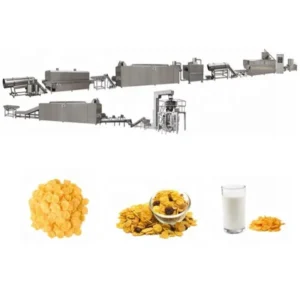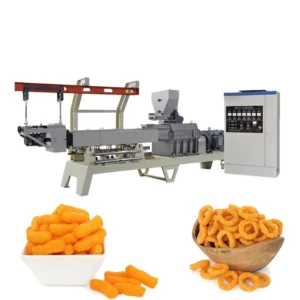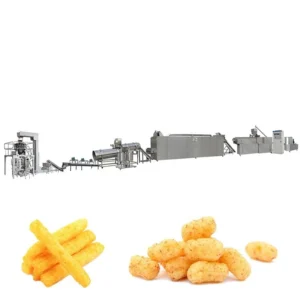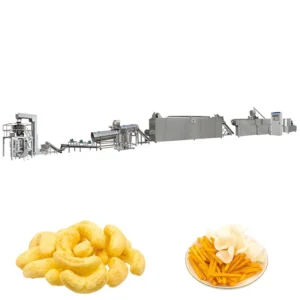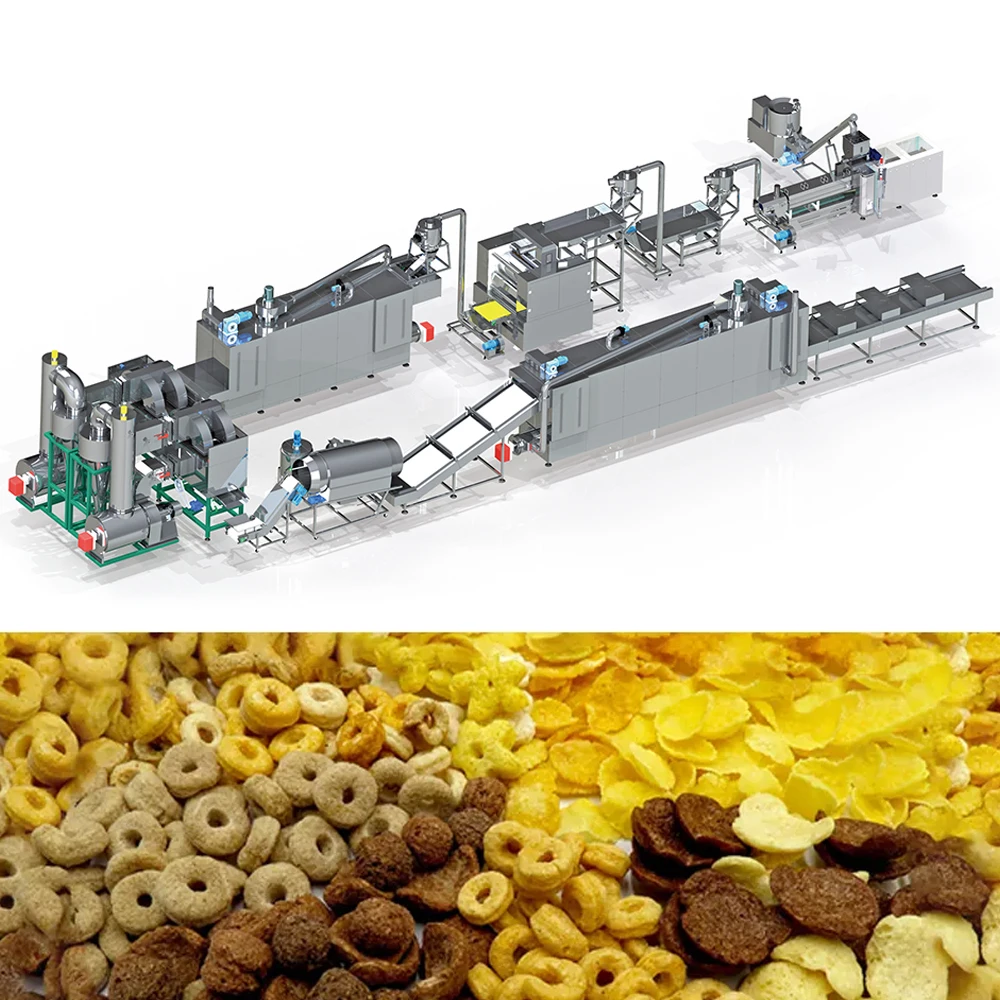
Integrated Line Throughput Matching — Every station from mixing to packing is sized against the extruder’s actual output on your grain formulation, preventing the dryer or flaker from becoming a bottleneck.
Technical Specifications
| Parameter | Value |
|---|---|
| Model | MT70 / MT85 / MT75 |
| Product Type | Corn Flakes Breakfast Cereal Production Line |
| Extruder Type | Twin Screw (MT-75) |
| Installed Power | 160 kW (MT70); 190 kW (MT85); 210 kW (MT75) |
| Power Consumption | 120 kW (MT70); 140 kW (MT85); 150 kW (MT75) |
| Output Capacity | 150–200 kg/h (MT70, basis to be confirmed); 300–400 kg/h (MT85, basis to be confirmed); 300–500 kg/h (MT75, basis to be confirmed) |
| Extruder Capacity | 200–300 kg/h (MT-75, basis to be confirmed) |
| Flaking Machinery Capacity | 200–300 kg/h (basis to be confirmed) |
| Overall Dimensions (L×W×H) | 41 × 1.5 × 2.2 m (MT70); 43 × 1.5 × 3.2 m (MT85); 45 × 1.5 × 3.5 m (MT75) |
| Dryer Heating Source | Gas / Electric |
| Flaking Machinery Drive | Double motors for separate roller driving, hydraulic system |
| Flaking Control | PLC with infrared sensor temperature control |
| Roasting Oven | Hot air with dual circulating fans, cyclone dust removal |
| Coating System | Double tumble sugar melter, elevator, coating drum, spraying nozzle |
| Control System | PLC (flaking confirmed); line-wide PLC/MCC available |
| Screw Feature | Automatic lubricating, cooling function, wear-resistant material |
| Line Stations | Mixing → Extrusion → Molding/Cutting → Drying → Flaking → Hot Air Roasting → Sugar Coating → Cooling → Packing |
| Warranty | 24 months, lifetime service |
Application Suitability
| Application | Material or Output |
|---|---|
| Natural corn flakes | Corn grits, maize flour |
| Sugar-coated corn flakes | Corn grits with sugar syrup coating |
| Chocolate-coated breakfast cereal | Extruded cereal pieces with chocolate enrobing |
| Puffed cereal snack shapes | Various grain formulations via die change |
| Fortified breakfast cereal | Grain blends with added vitamin and mineral premix |
Why "Rated Capacity" Means Nothing Without the Rest of the Line
A corn flakes breakfast cereal production line full equipment range only delivers its rated output when every station — extruder, dryer, flaker, roaster, and coater — is balanced to the same throughput on your specific grain blend.
I once watched a line in Mexico stall within the first hour of commissioning. The extruder was pushing out corn grits pellets at full speed, but the flaking rollers could not keep pace. Half-cooked pellets piled up on the conveyor while the roasting oven sat idle downstream, burning gas for nothing. The buyer had compared extruder capacity figures across quotes without ever asking whether the flaker and oven matched. That gap between a single-machine spec sheet and a coordinated line is where most cereal projects fail. The corn flakes breakfast cereal production line full equipment range exists to close that gap. [NEED_CITE: throughput matching methodology for cereal processing lines]
How Each Station Shapes the Final Flake
Understanding the sequence is critical when surveying a corn flakes breakfast cereal production line full equipment range. The twin-screw extruder gelatinises the starch in corn grits under controlled moisture and barrel temperature, producing a dense, half-cooked pellet. That pellet must then be dried to a precise moisture window before the flaking rollers compress it into a thin, uniform flake. If the dryer removes too little moisture, the flake tears. Too much, and it shatters into fines that never reach the roasting oven. Each station’s throughput and parameter range must be specified together, not sourced from separate vendors who assume the other party will handle the mismatch.
The Flaking and Roasting Interface That Determines Crispness
After flaking, the thin corn flakes enter the hot air roasting oven where surface bubbling and final crispness develop. The oven’s dual circulating fans and conciliation burner create a uniform temperature profile across the vibrating pan, while the cyclone dust removal device captures fine particulates before they scorch. The flaking station’s PLC-controlled hydraulic double-roller system and infrared sensor maintain even flake thickness, which directly controls how each flake responds to roasting heat. A thicker flake needs more residence time; a thinner one burns at the edges before the centre crisps. This is the interface where most generic line builds break down because the flaker and oven were specified independently. [NEED_CITE: starch gelatinisation and flake thickness interaction in cereal roasting]
What the Power and Dimension Figures Actually Tell You
The installed power spread across the three models — 160 kW, 190 kW, and 210 kW — reflects the progressive addition of roasting and coating capacity as throughput rises, not simply a larger extruder motor. The overall line length of 41 to 45 metres means you need a clear, unobstructed floor run with adequate ceiling height, especially for the MT85 and MT75 where the roasting oven and cooling conveyor reach 3.2 and 3.5 metres respectively. The twin-screw extruder’s automatic lubricating and cooling function reduces unplanned stops during long production runs, while the wear-resistant screw material extends intervals between barrel and screw element replacements. Gas or electric dryer heating options let you match local utility costs, which matters when the dryer runs continuously alongside the roasting oven.
When Stations Are Mismatched: The Hidden Costs
Buying an extruder with generous output and pairing it with a dryer or flaker from a different supplier often creates a line where one station idles while another overloads. The result is not just lower throughput — it is inconsistent flake density, uneven roasting, and coating that clumps because the flakes arrived at the sugar drum at varying temperatures. Operators spend shifts adjusting rather than producing, and wear parts like screws and dies degrade faster under the stop-start cycling that mismatched stations force on the extruder. Buyers who skip the throughput calculation before ordering frequently discover these problems only after installation, when reconfiguring the line means replacing entire stations. [NEED_CITE: impact of station mismatch on cereal line downtime and wear]
Why Source Every Station From One Equipment Catalogue
Having every station — mixing, extrusion, drying, flaking, roasting, coating, cooling, and packing — available in a single corn flakes breakfast cereal production line full equipment range means throughput is calculated across the entire sequence before any machine is built. Screw configuration and die design are matched to your grain formulation, not copied from a generic template. The in-house testing workshop runs trial production on your actual raw material before shipment, so flake thickness, roasting colour, and coating coverage are verified in advance. Electrical schematics, voltage, and control language are confirmed for your target market during the specification phase, not discovered as a surprise on commissioning day. Pre-sales consultation covers line layout and utility planning, and on-site installation includes operator training on every station.
Documentation & Verification
- Line layout drawing with capacity calculation across all stations from mixing to packing
- Machine specification sheet with screw and die configuration matched to your corn grits
- Electrical schematic confirming voltage, frequency, and control language for your market
- Trial run report produced on your raw material before the line leaves the factory
- CE declaration of conformity and ISO certificate for the complete line
- Wear parts list covering screws, dies, flaking roller surfaces, and oven components
Installation, Commissioning & Support
- Floor plan review for the 41–45 m line length and 3.5 m maximum height clearance requirement
- Dedicated power circuit sized to 160–210 kW installed capacity depending on model selected
- Gas supply connection specified for dryer and roasting oven when gas heating is chosen
- First-run parameter setting on your corn grits formulation, including extruder barrel temperatures and flaker roller gap
- Operator training covering PLC interface, hydraulic roller adjustment, and roasting oven fan balance
- Wear parts stock recommendation based on screw, die, and roller service intervals for your production schedule
What to Include With Your Enquiry
To configure a corn flakes breakfast cereal production line full equipment range that actually matches your output target, share your corn grits specification including particle size and moisture content, your daily production goal in finished flake weight, and whether you need sugar-coated, chocolate-coated, or natural product variants. Provide your facility’s available floor length, ceiling height, and local voltage and frequency standard so the electrical and layout design starts from accurate inputs.
Frequently Asked Questions
Q: What capacity models are available and how do they map to different production targets?
A: The line is offered in three models — MT70, MT85, and MT75 — covering a range of throughput levels. The MT70 suits smaller operations or pilot-scale cereal production, while the MT85 and MT75 serve medium to larger output requirements. Actual capacity depends on your raw material, moisture content, and whether you produce natural or sugar-coated flakes, so a throughput calculation based on your specific formulation is recommended before model selection.
Q: Which heating source options are available for the dryer and roasting oven?
A: Both gas and electric heating are available for the dryer, and the roasting oven uses hot air with a conciliation burner and dual circulating fans. The choice between gas and electric typically depends on local utility costs and availability. Gas heating is common in regions with inexpensive natural gas infrastructure, while electric heating suits facilities where gas supply is limited or where emission regulations restrict on-site combustion.
Q: How does the flaking station’s hydraulic roller system and PLC control affect flake consistency?
A: The flaking machinery uses a hydraulic system for double rollers with separate motors driving each roller independently. The PLC controls roller gap pressure, and an infrared sensor monitors temperature across the roller surface. This combination maintains even flake thickness across the full roller width, which directly affects how uniformly the flakes roast and how consistently they absorb sugar or chocolate coating downstream.
Q: Can individual stations be purchased separately, or is the line only offered as a complete package?
A: Individual stations — extruder, dryer, flaker, roasting oven, coating system — are available from the same equipment catalogue and can be specified separately. However, throughput matching between stations is calculated as part of the line configuration process, so purchasing individual machines without that calculation risks creating bottlenecks or idle capacity at certain points in the sequence.
Q: What utility requirements does each station need for installation planning?
A: The full line requires a dedicated electrical circuit sized to the selected model’s installed power, gas supply piping if gas heating is chosen for the dryer and oven, compressed air for pneumatic actuators in the coating and packing stations, and water supply for the extruder’s screw cooling system. Exact utility specifications are provided in the electrical schematic and line layout documentation after your model and configuration are confirmed.