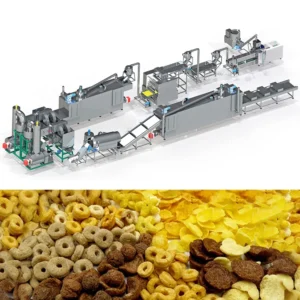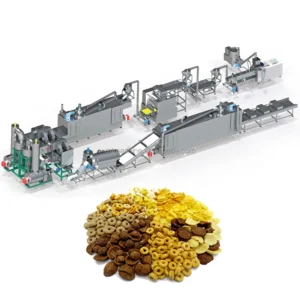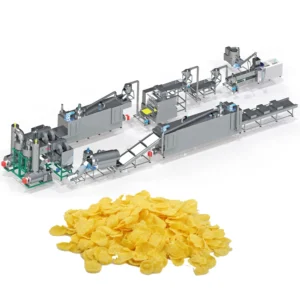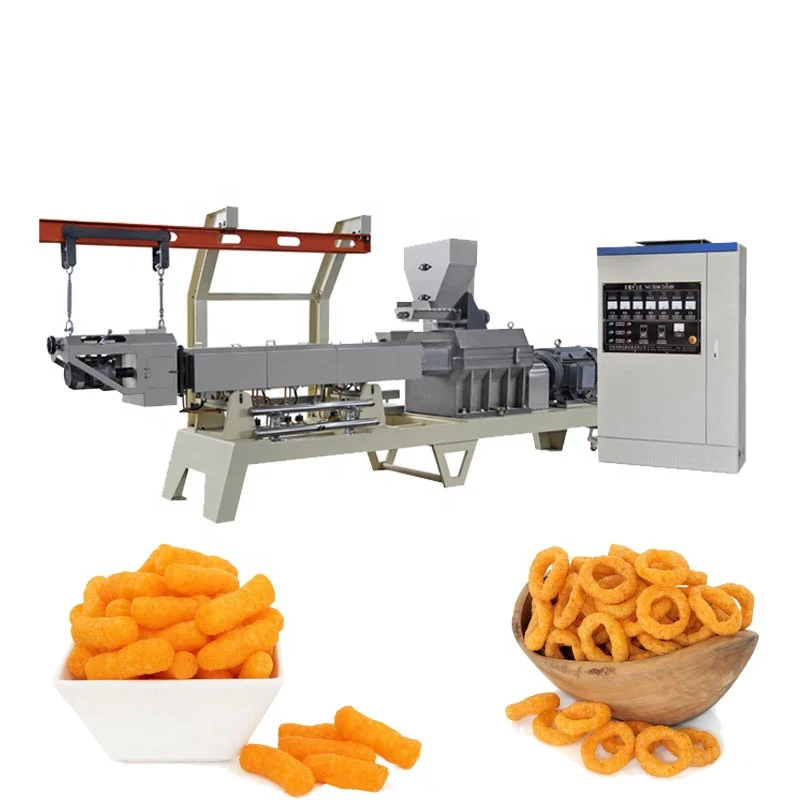
Balanced Line Throughput — Every station from the mixer to the sugar coater is specified as a matched set, so extruder output never waits on an undersized dryer or flaker.
Technical Specifications
| Parameter | Value |
|---|---|
| Product Type | Corn Flakes Breakfast Cereal Production Line |
| Model Options | MT70 / MT85 / MT75 |
| Screw Type | Twin Screw |
| Installed Power (MT70 / MT85 / MT75) | 160 kW / 190 kW / 210 kW |
| Power Consumption (MT70 / MT85 / MT75) | 120 kW / 140 kW / 150 kW |
| Capacity (MT70 / MT85 / MT75) | 150–200 kg/h / 300–400 kg/h / 300–500 kg/h (basis not stated in source) |
| Overall Dimensions (MT70 / MT85 / MT75) | 41 × 1.5 × 2.2 m / 43 × 1.5 × 3.2 m / 45 × 1.5 × 3.5 m |
| Control System | PLC |
| Dryer Heating Source | Gas or Electric |
| Flaking Machinery Drive | Double Motors for separate roller driving |
| Flaking Roller Pressure | Hydraulic system |
| Hot Air Roasting Oven | Conciliation burner, dual circulating fans, cyclone dust removal |
| Coating System | Double tumble melter, elevator, coating drum, spraying nozzle |
| Certification | CE |
Application Suitability
| Application | Material or Output |
|---|---|
| Natural corn flakes production | Corn, rice, wheat, oat, barley powder blends |
| Sugar-coated breakfast cereals | Extruded flakes with sugar or honey glaze |
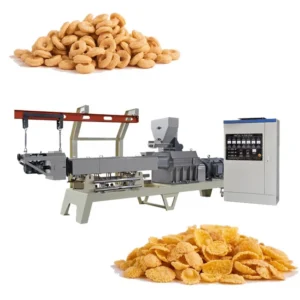
| Puffed cereal snack shapes | Rings, balls, tubes, sticks, stars, fruit loops, wheels, flowers, hearts via interchangeable die moulds |
| Fortified breakfast cereal lines | Multi-grain formulations with added nutritional premixes |
| Instant porridge base material | Pre-gelatinised grain granules from twin-screw extrusion |
What "Rated Capacity" Doesn’t Tell You About Corn Flake Lines
A quoted throughput figure means nothing until the raw material formulation and moisture content are locked in.
When sourcing a corn flakes machine full equipment range, buyers often compare lines on a single kg/h number. But twin-screw extrusion behaviour shifts dramatically between pure corn grits and a multi-grain blend with higher fibre or protein content — the same extruder may hold its rated output on one recipe and struggle on another. I have watched trial runs where switching from standard corn flour to a whole-wheat premix dropped expansion noticeably and left flakes too dense for the downstream roaster. [NEED_CITE: effect of fibre content on extrusion expansion ratio]
Station-by-Station Equipment Survey
This corn flakes machine full equipment range covers every processing stage under one specification umbrella. The line begins with a mixing and batching system that feeds the twin-screw extruder, where starch gelatinisation and moisture conditioning take place under controlled barrel temperatures. From extrusion, the material moves through the flaking machinery, which presses the cooked granules between hydraulically loaded rollers to form uniform flakes before drying.
Each station is selected so its throughput window overlaps the extruder output band. The dryer, hot-air roasting oven, and coating drum are all scaled to the same material flow, preventing the common bottleneck where one undersized machine forces the entire line to idle.
Matching the Dryer and Roaster to Extruder Output
Flake moisture leaving the extruder and flaker is high enough that drying must happen in a continuous pass before the product can be roasted without sticking. The dryer in this corn flakes machine full equipment range offers gas or electric heating, chosen based on local utility costs and available fuel infrastructure. After drying, the hot-air roasting oven uses a conciliation burner and two separate circulating fans with cyclone dust removal to raise surface temperature evenly, creating the characteristic blistered bubbles on each flake. [NEED_CITE: cereal roasting temperature profiles for surface blistering]
If the roaster is too short or its fan capacity too low, flakes exit with uneven colour and a soft centre instead of the crisp bite the market expects. That is why roaster length and airflow are specified relative to the extruder model, not picked from a generic catalogue.
Reading the Specification Sheet for Extrusion Decisions
Twin-screw extrusion is chosen here over single-screw because multi-grain blends — corn, rice, wheat, oat, barley — vary in particle size, fat content, and fibre level. Twin screws handle that variation with more consistent conveyance and mixing inside the barrel. The screw configuration and die design are adjusted to the buyer’s actual formulation, which determines residence time, shear intensity, and the degree of starch gelatinisation.
Installed power ranges from 160 kW to 210 kW across the MT70, MT85, and MT75 models, reflecting the increasing barrel volume and motor load required at higher throughputs. The PLC control system allows operators to store recipes for different cereal formulations, keeping barrel temperature zones, screw speed, and feed rate repeatable across production runs. The flaking machinery adds another layer of control: hydraulic double rollers driven by independent motors with infrared-sensor temperature regulation ensure that roller gap and surface heat stay consistent, which directly governs flake thickness and surface finish.
The Hidden Cost of Unmatched Stations
Buyers who assemble a line from separate vendors often discover the mismatch during commissioning. An extruder running at full output feeds a dryer that cannot remove moisture fast enough, so flakes arrive at the roaster sticky and clumped. The roaster then has to slow down, which backs up the entire line. [NEED_CITE: throughput bottleneck causes in cereal processing lines] In other cases, the sugar coating drum is sized for a lower throughput, and coated flakes pile up on the conveyor waiting for coating cycles, leading to uneven glaze coverage and product waste. These problems are expensive to fix once the equipment is bolted to the floor.
Why Source the Full Range Here
Complete line configuration under one supplier means throughput calculations are done station by station against your target recipe, not copied from a generic layout. Screw and die configurations are specified to your raw material before the extruder is assembled. An in-house testing workshop allows trial runs on your actual formulation — not just standard corn flour — so expansion, flake density, and roaster behaviour are verified before shipment.
Documentation covers line layout, capacity calculations, electrical schematics, and voltage confirmation matched to your site conditions. On-site installation and commissioning include operator training, and wear parts lists are provided so screw segments and die plates are available when first replacement is due.
Documentation & Verification
- Line layout drawing with station-by-station throughput matched to your cereal formulation
- Screw and die configuration record specific to your grain blend and target flake density
- Electrical schematic with voltage, frequency, and PLC language confirmed for your facility
- Trial run report on your actual raw material conducted in the testing workshop
- Factory test record documenting run parameters before crating and dispatch
- CE declaration of conformity and ISO certificate included with shipment documentation
Installation, Commissioning & Support
- Floor plan review to confirm the MT70/MT85/MT75 line footprint fits your available bay length and ceiling height
- Dedicated power circuit sized to the model’s installed power rating of 160–210 kW with voltage and frequency verified
- Extruder barrel and screw segments shipped disassembled, reassembled on-site with alignment checked against the flaking mill
- PLC control language and HMI labels configured to your operator language before commissioning begins
- First production run supervised on your raw material to validate flake thickness, roast colour, and coating uniformity
- Wear parts inventory including spare screw elements, die plates, and flaking roller covers reviewed during training
Preparing Your Inquiry
To specify the right configuration, share your raw material formulation — including grain types, particle size, and any added fibre or protein — along with the target flake shape and whether you need natural or sugar-coated output. Provide your local voltage, frequency, and preferred PLC language, plus available floor space and ceiling clearance so the line layout can be drafted to fit.
Frequently Asked Questions
Q: How is each station’s capacity matched to the extruder so no single machine bottlenecks the line?
A: Every station — dryer, flaker, roaster, coater — is selected with a throughput window that overlaps the extruder’s output range for your specific formulation. Capacity calculations are documented in the line layout proposal, and adjustments are made during the trial run to confirm material flow stays balanced end to end.
Q: What voltage, frequency, and PLC language options are available for each station?
A: Voltage and frequency are confirmed during the specification stage to match your local grid, and the PLC interface can be configured to your preferred operator language. Electrical schematics are provided for review before production begins so any discrepancies are caught early.
Q: Can individual stations like the flaker or coating drum be purchased separately?
A: Individual stations can be supplied, but throughput and interface compatibility with your existing equipment must be verified first. We review your current line speed, conveyor heights, and control signals to ensure the standalone machine integrates without creating a bottleneck or control mismatch.
Q: What die mould shapes are available and how does changing the mould affect downstream settings?
A: Die moulds produce shapes including rings, balls, tubes, sticks, stars, fruit loops, and wheels. Each shape changes the material density and surface area leaving the extruder, which means dryer retention time and roaster temperature may need adjustment. These parameter shifts are documented during the trial run.
Q: What is the footprint requirement and can the layout be customised to an existing factory?
A: Overall dimensions range from 41 to 45 metres in length depending on the model. The line layout is drafted to your floor plan, with station positions adjusted for column spacing, utility drop points, and material flow direction to fit within your existing building envelope.