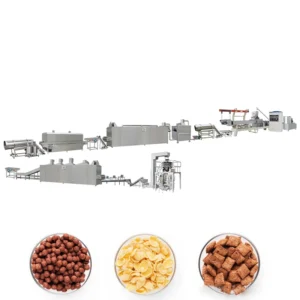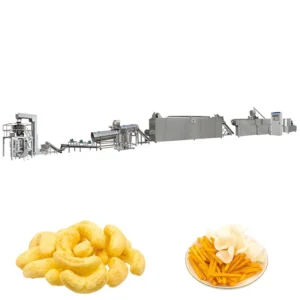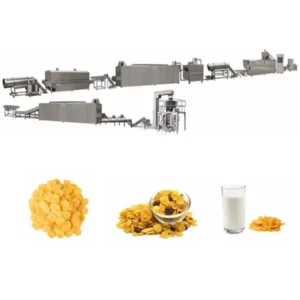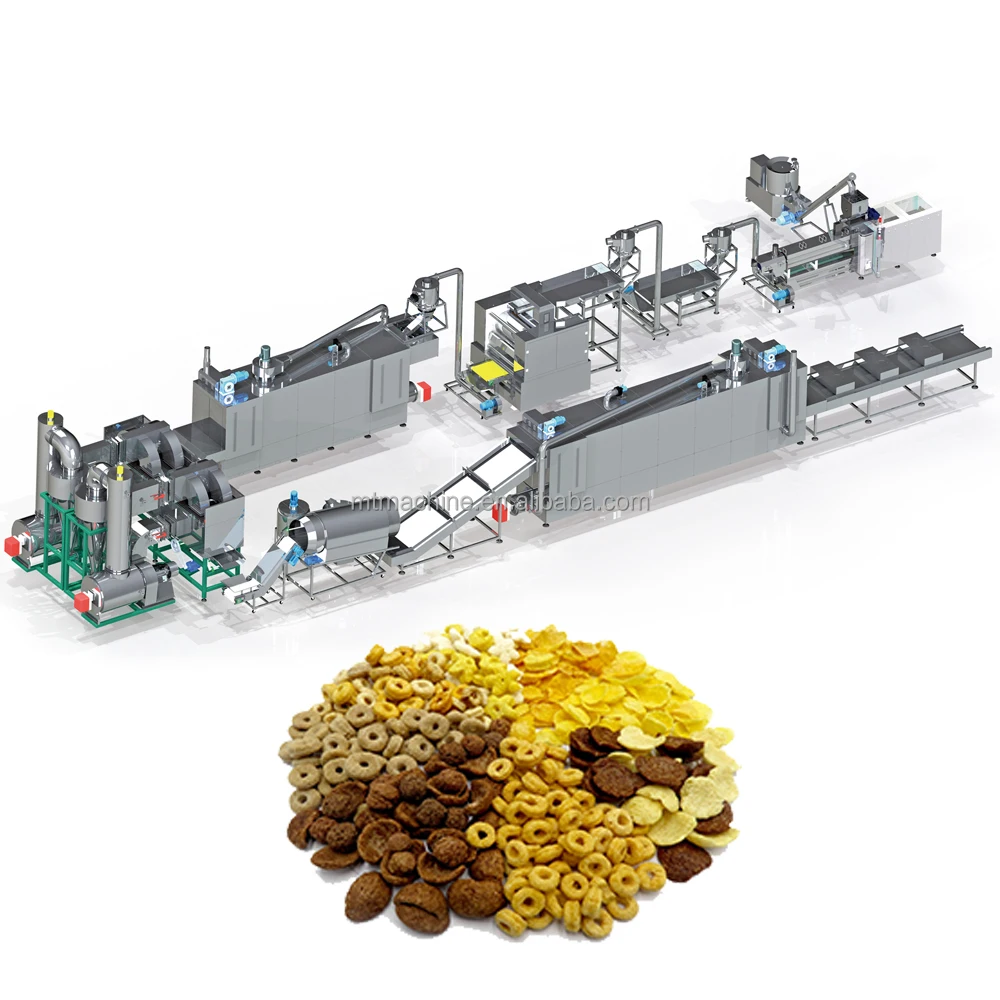
Matched Throughput Across Stations — Every mixer, extruder, flaker, dryer, roaster and coater in a Meiteng corn flakes line is sized to the same output target so no single unit chokes the flow.
Technical Specifications
| Parameter | Value |
|---|---|
| Product Type | Corn Flakes Breakfast Cereal Production Line |
| Models Available | MT70 / MT85 / MT75 |
| Screw Type | Twin Screw |
| Installed Power | 160 kW (MT70); 190 kW (MT85); 210 kW (MT75) |
| Power Consumption | 120 kW (MT70); 140 kW (MT85); 150 kW (MT75) |
| Output Capacity | 150-200 kg/h (MT70); 300-400 kg/h (MT85); 300-500 kg/h (MT75) (basis to be confirmed) |
| Overall Dimensions | 41 × 1.5 × 2.2 m (MT70); 43 × 1.5 × 3.2 m (MT85); 45 × 1.5 × 3.5 m (MT75) |
| Control System | PLC for flaking machinery; MCC line control |
| Heating Source for Dryer | Gas or Electric |
| Flaking Machinery Drive | Double motors for separate roller driving; hydraulic system for double rollers |
| Flaking Temperature Control | Infrared sensor |
| Roasting Oven | Hot air circulating with two separate fans, cyclone dust removal, conciliation burner |
| Coating System | Double tumble sugar melter, elevator, coating drum, spraying nozzle |
| Basic Materials Processed | Corn, rice, wheat, oat, barley powder |
| Key Features | Automatic lubricating and cooling on extruder; wear-resistant screw process; CE declared; ISO declared |
Application Suitability
| Application | Material or Output |
|---|---|
| Natural corn flakes for breakfast cereal retail | Corn grits, corn flour blends |
| Sugar-coated corn flakes for breakfast cereal retail | Corn, rice or wheat base with sugar or syrup coating |
| Extruded cereal shapes from the same platform | Ball, tube, stick, ring, fruit loop, star, wheel, flower, heart shapes via die adjustment |
| Multigrain breakfast flakes | Oat, barley and wheat powder blends |
| Puffed cereal snack diversification | Rice and corn blends shaped through interchangeable dies |
Why Matching Every Station Matters More Than the Extruder Nameplate
A line is only as fast as its slowest downstream unit.
I once watched a breakfast cereal producer run a twin-screw extruder at full capacity while the rotary dryer downstream could not keep up, leaving wet flakes piling on the cooling belt. The extruder was technically capable, but the dryer was undersized for the moisture load that the recipe produced. That mismatch turned a nominally high-output line into a bottlenecked, stop-and-start operation. When sourcing a breakfast cereal corn flakes machine full equipment range, the real question is whether the dryer, roaster and coating drum have been calculated against the same throughput and moisture premise as the extruder. [NEED_CITE: typical moisture removal requirements in flaked cereal drying]
How the Extruder Feeds the Rest of the Line
The twin-screw extruder sits at the centre of the breakfast cereal corn flakes machine full equipment range, cooking and shaping the dough before it reaches the flaking rolls. Automatic lubricating and cooling functions on the extruder keep barrel temperatures stable across long production runs, which is critical because any temperature drift at this stage changes the gelatinisation degree and, in turn, the flake thickness downstream. Screw elements built with a wear-resistant process extend service intervals so the line does not lose output to unplanned screw changes.
Flaking and Drying as a Paired System
The hydraulic double-roller flaking machinery uses independent motors for each roller and an infrared sensor for temperature regulation. This means roll gap and surface temperature can be adjusted separately, giving the operator control over flake density and surface finish. After flaking, the dryer must remove a specific amount of moisture per kilogram of product; if the dryer capacity was sized on a different moisture premise than what the extruder actually delivers, the line stalls. Gas or electric heating options allow the dryer to match the utility infrastructure available at the installation site.
Reading the Specs That Shape Daily Output
Installed power figures of 160 kW to 210 kW across the MT70, MT85 and MT75 models reflect different motor and heater configurations, not simply bigger machines. Power consumption values run lower than installed power because heaters cycle and motors do not draw peak load continuously. Overall dimensions stretching beyond 40 metres in length account for every station in sequence — mixing, extruding, flaking, drying, hot-air roasting, cooling and packing — and this footprint must fit within the buyer’s hall height and column spacing. The PLC governing the flaking machinery coordinates roller pressure and speed, while the MCC handles start-stop sequencing for the entire line, so operators manage two separate control layers rather than one overloaded interface.
What Happens When Downstream Capacity Is an Afterthought
When a sugar-coating drum is added to a line without recalculating the upstream dryer output, the coating drum either runs half-empty or the drying stage before coating leaves flakes too moist for proper sugar adhesion. Producers then face cracked coatings, uneven gloss and product that fails shelf-life tests. Similarly, if the hot-air roasting oven with its two circulating fans and cyclone dust removal is not matched to the dryer discharge rate, flakes spend too little or too long in the roasting zone, producing off-colour batches. [NEED_CITE: cereal roasting temperature profiles and colour development]
Why Buyers Source the Full Range From One Supplier
Every station on a Meiteng line is specified against the same raw material and throughput premise, so the mixer batch size aligns with extruder feed rate, flaker capacity matches extruder discharge, and the roaster volume corresponds to dryer output. The in-house testing workshop runs trial production on the buyer’s actual recipe before the line ships, which means screw configuration, die selection and dryer temperature profiles are validated on real material rather than assumed from a generic build. Electrical schematics and voltage confirmation are locked to the destination market before fabrication starts. Twin-screw expertise spans pet food, aquatic feed, snacks and cereals, so the screw and die configuration for a corn flakes recipe is drawn from a wide application library rather than a single template. Pre-sales engineering through on-site installation, commissioning and operator training keeps the same technical team involved across every phase.
Documentation & Verification
- Line layout and capacity calculation showing matched throughput at every station for your target output
- Machine specification sheet with screw and die configuration record matched to your raw material
- Electrical schematic with voltage and frequency confirmed for your local grid standard
- Trial run report produced on your actual recipe in the testing workshop before shipment
- CE declaration of conformity and ISO certificate for customs and regulatory filing
- Operation and maintenance manual with wear parts list specific to your line configuration
Installation, Commissioning & Support
- Foundation plan accounts for the 41 to 45 metre line length and individual station weights
- Dedicated power circuits sized to 120-150 kW continuous draw depending on model selected
- Stations ship in modular sections for reassembly inside existing factory door clearances
- First-run parameter setting covers barrel temperature zones, roller gap and roaster fan balance
- Operator training includes PLC interface navigation for the flaking machinery and MCC line sequencing
- Wear parts inventory covers spare screw elements, dies and flaking roller surfaces for initial replacements
What to Share When Requesting a Quotation
To size the breakfast cereal corn flakes machine full equipment range correctly, start with the exact raw material composition and moisture content you plan to run, along with the target hourly output and whether you need natural flakes, sugar-coated flakes or both. Include your workshop length, width and clear height so the layout can be drawn around existing columns and doors. Confirm the local voltage, frequency and preferred control language so electrical panels and PLC screens are configured before dispatch.
Frequently Asked Questions
Q: How is output capacity verified before the line ships?
A: Capacity figures listed for each model are reference values that depend on raw material type, moisture content and flake thickness target. We run a trial in the testing workshop using your actual recipe and measure real throughput at the packing station, then document the result in a trial run report that accompanies the shipment.
Q: What voltage, frequency and control language options are available?
A: Electrical panels and PLC screens are configured to match the destination market before fabrication. Buyers confirm voltage, frequency and preferred HMI language during the specification stage so the MCC and flaking PLC display the correct parameters and labels from day one. [NEED_CITE: voltage and frequency standards by export market]
Q: How are dryer, roaster and coating drum sizes matched to the extruder?
A: Each downstream station is calculated from the extruder discharge rate and the moisture or coating load that the specific recipe requires. The dryer thermal capacity, roasting oven fan volume and coating drum residence time are all derived from the same throughput premise so no station becomes a bottleneck.
Q: Which die configurations produce which cereal shapes?
A: The twin-screw extruder accepts interchangeable dies that form shapes including ball, tube, stick, ring, fruit loop, star, wheel, flower and heart profiles. Die changes involve releasing the die plate, swapping the insert and resetting the cutter, and the screw configuration record documents which screw profile pairs with each die for consistent results.
Q: What spare wear parts ship with the line?
A: The wear parts list included with your documentation specifies spare screw elements, dies and flaking roller surfaces matched to your line model. Replacement parts are manufactured at the same facility, so reordering uses the configuration record from your original build rather than generic part numbers.