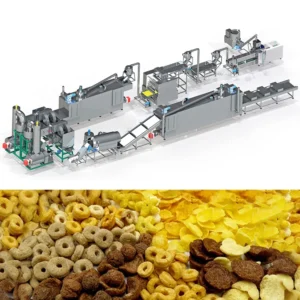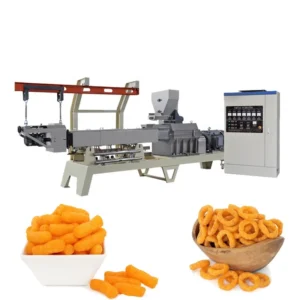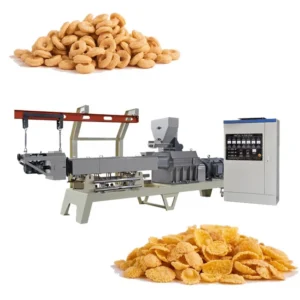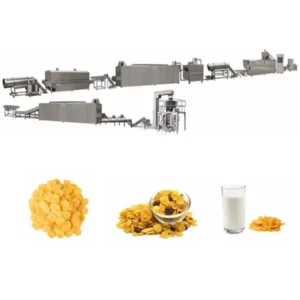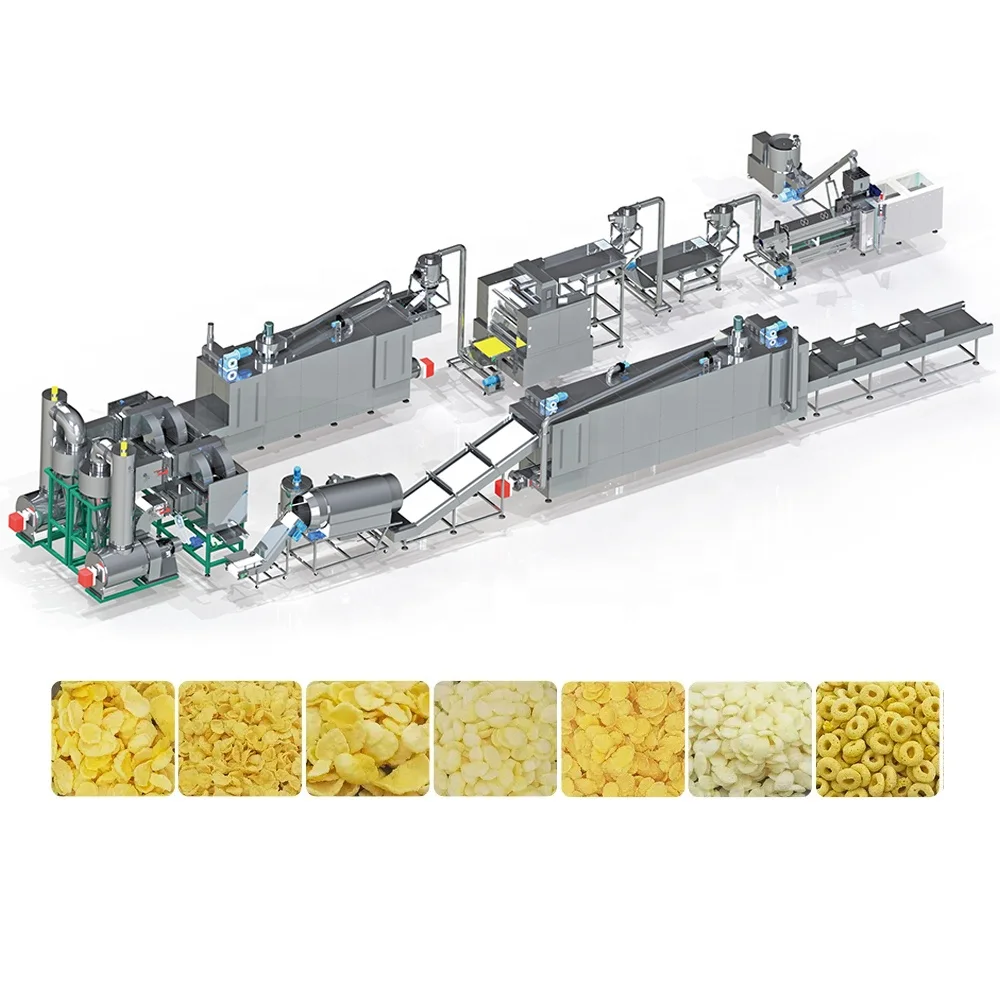
Hydraulic Flaking Precision — A PLC-controlled flaking machine with infrared sensor temperature management ensures uniform sheet thickness, preventing the roller sticking and low yield rates common in high-sugar breakfast cereal recipes.
Technical Specifications
| Parameter | Value |
|---|---|
| Product Type | Corn Flakes Breakfast Cereal Production Line |
| Model | MT70 / MT85 / MT75 |
| MT70 Installed Power | 160 kW |
| MT85 Installed Power | 190 kW |
| MT75 Installed Power | 210 kW |
| MT70 Power Consumption | 120 kW |
| MT85 Power Consumption | 140 kW |
| MT75 Power Consumption | 150 kW |
| Extruder Type | Twin-screw (MT-75 detailed) |
| Extruder MT75 Capacity | 200–300 kg/h (basis to be confirmed) |
| Flaking Machine Capacity | 200–300 kg/h (basis to be confirmed) |
| Flaking Control System | PLC |
| Flaking Roller Drive | Hydraulic system with double independent motors |
| Flaking Temperature Control | Infrared sensor for even temperature pipe control |
| Dryer Heating Source | Gas or Electric |
| Hot Air Roasting Oven | Vibrating pan, conciliation burner, dual circulating fans |
| Raw Materials | Corn, rice, wheat, oat, barley powder |
| Overall Dimensions (MT75) | 45 × 1.5 × 3.5 m |
Application Suitability
| Application | Material or Output |
|---|---|
| Natural Corn Flakes Production | Standard corn grits at controlled moisture |
| Sugar-Coated Cereal Processing | High-maltose syrup or honey coatings |
| Multi-Grain Flakes | Rice, wheat, oat, and barley powder blends |
| Shaped Cereal Snacks | Balls, tubes, rings, stars, fruit loops |
| Fortified Breakfast Cereals | Vitamin-enriched raw material blends |
Why Matching Station Capacity Is More Important Than Extruder Output Alone
A corn flakes line only produces at the speed of its slowest station, and mismatched downstream equipment is the most frequent cause of lost capacity.
I once stood in a workshop where a 300 kg/h extruder was paired with a flaking machine that could only handle 200 kg/h on the customer’s actual recipe. The result was a constant bottleneck, with operators manually reducing feed rates every twenty minutes to prevent the flaking rollers from jamming. The corn flakes breakfast cereal production line full equipment range solves this by sizing every station — from the batching system through the roasting oven — to the extruder’s real-world output on your specific raw material, not its theoretical maximum [NEED_CITE: industrial line throughput matching principles].
Station-by-Station Equipment Matching
The full equipment catalogue for this line includes mixing and batching systems, twin-screw extruders, hydraulic flaking machines, dryers, hot air roasting ovens, sugar coating drums, cooling conveyors, and packing stations. Each component is specified to match the throughput of the others, so the corn flakes breakfast cereal production line full equipment range operates as a single coordinated system rather than a collection of mismatched machines.
Temperature Control at the Flaking Stage
The flaking machine uses an infrared sensor to monitor and regulate the temperature pipe that pre-heats the pellets before they pass through the rollers. This is critical for high-sugar recipes where the material becomes sticky at certain temperatures. Without precise thermal management, the rollers accumulate residue, the sheet thickness becomes inconsistent, and the final corn flakes break into fragments rather than holding their shape through the roasting oven [NEED_CITE: cereal flaking temperature management].
Understanding the Specifications That Matter
The twin-screw extruder features automatic lubricating and cooling functions, which maintain stable barrel temperatures during extended production runs and extend screw life under continuous operation. The hydraulic double-roller system on the flaking machine, driven by two independent motors, allows for precise adjustment of the roller gap — a setting that directly determines whether the final flake is thin and crisp or thick and chewy. The hot air roasting oven uses a vibrating pan with a conciliation burner and dual circulating fans to create the surface bubbles and golden color that define a quality corn flake, while the cyclone dust removal device captures fines before they can contaminate the coating stage. These specifications translate directly to product consistency and operational uptime on the factory floor.
The Cost of Undersized Downstream Equipment
When a dryer or roasting oven cannot handle the extruder’s output, the entire line must be throttled back. Operators reduce feed rates, which changes the residence time in the extruder barrel, which in turn alters the starch gelatinization and expansion of the pellets. The corn flakes that reach the roasting oven are then inconsistent in moisture content, leading to uneven browning and a mix of over-roasted and under-roasted product in the same batch. This is not a problem that can be fixed by adjusting a single setting — it requires either replacing the undersized station or accepting permanent capacity loss [NEED_CITE: extrusion line bottleneck consequences].
What Sets This Equipment Range Apart
Every station in this catalogue is designed and manufactured under one supplier, which means the mechanical interfaces, control protocols, and throughput calculations are coordinated before the equipment leaves the factory. The in-house testing workshop allows trial runs on the customer’s actual raw material before shipment, so recipe adjustments happen in a controlled environment rather than during on-site commissioning. The PLC control system across the line enables consistent parameter recall between batches, and the screw and die configurations are specified to the buyer’s raw material rather than copied from a generic template. Documentation includes a line layout with capacity calculations that show how each station’s throughput relates to the others.
Documentation & Verification
- Line layout showing throughput calculations for every station in the corn flakes line
- Screw and die configuration record matched to your raw material blend
- Trial run report on your recipe conducted in the testing workshop before dispatch
- Electrical schematic with voltage and frequency confirmation for your target market
- Factory test record documenting actual output on your material
- Operation and maintenance manual with wear parts replacement schedules
Installation, Commissioning & Support
- MT75 requires a minimum 45-meter linear footprint with adequate clearance for maintenance access
- Power supply must support 210 kW installed capacity with dedicated circuit protection
- On-site assembly includes alignment verification of the hydraulic flaking rollers
- Commissioning covers PLC parameter setup for your specific raw material and recipe
- Operator training includes roller gap adjustment and infrared sensor calibration
- Spare screws, dies, and roller surfaces stocked with documented replacement intervals
- Preventive maintenance schedule tied to actual operating hours and output volume
Preparing Your Inquiry
To receive a configuration that matches your production requirements, specify the raw material composition including any sugar or maltose content, the target hourly output in kilograms, and the available factory floor dimensions. Include the local voltage and frequency standards, the preferred control language for the PLC interface, and whether the dryer heating source should be gas or electric based on your utility infrastructure. If you have existing upstream or downstream equipment that must integrate with this line, provide those specifications as well.
Frequently Asked Questions
Q: How is throughput matched between the extruder, flaking machine, dryer and coating drum so no station bottlenecks the line?
A: Each station’s capacity is calculated based on the extruder’s actual output on your raw material, not a generic rating. The line layout document shows the throughput calculation for every station, so you can verify that the flaking machine, dryer, roasting oven, and coating drum can all handle the extruder’s production rate without creating a bottleneck.
Q: What supporting stations are available to complete the full equipment range?
A: The catalogue includes mixing and batching systems, conveying equipment, dryers, flavouring drums, coating and seasoning lines, cooling conveyors, and packing stations. Each is sized to match the throughput of the core extrusion and flaking stations, ensuring consistent material flow from raw ingredient input through to final packaged product.
Q: Which extruder model fits my target capacity and factory footprint?
A: The MT70, MT85, and MT75 models cover different capacity ranges and physical dimensions. The MT70 has a 41-meter overall length, the MT85 extends to 43 meters, and the MT75 reaches 45 meters. Selection depends on your target output, available floor space, and the specific raw material characteristics that affect extrusion behavior.
Q: Can the dryer heating source be configured for gas or electric depending on local utility availability?
A: Yes, the dryer heating source is configurable between gas and electric based on your factory’s utility infrastructure. This decision affects the dryer’s thermal response time and operating cost structure, so it should be confirmed during the line configuration phase before equipment fabrication begins.
Q: What spare wear parts are stocked and how are they ordered after first replacement is due?
A: Wear parts including screws, dies, and flaking roller surfaces are documented in the spare parts list provided with the line. The operation manual specifies replacement intervals based on operating hours, and the parts list includes specifications so replacements can be ordered directly or sourced locally if preferred.