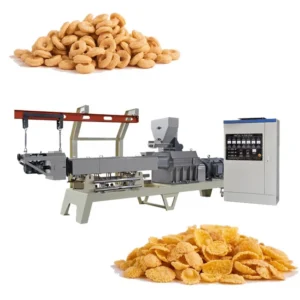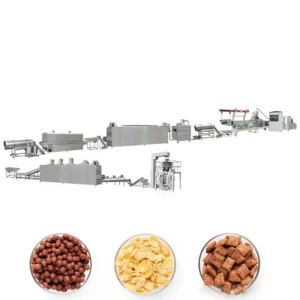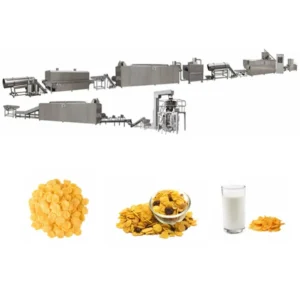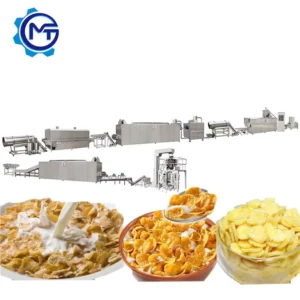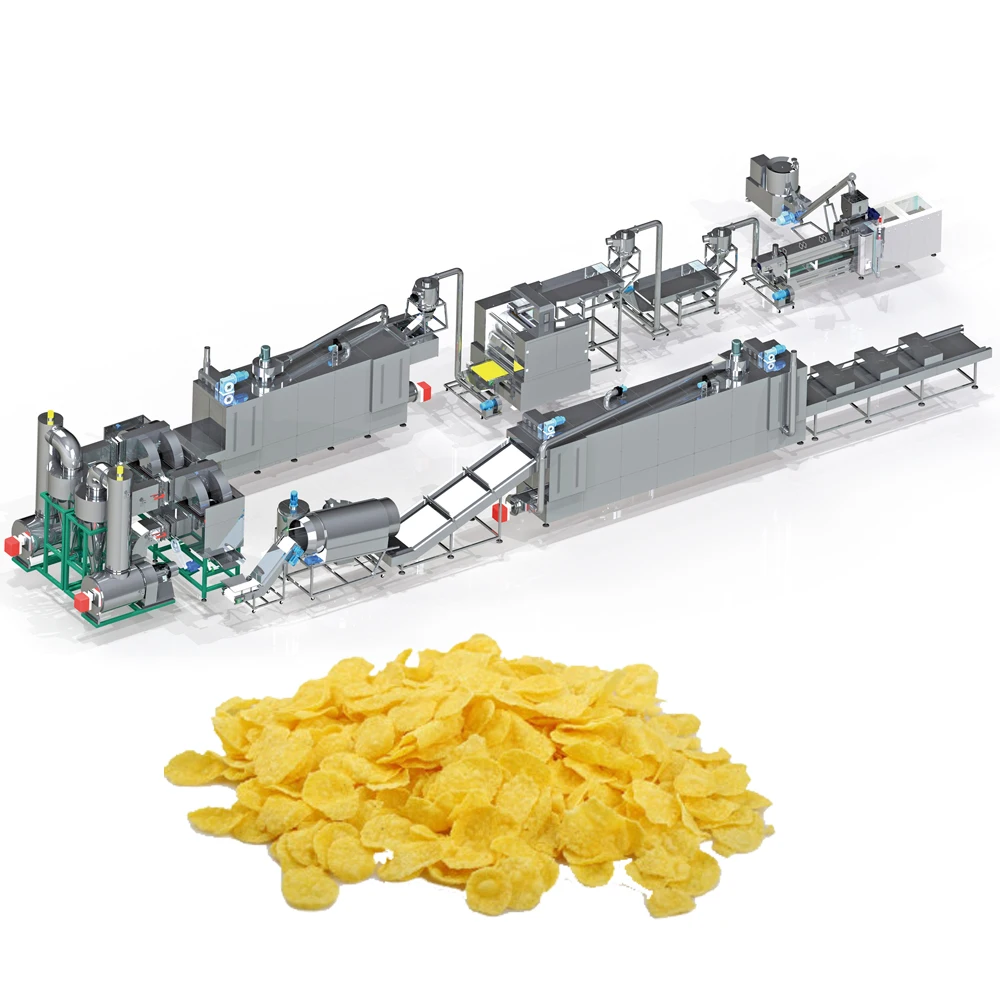
Integrated Line Engineering — every station from mixer to roasting oven is sized against the extruder’s real throughput, so a corn flakes production line equipment manufacturer delivers balanced output rather than isolated machine specs.
Technical Specifications
| Parameter | Value |
|---|---|
| Product Type | Corn Flakes Production Line |
| Available Models | MT70 / MT85 / MT75 |
| Installed Power | MT70: 160 kW · MT85: 190 kW · MT75: 210 kW |
| Power Consumption | MT70: 120 kW · MT85: 140 kW · MT75: 150 kW |
| Output Capacity | MT70: 150–200 kg/hr (basis to be confirmed) · MT85: 300–400 kg/hr (basis to be confirmed) · MT75: 300–500 kg/hr (basis to be confirmed) |
| Overall Dimensions (L×W×H) | MT70: 41 × 1.5 × 2.2 m · MT85: 43 × 1.5 × 3.2 m · MT75: 45 × 1.5 × 3.5 m |
| Extruder Screw Type | Twin-screw |
| Control System | PLC control on flaking machine; MCC & PLC available for full line |
| Dryer Heating Source | Gas or Electric |
| Flaking Mechanism | Hydraulic double-roller system with dual motors and infrared temperature sensor |
| Roasting Oven | Hot air circulation with dual fans, vibrating pan, cyclone dust removal |
| Coating System | Double tumble sugar melter, elevator, coating drum with spray nozzle |
| Line Sequence (Natural) | Mixing → Extruding → Flaking → Drying → Hot Air Roasting → Cooling → Packing |
| Line Sequence (Sugar-Coated) | Mixing → Extruding → Flaking → Drying → Roasting → Sugar Spraying → Coating → Drying → Cooling → Packing |
| Lubrication | Automatic lubricating and cooling on extruder |
| Certification | CE, ISO |
Application Suitability
| Application | Material or Output |
|---|---|
| Natural corn flakes for retail breakfast cereal | Corn grits and corn flour blends |
| Sugar-coated corn flakes for food service | Corn base with sugar glaze coating |
| Multi-grain breakfast flakes | Rice, wheat, oat, and barley powder blends |
| Shaped cereal pieces on shared line | Balls, tubes, rings, stars, and fruit loops from mixed cereal powders |
| Puffed snack production using shared equipment | Corn, rice, and grain-based snack formulations |
Why "Rated Capacity" Fails When Your Flour Blend Changes
Capacity is only real when verified on the buyer’s exact recipe, not on a generic test formula.
I have watched lines stall during commissioning because the extruder was benchmarked on standard corn grits while the buyer intended to run a multi-grain blend with higher fiber content. The starch gelatinisation window shifted, expansion dropped, and the flakes came off the roller too dense to toast properly. That mismatch rarely surfaces until raw material hits the hopper on-site, where adjustments cost weeks instead of hours [NEED_CITE: typical commissioning delays caused by raw material mismatch in extrusion lines].
A corn flakes production line equipment manufacturer that tests only with stock recipes leaves density, moisture, and residence time questions for the buyer to solve alone. The consequence is a flaking station that cannot keep pace or a roasting oven running well outside its designed thermal load.
Barrel Zones and Screw Geometry Define Flake Texture
Twin-screw extrusion gives operators independent control over shear intensity and residence time across multiple barrel zones. On a corn flakes line, the screw configuration must match the gelatinisation behaviour of the specific cereal blend. A high-amylose corn flour needs a different compression ratio and barrel temperature gradient than an oat-heavy mix. Getting this wrong means the dough sheet exiting the die lacks the elasticity required for clean flaking.
Flaking and Roasting Precision Determine Final Density
The hydraulic double-roller system on the flaking station applies uniform pressure across the dough sheet, while the infrared sensor monitors roller surface temperature to prevent sticking or premature drying. Downstream, the hot air roasting oven uses two separate circulating fans and high-temperature spraying tubes to toast flakes evenly. Cyclone dust removal keeps fines from recirculating into the product stream [NEED_CITE: food safety standards for particulate control in cereal roasting equipment]. This sequence locks in the crispness and bowl-life that retail buyers expect from corn flakes.
Reading the Spec Sheet Against Your Production Target
Installed power ratings across the MT70, MT85, and MT75 models range from 160 kW to 210 kW, with operating consumption proportionally lower. The gap between installed and consumed power reflects peak load headroom during start-up and recipe changeovers. Overall line length stretches from 41 m to 45 m depending on model, which directly affects workshop layout and utility routing. Twin-screw extrusion, combined with PLC-controlled flaking and MCC integration, ensures that speed adjustments at the extruder propagate through the dryer and roasting oven without manual recalibration at each station. Automatic lubrication and cooling on the extruder reduce unplanned stops during long production runs, keeping the thermal profile stable.
The Hidden Cost of Mismatched Station Throughput
When an extruder runs faster than the flaker can press, dough accumulates and cools before reaching the rollers, producing uneven sheets that shatter during roasting. When the roasting oven cannot handle the volume from the dryer, flakes sit in the conveyor and absorb ambient moisture, losing crispness before packing. These bottlenecks rarely appear in quoted specifications because each machine is rated in isolation [NEED_CITE: throughput balancing methodology in multi-station food processing lines]. Buyers end up running the entire corn flakes production line well below nameplate capacity just to maintain product quality.
What Makes This Supply Model Different
Every station — mixer, extruder, flaker, dryer, roasting oven, coating drum, cooler — is selected and matched under a single supplier, so throughput calculations account for real product transfer losses between stages. Screw and die configurations are specified against the buyer’s cereal blend and target flake density, not copied from a generic build. The in-house testing workshop runs the buyer’s actual raw material before shipment, generating a trial report that confirms capacity and texture. Electrical schematics are confirmed for local voltage and frequency before production begins, preventing commissioning delays. Twin-screw expertise spans corn, multi-grain, and shaped cereal formats, allowing the same line platform to produce rings, balls, and stars alongside traditional flakes.
Documentation & Verification
- Line layout drawing showing station throughput matching for your target output
- Trial run report using your cereal flour blend before dispatch
- Screw and die configuration record matched to your recipe
- Electrical schematic with voltage and frequency confirmed for your facility
- CE declaration of conformity and ISO certificate for customs clearance
- Operation and maintenance manual with wear parts list
Installation, Commissioning & Support
- Foundation plan based on MT70/MT85/MT75 overall dimensions and weight distribution
- Dedicated power circuit sized to installed power rating up to 210 kW
- Line arrives in modular sections for sequential assembly within your workshop footprint
- First-run parameter setting on your raw material with extruder screw and barrel temperature calibration
- Operator training covering PLC interface, hydraulic roller adjustment, and roasting oven fan balance
- Initial spare wear parts including screws, dies, and roller surfaces shipped with the line
- Scheduled maintenance intervals for automatic lubrication system and dryer heating elements
What We Need to Configure Your Line
Share your cereal flour composition, target flake thickness, and daily production volume so we can match extruder model and downstream station sizing. Confirm your workshop length and ceiling height to verify that the 41–45 m line footprint fits your facility. Provide local voltage, frequency, and preferred control language so electrical panels and PLC interfaces are configured before production begins.
Frequently Asked Questions
Q: How is line capacity verified on the buyer’s actual raw material before shipment?
A: The buyer sends a representative batch of their cereal flour blend to the in-house testing workshop. We run the complete extrusion-to-flaking sequence, record expansion ratio, flake density, and throughput, and issue a trial report. If adjustments to screw configuration or barrel temperature are needed, they are made and re-tested before the line is approved for shipment.
Q: How are extruder screw configuration and die design specified for different cereal blends?
A: Each cereal flour — corn, rice, wheat, oat, or blends — has a distinct starch gelatinisation temperature and expansion behaviour. We select screw element arrangement, compression ratio, and die geometry based on the buyer’s recipe and target flake density, then validate the build during the pre-shipment trial run.
Q: What voltage, frequency, and control language options are confirmed before production?
A: Electrical schematics are finalised after the buyer confirms local supply voltage and frequency. PLC and MCC interfaces are configured to the operator’s preferred language. This confirmation step occurs before production starts, so panels and wiring match the destination facility on arrival.
Q: How is throughput matched between extruder, flaker, dryer, and roasting oven?
A: Each station is selected based on the extruder’s verified output on the buyer’s raw material. The flaker roller speed, dryer belt length, and roasting oven residence time are calculated so no station accumulates backlog or starves the next stage, preventing bottlenecks that reduce effective line capacity.
Q: What spare wear parts are supplied with the initial shipment?
A: The initial shipment includes a documented wear parts list covering extruder screws, die plates, and flaking roller surfaces. Quantities are calculated to cover the first replacement cycle based on the expected production volume and the abrasiveness of the buyer’s cereal blend.