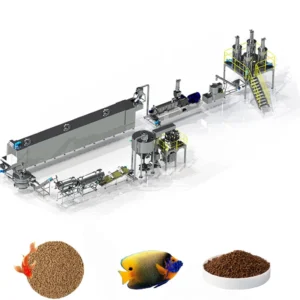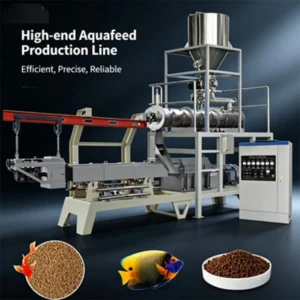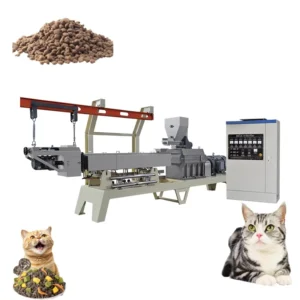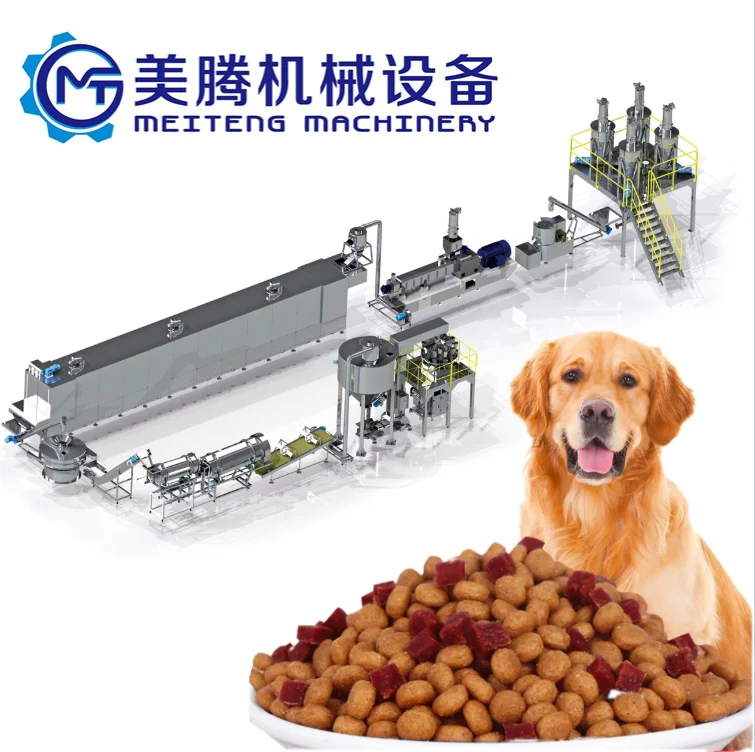
Complete Line Sizing — Every station from mixer to packer is throughput-matched so no single unit bottlenecks the pet food extrusion workflow.
Technical Specifications
| Parameter | Value |
|---|---|
| Product Type | Pet Food Extrusion Production Line |
| Automation Level | Full automation from raw material mixing, extrusion, drying to packaging |
| Control System | Available with PLC or MCC control (language configurable) |
| Recipe Adaptability | Dry kibble, semi-moist, and treats |
| Line Stations | Mixing, extrusion, drying, packaging |
| Energy Design | Energy-saving technology (specific metrics basis to be confirmed) |
| Maintenance | Modular components for quick cleaning and maintenance |
| Capacity & Layout | Customizable capacity and layout (basis to be confirmed) |
| Material Grade | Food-grade materials |
| Standards | CE, FDA (source value — verify against manufacturer catalog) |
Application Suitability
| Application | Material or Output |
|---|---|
| Dry kibble for dogs and cats | Corn flour, meat meal, bone meal, vitamin premix |
| Semi-moist pet food | Fresh meat slurry, glycerin, starch blends |
| Extruded pet treats | Rice flour, chicken powder, palatant coatings |
| Floating and sinking aquatic feed | Fish meal, soybean meal, wheat middlings |
| Bird and small animal feed | Millet, sunflower meal, seed blends |
Why an Undersized Dryer Can Stall Your Entire Pet Food Extrusion Production Line
The extruder sets the pace, but the dryer decides whether you actually ship product.
I once watched a kibble line in Bogotá sit idle for two shifts because the dryer could not handle the moisture load coming off the extruder. The extruder was pushing product at its rated throughput, yet pellets piled up on the belt waiting for dryer space. Throughput dropped to whatever the dryer could clear. That is the bottleneck most buyers discover after installation, not during the quote stage. When every station in a pet food extrusion production line is sized against real moisture and volume data rather than nominal extruder capacity, the line holds its rate from first hour to last [NEED_CITE: importance of mass balance in extrusion line design].
Station-by-Station Equipment Breakdown
A complete pet food extrusion production line covers raw material batching, mixing, conveying, extrusion, drying, flavouring or coating, cooling, and final packaging. Each station has its own throughput envelope. The mixer must homogenise the batch before the extruder hopper runs low; the belt dryer must remove enough moisture so that the coating drum receives kibble below a target water activity level; the cooler must bring product temperature within a range safe for bagging. If one station falls short, the stations downstream starve while upstream units accumulate buffer stock.
How Throughput Matching Prevents Mid-Run Shutdowns
Matching throughput starts with the raw material formulation, because moisture content and bulk density at the extruder inlet dictate what the dryer must handle. A recipe with high fresh meat slurry introduces significantly more water than a corn-dominant formula, and the dryer belt speed, air temperature, and retention time must accommodate that extra load. The same logic applies to the coating drum: if the line runs both dry kibble and semi-moist treats, the drum volume and spray system must cover the heavier application rate. Engineering every station around the buyer’s actual recipe, rather than a generic baseline, is what keeps a pet food extrusion production line running without manual intervention [NEED_CITE: throughput matching between extrusion and downstream drying stages].
What the Control System Actually Monitors
The PLC or MCC control architecture governs motor start sequences, barrel temperature zones, feeder screw speed, and dryer air temperature across the line. Sensor inputs from each station feed back to the central interface, so operators see real-time throughput and temperature data on one screen rather than walking to each machine. Food-grade contact materials throughout the product zone mean that clean-in-place procedures do not degrade seals or gaskets over repeated wash cycles. Modular component design lets maintenance crews pull a screw section or replace a dryer belt segment without dismantling the full assembly, cutting changeover time between recipes.
The Cost of Ignoring Utility and Footprint Planning
I have seen lines arrive at a facility only to find that the local three-phase supply could not handle the combined motor load. The extruder alone draws substantial current, and adding the dryer heating elements on the same circuit trips breakers under full load. Beyond electrical capacity, the physical footprint of the dryer and cooler often exceeds what buyers budget for in floor space. When these details surface during installation instead of the layout stage, commissioning delays stretch into weeks [NEED_CITE: electrical load planning for industrial extrusion installations]. Choosing the wrong configuration at the quoting stage means either living with a constrained line or paying to re-route utilities after the equipment is bolted down.
Why Buyers Source This Equipment Here
The full line comes from one supplier, so throughput calculations cover every station rather than relying on separate vendors to coordinate. Screw configuration and die design are specified to the buyer’s raw material and target pellet density before the extruder leaves the factory. An in-house testing workshop runs trial batches on the buyer’s actual formulation, generating a documented report before shipment. Electrical schematics and voltage confirmation happen at the order stage, not on the day of installation. Pre-sales engineering consultation continues through on-site commissioning, operator training, and ongoing wear parts supply.
Documentation & Verification
- Line layout and capacity calculation showing matched throughput for each station
- Machine specification sheet with motor power, dimensions, and utility requirements per unit
- Screw and die configuration record matched to buyer’s raw material
- Electrical schematic and voltage confirmation document before production starts
- Trial run report on buyer’s actual raw material from the in-house testing workshop
- CE declaration of conformity and food-grade material certification on file
Installation, Commissioning & Support
- Foundation load assessment based on extruder weight and dryer length before equipment arrival
- Dedicated electrical circuit sizing for combined extruder motor and dryer heating load
- Sectional delivery of dryer and cooler allowing assembly within standard workshop clearances
- First-run parameter logging of barrel temperatures, screw speed, and dryer retention time
- Operator training on PLC interface language and recipe recall functions
- Wear parts list covering screws, dies, and seals with reorder lead times noted
- Scheduled maintenance calendar aligned with modular component replacement intervals
What to Include in Your Initial Inquiry
To size a pet food extrusion production line accurately, share your target recipe with raw material percentages and expected moisture content, your daily output target, and the available workshop length and ceiling height. Specify your local voltage and frequency, the control language your operators need, and whether any existing upstream or downstream equipment must be integrated. If you have a sample of your raw material available, indicate whether you can ship it for a pre-shipment trial run in the testing workshop.
Frequently Asked Questions
Q: What stations are included in the full line and can individual machines be ordered separately?
A: The line covers mixing, conveying, extrusion, drying, coating, cooling, and packaging. Each station can be ordered individually for line expansion or replacement. When ordered as a full set, throughput is calculated so that no single station bottlenecks the others, based on your raw material and target product specification.
Q: How is throughput matched between the extruder, dryer, and coating drum?
A: Matching starts with your formulation’s moisture content and bulk density at the extruder outlet. The dryer belt length, air temperature, and retention time are sized to handle that moisture load, and the coating drum volume is set for the application rate your recipe requires. This prevents product accumulation or starvation at any transfer point.
Q: What factory footprint and utility connections does each station require?
A: Each station has its own floor space, electrical load, and ventilation requirement. The extruder needs a dedicated motor circuit; the dryer requires heating element power and exhaust ducting; the cooler needs ambient air intake. A line layout document details the footprint and utility points for your specific configuration before installation begins.
Q: Which spare wear parts are stocked and how are they ordered?
A: Screws, dies, barrel liners, and seals are documented in a wear parts list provided with the line. Each part is identified by the configuration record tied to your order. Replacement parts are manufactured to the same specification as the originals and can be ordered individually or as a scheduled maintenance kit.
Q: Can the line layout be reconfigured for future capacity expansion?
A: The modular design of each station allows reconfiguration. When planning the initial layout, engineers leave utility stub points and floor space allowances for a longer dryer or additional coating drum. This means future expansion involves adding stations rather than redesigning the entire line footprint.