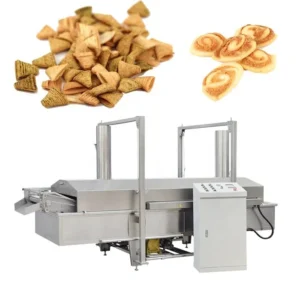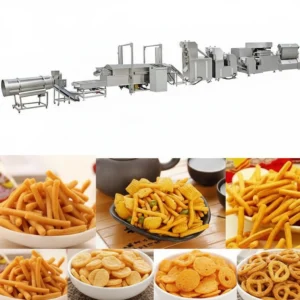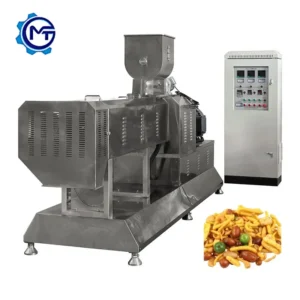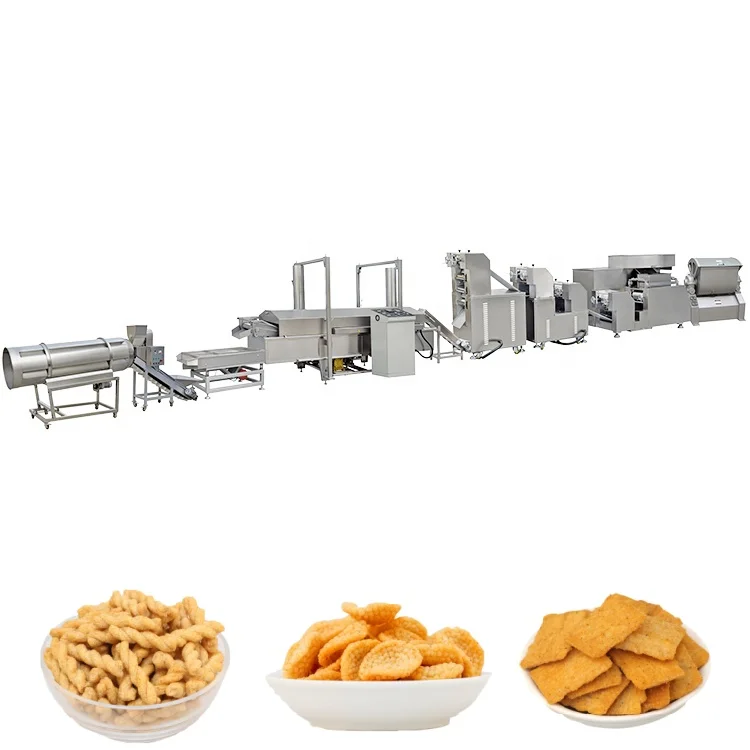
Matched Throughput Across Stations — the MT100/MT120 line is configured so mixing, extrusion, frying, and flavoring capacities align from one manufacturer instead of relying on separate vendors.
Technical Specifications
| Parameter | Value |
|---|---|
| Model | MT100/MT120 |
| Product Type | Fried Puffed Snack Food Production Line |
| Extruder Type | Single Screw Extruder |
| Screw Configuration | High and low pressure screw |
| Rated Power | 50–70 kW (electric heating); gas/diesel variant approximately 50–60 kW |
| Voltage & Frequency | Three phase 380 V / 50 Hz; Single phase 220 V / 50 Hz (customizable to local voltage) |
| Output Capacity | 120 kg/h (basis not stated in source — confirm raw material type, moisture content and product shape) |
| Overall Dimensions (L×W×H) | 12,000–26,000 × 1,200 × 2,200 mm |
| Construction Material | Food-grade stainless steel 201 (304 optional) |
| Energy Source Options | Electricity / Gas / Diesel / Steam |
| Motor & Electrical Components | Siemens (China) or top Chinese brand motors; Delixi or Delta inverters |
| Die Configuration | Adjustable dies for multiple shapes (screw shell, round tube, square tube, ring, cartoon shapes) |
| Raw Materials | Wheat flour, corn starch, potato starch |
| Process Flow | Mixer → Screw Conveyor → Single Screw Extruder → Pulling and Cutting Machine → Automatic Fryer → Automatic Flavoring Line → Cooling |
| Certification | CE, ISO 9001 |
| Warranty | One year warranty and lifetime technical guidance |
Application Suitability
| Application | Material or Output |
|---|---|
| Salad stick production | Wheat flour and corn starch blends, extruded into hollow tubes then fried to secondary puffing |
| Golgappa / pani puri shells | Wheat flour or potato starch, thin-wall round or semi-spherical shapes requiring controlled expansion during frying |
| Shaped fried puffed snacks | Corn starch and wheat flour mixtures formed into screw shells, rings, square tubes, and cartoon shapes |
| Starch-based secondary puffing lines | Potato starch or blended starches processed through single screw extrusion before automatic frying |
Why "120 kg/h" Means Little Without the Raw Material Context
Output ratings on any fried puffed snack food production line equipment depend entirely on what you actually feed into the hopper.
I learned this the hard way years ago in a workshop outside Suzhou. We sized a salad stick line based on a standard corn flour test run, then the buyer switched to a high-oil recipe on day one of production. The material viscosity dropped, expansion collapsed, and they shut down for two weeks while we re-cut the screw combination. A capacity figure printed on a spec sheet does not account for moisture content, starch ratio, or fat percentage in your specific recipe. When evaluating fried puffed snack food production line equipment, always ask which raw material and which die shape produced the published number — and insist on a trial with your own formulation before the machines leave the factory [NEED_CITE: common causes of extruder throughput shortfall in starch-based snack lines].
How the Single Screw Configuration Handles Starch Variability
The MT100/MT120 uses a high and low pressure screw arrangement rather than a uniform-pitch design. This matters because wheat flour, corn starch, and potato starch each gelatinise at different temperatures and require different shear profiles inside the barrel. The pressure staging allows the screw to compress low-density starch blends without stalling while still generating enough expansion force for denser wheat flour recipes. For a fried puffed snack food production line, this flexibility means you can switch between salad sticks and golgappa shells without replacing the entire screw assembly.
Die Swaps and Shape Changeover on One Extruder
The adjustable die system on this line covers screw shells, round tubes, square tubes, rings, and custom cartoon shapes. Changeover involves pulling the die plate, swapping the insert, and resetting the pulling-and-cutting station to match the new profile length. In my experience on starch-based extrusion lines, the bottleneck during shape changes is rarely the die itself — it is the downstream cutter and fryer basket alignment. Because MT supplies the cutting machine and fryer as part of the same line, the conveyor spacing and basket dimensions are pre-matched to the die range, which eliminates the trial-and-error period that typically follows a shape change [NEED_CITE: die changeover procedures on single screw snack extruders].
Reading the Specs That Actually Matter for Frying Snack Lines
The 50–70 kW rated power range for electric heating reflects the combined load of barrel heaters and the fryer heating elements. If your facility runs on gas or diesel, the variant drops to approximately 50–60 kW, which affects your transformer sizing and dedicated circuit planning. The overall line length of 12,000 to 26,000 mm depends on whether you include the full cooling conveyor and packing station — a shorter layout may omit the automatic cooling section, which then requires floor-space for manual cooling racks. Food-grade stainless steel 201 is standard across contact surfaces, with 304 available for buyers in markets where local food safety codes mandate it. The Delixi or Delta inverters control screw speed and conveyor rates; confirming the inverter brand and programming language before production avoids commissioning delays on site.
The Hidden Cost of Mismatched Fryer and Extruder Capacity
When the extruder and fryer come from different suppliers, the fryer basket cycle time often does not match the extruder output rate. Product piles up on the cutting conveyor, moisture re-absorbs into the half-dried pieces, and frying oil temperature drops each time an overloaded batch enters the tank. I have walked into snack factories where the operator was manually throttling the extruder down to keep the fryer from flooding — effectively running a 120 kg/h line at half its nameplate capacity. Sourcing the complete fried puffed snack food production line equipment from one manufacturer means the fryer volume, oil recovery rate, and conveyor transfer speed are calculated together during the layout phase [NEED_CITE: fryer sizing relative to extruder output in secondary puffing lines].
Why Buyers Source This Line From MT
MT configures every station from the mixer through the flavoring drum as a matched set, so throughput is balanced at each stage rather than assembled from independent vendors. The in-house testing workshop runs your actual raw material before shipment, producing a trial report that documents expansion rate, die performance, and frying behaviour on your recipe. Screw configuration and die design are specified to your target product shape, not copied from a generic build. Electrical schematics and voltage confirmation are completed before production, which prevents the three-week delay that happens when a 380 V machine arrives at a 440 V facility. CE and ISO 9001 documentation ships with every line, and engineers are available for overseas installation and operator training.
Documentation & Verification
- Line layout and capacity calculation showing matched throughput from mixer to packing station
- Screw and die configuration record matched to your raw material and target snack shape
- Electrical schematic with confirmed voltage, frequency, and control panel language for your market
- Trial run report on your raw material conducted in the testing workshop before dispatch
- CE declaration of conformity and ISO 9001 certificate included with shipment
Installation, Commissioning & Support
- Line footprint of 12,000–26,000 mm requires level concrete flooring with drainage near the fryer station
- Three phase 380 V / 50 Hz supply with dedicated circuit for the 50–70 kW electric heating load
- Machines ship in modular sections; on-site assembly includes conveyor alignment and fryer leveling
- First run commissioning covers barrel temperature profiling, screw speed calibration, and fryer oil temperature setting
- Operator training includes die changeover, screw cleaning, and fryer oil filtration procedures
- Wear parts list covers screws, dies, and cutting blades with recommended replacement intervals
What We Need to Configure Your Line
To size the MT100/MT120 correctly, share your target product shape, raw material formulation with moisture percentage, and daily production target. Confirm your facility voltage and frequency so the electrical package matches before production begins. If you have existing upstream mixers or downstream packing equipment, provide the model and throughput so the new line integrates without bottlenecks.
Frequently Asked Questions
Q: How is the 120 kg/h output capacity verified, and on which raw material is it based?
A: The published 120 kg/h figure is a baseline that varies depending on raw material type, moisture content, and die shape. MT verifies actual throughput by running your specific formulation in the in-house testing workshop before shipment. The trial report documents real output under your recipe conditions, so you receive a confirmed number rather than a generic estimate.
Q: Which voltage and frequency configurations are available for different export markets?
A: The standard configuration is three phase 380 V / 50 Hz, with single phase 220 V / 50 Hz available. Voltage and frequency are customizable to match your local supply, and the control panel language is confirmed during the specification stage. Providing your facility electrical details early prevents commissioning delays after delivery.
Q: What die shapes are included as standard, and can custom shapes be developed?
A: Standard dies cover screw shells, round tubes, square tubes, rings, and cartoon shapes. Custom die inserts can be developed for specific market requirements, with the pulling-and-cutting station adjusted to match the new profile. Die changeover is handled on-site, and the trial run verifies expansion behaviour for each shape before the line ships.
Q: How are the extruder, fryer, and flavoring line balanced to avoid bottlenecks?
A: Every station is configured as a matched set from one manufacturer, so fryer basket volume, oil recovery rate, and flavoring drum capacity are calculated against the extruder output. This prevents the common problem where product piles up between stations because one machine runs faster than the next.
Q: Is a trial run on the buyer’s raw material conducted before shipment?
A: Yes, MT runs your actual raw material in the testing workshop and documents expansion rate, product density, die performance, and frying behaviour in a trial report. This confirms the screw configuration and die selection work with your specific formulation, reducing the risk of production delays after installation.