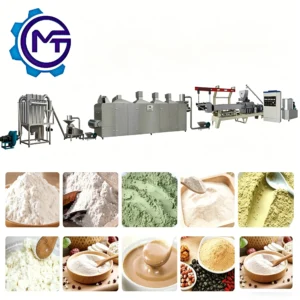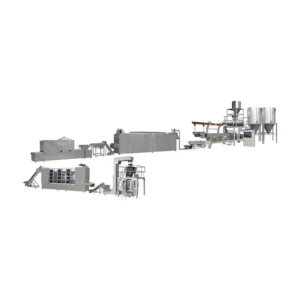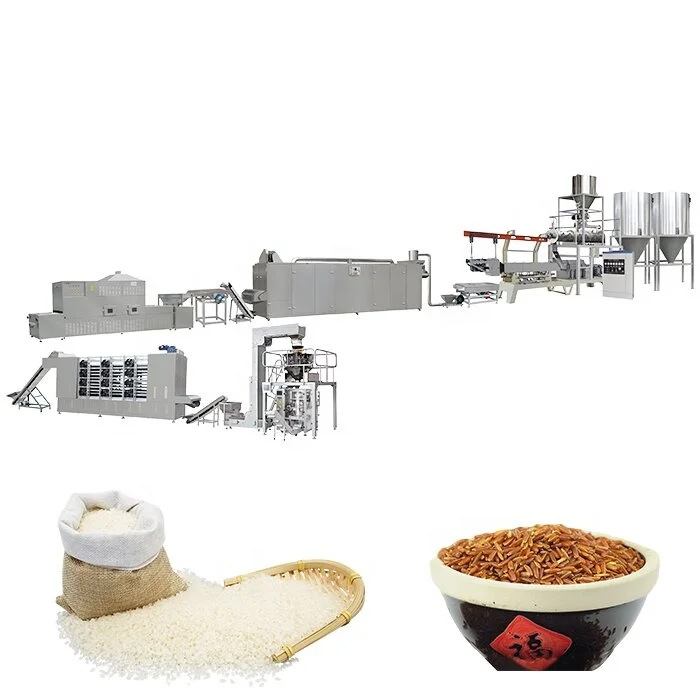
Throughput-matched line design — Every station from batching to packing is sized to the extruder’s actual output on your grain formulation, preventing the bottleneck that happens when vendors quote isolated machine capacities.
Technical Specifications
| Parameter | Value |
|---|---|
| Model | MT65 / MT70 / MT85 / MT75 / MT95 |
| Product Type | Fortified Artificial Rice Extrusion Line |
| Screw Type | Twin-screw |
| Installed Power | MT65: 85 kW | MT70: 120 kW | MT85: 235 kW | MT75: 180 kW | MT95: 260 kW |
| Power Consumption | MT65: 60 kW | MT70: 85 kW | MT85: 165 kW | MT75: 135 kW | MT95: 195 kW |
| Output Capacity | MT65: 80–100 kg/h | MT70: 100–120 kg/h | MT85: 200–300 kg/h | MT75: 300–500 kg/h | MT95: 800–1000 kg/h (basis not stated in source — confirm raw material formulation and moisture content) |
| Overall Dimensions | MT65: 28 × 1.2 × 2.2 m | MT70: 30 × 1.5 × 2.2 m | MT85: 34 × 3.5 × 4.3 m | MT75: 32 × 3.5 × 4.3 m | MT95: 36 × 3.5 × 4.3 m |
| Feeding System | Single or double screw feeding, selectable by material characteristics |
| Screw Material | Wear-resistant alloy |
| Lubrication | Automatic lubricating system |
| Cooling | Integrated extruder cooling system |
| Drying Oven Heating | Electric or gas |
| Drying Method | Circulation drying with mesh belt, frequency motor speed control |
| Control System | Frequency speed control (PLC / MCC availability to be confirmed) |
| Certification | CE (per company profile) |
Application Suitability
| Application | Material or Output |
|---|---|
| Fortified rice kernel production | Broken rice and starch-based formulations with added vitamins and minerals |
| Nutritional rice for food aid programs | Rice bran, corn, millet blended with micronutrient premix |
| Grain reprocessing into artificial kernels | Wheat, oats, buckwheat, bean flour with starch binder |
| Infant and weaning food base material | Pre-cooked rice and starch blends with controlled gelatinisation |
What "300 kg/h" Really Means When You Process Fortified Rice
Capacity only holds when the extruder screw profile, die geometry, and moisture window match your exact grain blend.
I watched a line in Southeast Asia lose half its rated output because the buyer’s formulation carried higher oil content than the sample used for the initial quote. The die holes clogged within minutes, and the operator spent more time clearing blockages than running product. The artificial rice making machine manufacturer had sized the dryer and cooler for the nominal figure, so the entire downstream section sat idle while the extruder struggled [NEED_CITE: impact of lipid content on twin-screw extrusion die performance]. That experience reinforced a rule I now follow without exception: no line ships until we have run the buyer’s actual raw material through our testing workshop and documented the real throughput.
How Screw Configuration Controls Kernel Density and Shape
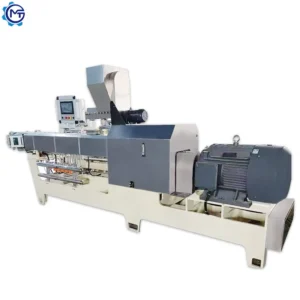
The twin-screw design on this fortified rice extrusion line allows the screw profile to be rebuilt section by section. Conveying elements, kneading blocks, and reverse-flight segments are arranged to control residence time and shear intensity inside the barrel. A formulation heavy in broken rice requires a different compression ratio than one built around bean flour and oat starch. Getting this wrong means kernels that either fracture during drying or fail to hold their shape when cooked. The die plate is matched to the screw configuration so that pressure at the die face produces clean cuts at the target kernel geometry.
Why Station Matching Matters More Than Extruder Size
A common failure on nutritional powder processing line projects is an extruder that runs well while the dryer cannot keep up. Moisture reduction in artificial rice kernels requires a specific dwell time on the mesh belt; if the oven is undersized, kernels exit with internal moisture that causes cracking during storage. The circulation drying oven on this line uses frequency-controlled belt speed so that residence time adjusts to the actual output rate rather than a fixed assumption [NEED_CITE: mesh belt dryer residence time requirements for extruded rice kernels]. The roasting and cooling stations downstream are sized using the same throughput calculation, which means no station forces the others to idle.
Reading the Power and Capacity Data Correctly
The installed power figures range from 85 kW on the MT65 to 260 kW on the MT95, while actual power consumption sits at roughly 70–75% of those values during steady-state operation. This gap reflects the start-up surge and the headroom needed when feed rate fluctuates. The selectable single or double screw feeding system lets the operator match material uniformity — double screw feeding suits blends with varying particle size, while single screw works for homogeneous starch premixes. The automatic lubricating system and integrated barrel cooling extend screw and barrel life under continuous operation, which matters when the line runs multi-shift schedules common in food aid contract production.
The Hidden Cost of Skipping the Trial Run
Buyers who accept a line without a factory trial on their own material inherit all the process risk. Die clogging, inconsistent kernel size, and moisture variation show up during commissioning rather than before shipment, when corrections cost weeks of on-site rework. Electrical mismatches add another layer — voltage, frequency, and control panel language need confirming before the cabinet is wired, not after it arrives at a port with different standards [NEED_CITE: industrial voltage and frequency standards by export market]. Every one of these issues is preventable with a structured pre-shipment test, yet they remain among the most frequent reasons commissioning schedules slip.
Why Source This Line From Meiteng
Every station from the batching system through extrusion, vibrating separation, low-temperature drying, cooling, high-temperature roasting, and packing is specified under one supply contract, so throughput matching is the supplier’s responsibility rather than the buyer’s assembly problem. Screw configuration and die design are documented against the buyer’s specific grain formulation and target kernel shape. An in-house testing workshop allows trial runs on the buyer’s raw material before the line is crated for shipment. Pre-sales engineering covers line layout and utility planning, while on-site installation, commissioning, and operator training follow delivery. Wear parts lists and replacement screw and die sets are defined before the first order ships.
Documentation & Verification
- Line layout and capacity calculation showing throughput match across every station
- Screw and die configuration record tied to your grain blend and kernel geometry
- Trial run report from our testing workshop on your raw material before dispatch
- Electrical schematic with voltage, frequency, and control language confirmed for your site
- CE declaration of conformity and ISO certificate included with shipping documents
- Wear parts list with part numbers for screws, dies, and mesh belt sections
Installation, Commissioning & Support
- Foundation plan accounts for the MT95 line footprint of 36 × 3.5 × 4.3 m and vibration isolation at the extruder base
- Dedicated power circuit sized for the model’s installed power, up to 260 kW on the MT95
- Extruder barrel sections and dryer modules ship in bolted assemblies for on-site joining
- First-run parameter setting covers barrel temperature profile, screw speed, and mesh belt frequency
- Operator training addresses die changeover, feeding system adjustment, and automatic lubrication checks
- Initial spare set of screws, dies, and belt clips ships with the line to cover the first replacement cycle
Before You Request a Quote
To configure this fortified rice extrusion line correctly, share your raw material formulation including moisture and lipid content, your target kernel shape and cooking behaviour specification, and your required daily output. Confirm the voltage, frequency, and control language at your facility, along with available workshop floor area and ceiling height. If you have existing upstream milling or downstream packing equipment, let us know so the line interfaces match.
Frequently Asked Questions
Q: What raw material conditions are the quoted output capacities based on?
A: The kg/h figures in the specification table are listed without a stated basis. Actual throughput depends on your grain formulation, moisture content, and target kernel density. We confirm real capacity by running your material in our testing workshop and documenting the result before quoting a final line configuration.
Q: How is the screw profile selected for my specific grain blend?
A: We review your formulation’s starch type, protein level, and particle size distribution, then arrange conveying, kneading, and metering screw elements to achieve the required gelatinisation and pressure at the die. The configuration record is shipped with the line for future reference and replication.
Q: Can I send raw material for a trial run before the line ships?
A: Yes. Our in-house testing workshop runs your material on the matched extruder and documents throughput, kernel geometry, moisture profile, and any die or feeding issues. The trial report accompanies the shipment so your team has baseline parameters on day one.
Q: How do you confirm voltage and control language before production?
A: During the specification confirmation stage, we collect your site voltage, frequency, and preferred control panel language. The electrical schematic is reviewed and signed off before the cabinet is wired, preventing commissioning delays caused by mismatched standards.
Q: What spare wear parts ship with the line, and how are replacements handled?
A: An initial set of screws, dies, and consumable fittings is included based on the model. A wear parts list with part numbers ships in the documentation package, and replacement orders are fulfilled from stock to minimise downtime when the first changeover is due.