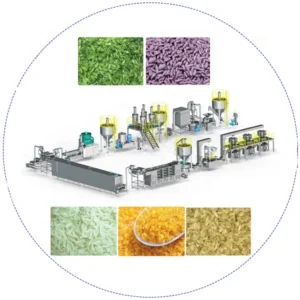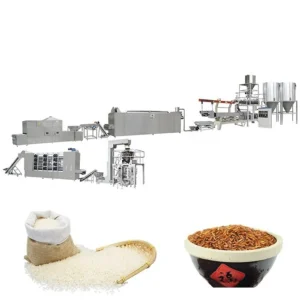
Integrated Line Sourcing — Every station in the artificial rice processing line from batching to packing is specified under one equipment catalogue, eliminating throughput mismatches between extruder output and downstream drying or cooling capacity.
Technical Specifications
| Parameter | Value |
|---|---|
| Model | MT65 / MT70 / MT85 / MT75 / MT95 |
| Product Type | Nutritional Artificial Rice Processing Line |
| Screw Type | Twin-screw |
| Installed Power | 85 kW (MT65) / 120 kW (MT70) / 235 kW (MT85) / 180 kW (MT75) / 260 kW (MT95) |
| Power Consumption | 60 kW (MT65) / 85 kW (MT70) / 165 kW (MT85) / 135 kW (MT75) / 195 kW (MT95) |
| Capacity | 80-100 kg/h (MT65, basis to be confirmed) / 100-120 kg/h (MT70, basis to be confirmed) / 200-300 kg/h (MT85, basis to be confirmed) / 300-500 kg/h (MT75, basis to be confirmed) / 800-1000 kg/h (MT95, basis to be confirmed) |
| Overall Dimensions | 28 × 1.2 × 2.2 m (MT65) / 30 × 1.5 × 2.2 m (MT70) / 34 × 3.5 × 4.3 m (MT85) / 32 × 3.5 × 4.3 m (MT75) / 36 × 3.5 × 4.3 m (MT95) |
| Control System | Frequency speed control with automated feeding, extruding, cutting, heating, gearing subsystems |
| Feeding System | Single or double screw feeding (configurable to material) |
| Screw Material | Special wear-resistant alloy technology |
| Lubrication | Automatic lubricating and cooling system |
| Drying Oven Heating Source | Electric or gas |
| Drying Method | Circulation drying with frequency motor-controlled mesh belt speed |
| Line Stations | Mixing → Extruding → Vibrating → Low temperature drying → Cooling → High temperature roasting → Cooling → Packing |
| Voltage & Frequency | Customizable per local grid requirements |
| Standards | CE, ISO |
Application Suitability
| Application | Material or Output |
|---|---|
| Nutritional fortified rice kernel production | Rice flour, broken rice, vitamins, minerals, micro-nutrients |
| Artificial rice from by-products | Broken rice, rice bran, corn, millet, starch binders |
| Instant rice processing | Pre-gelatinized starch, wheat, oats, buckwheat blends |
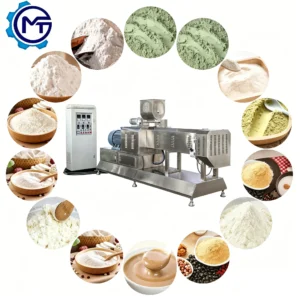
| Grain-based nutritional extrusion | Bean flour, corn grits, oat bran with supplement incorporation |
Why the Downstream Dryer Defines Your Real Throughput
A twin-screw extruder that pushes product faster than the circulation drying oven can remove moisture creates a hidden bottleneck that caps actual line output.
Buyers often fixate on extruder nameplate capacity when surveying an artificial rice processing line full equipment range, but the drying oven mesh belt speed and heating zone length determine how much product can actually move through without clumping or cracking. If the oven is sized for a lower output, the extruder must be throttled back, and the entire line runs below its rated figure. I have seen fortified rice lines where the extruder was capable of noticeably higher throughput, yet the drying station forced a slower pace to maintain kernel integrity [NEED_CITE: thermal dynamics in multi-stage grain drying]. Matching every station from mixing through packing under one specification sheet prevents this mismatch before the line is built.
Station-by-Station Equipment Breakdown
The artificial rice processing line full equipment range begins with a mixing and batching system where raw materials like broken rice, rice bran, and supplemental vitamins are blended to a uniform moisture content. The feeding system uses either a single or double screw feeder depending on material flow characteristics; double screw feeding is specified when the blend contains fine vitamin or mineral premixes that tend to bridge in standard hoppers. Frequency speed control governs the feed rate independently from the extruder screw speed, allowing operators to adjust residence time without changing the main drive.
Drying, Roasting, and Cooling Configuration
After extrusion and vibrating separation, kernels enter a low-temperature circulation drying stage where a frequency-controlled mesh belt advances product through heated zones. The drying oven is available with electric or gas heating sources, specified to the buyer’s utility infrastructure. A high-temperature roasting station follows, which sets the final kernel density and surface texture. Two cooling stages bookend the roasting step to prevent thermal shock and condensation before packing [NEED_CITE: moisture migration in extruded grain products during cooling].
Extruder and Line Parameters That Matter on the Floor
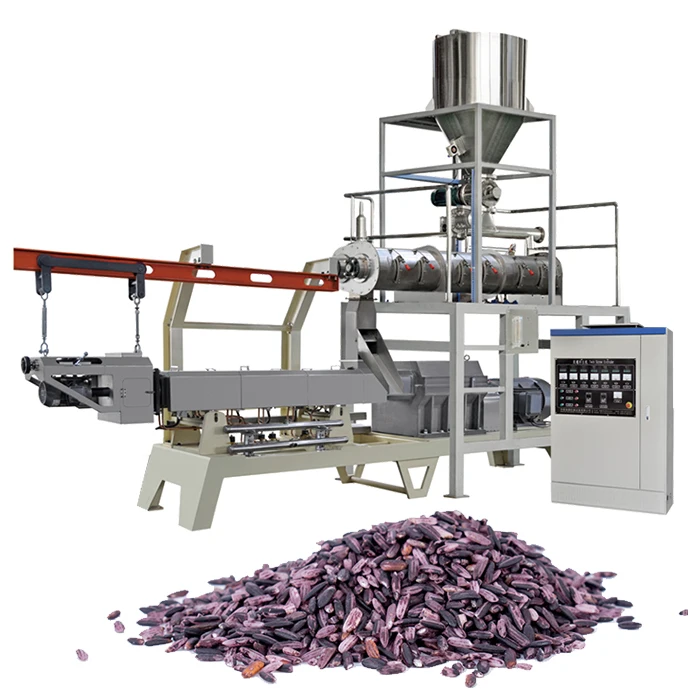
The twin-screw configuration is standard across the MT65 through MT95 range because nutritional rice formulations require thorough mixing of starch and protein fractions with micro-nutrient premixes inside the barrel. Single-screw extruders cannot achieve the same shear profile for heavily fortified blends, leading to uneven gelatinization and weak kernels that fracture during drying. The automatic lubricating and cooling system on the gearbox allows continuous operation without manual oil checks during production shifts, which matters on lines running three shifts. Screw elements are manufactured from a special wear-resistant alloy to extend service intervals when processing abrasive materials like rice bran or coarse corn grits. The installed power ranges from 85 kW on the MT65 to 260 kW on the MT95, with actual power consumption running lower during steady-state operation.
The Cost of Sourcing Stations Separately
When extruder, dryer, and cooling conveyor are purchased from separate vendors, the responsibility for throughput matching falls on the buyer or a third-party integrator. A dryer specified by its own manufacturer without knowledge of the extruder’s actual moisture output per hour often arrives undersized, forcing the line to run slower to achieve target kernel moisture. Electrical interlocks between stations become an aftermarket project, and control language on separate panels may not align. Spare parts sourcing fragments across multiple supply chains, and when a screw element or mesh belt section needs replacement, lead times compound [NEED_CITE: multi-vendor integration risks in food processing lines].
Why Source the Full Range from One Catalogue
Every station in this artificial rice processing line is specified together, meaning the dryer capacity is calculated against the extruder’s actual moisture discharge rate, not a generic throughput assumption. Screw and die configurations are documented against the buyer’s raw material formulation before production begins, not copied from a default build. The in-house testing workshop runs trial batches on the buyer’s actual recipe — including high-protein or vitamin-heavy blends — before the line ships, so gelatinization and expansion behavior are confirmed in advance. Voltage, frequency, and control panel language are confirmed against the destination market’s electrical standards during the specification stage, not discovered during commissioning. Line layout and capacity calculation documents are provided as a single package covering every station from batching to packing [NEED_CITE: factory acceptance testing protocols for extrusion lines].
Documentation & Verification
- Line layout and capacity calculation showing throughput matching between extruder, dryer, roaster, and cooler
- Screw and die configuration record matched to your fortified rice formulation
- Electrical schematic with voltage, frequency, and control language confirmation for your market
- Trial run report on your actual raw material blend conducted in the testing workshop before shipment
- CE declaration of conformity and ISO certificate
- Operation and maintenance manual with wear parts list specific to your screw configuration
Installation, Commissioning & Support
- Foundation and utility planning based on the 28 m to 36 m line footprint depending on selected model
- Dedicated electrical circuit sizing matched to installed power from 85 kW up to 260 kW
- Station-by-station assembly with throughput balancing between extruder output and dryer belt speed
- Initial parameter setting for barrel temperature zones and die pressure on your specific rice formulation
- Operator training covering frequency speed adjustment across feeding, extruding, and drying subsystems
- Wear parts inventory recommendation including screw elements and die plates based on material abrasiveness
What to Include in Your Inquiry
Specify your raw material blend — including the ratio of broken rice, starch, and any vitamin or mineral premix — along with target kernel size and daily production volume. Confirm your facility’s available floor space, ceiling height, and local voltage and frequency standards. Indicate whether you need the drying oven configured for electric or gas heating, and whether control panel language requirements differ from standard English.
Frequently Asked Questions
Q: How is line capacity verified on our specific raw material formulation before shipment?
A: Your actual raw material blend is run in our testing workshop before the line ships. The trial confirms gelatinization behavior, kernel density, and expansion characteristics under your specific vitamin and starch ratios. Parameters are documented and transferred to the commissioning team so the line starts at verified settings rather than generic defaults.
Q: What supporting stations are included and how is throughput matched across each station?
A: The line includes mixing, twin-screw extrusion, vibrating separation, low-temperature drying, cooling, high-temperature roasting, a second cooling stage, and packing. Each station is sized so its maximum throughput aligns with the extruder’s verified output on your material, preventing downstream bottlenecks.
Q: How are voltage, frequency, and control panel language confirmed for the destination country?
A: Your local electrical standards are confirmed during the specification stage. The electrical schematic is built to your grid requirements, and control panel labeling and HMI language are set before production. This prevents rewiring or panel replacement after arrival at your facility.
Q: What screw configuration is specified for fortified rice versus artificial rice from broken rice?
A: Fortified rice with high vitamin and mineral loading requires a screw profile that ensures thorough dispersion of micro-nutrients within the starch matrix. Artificial rice from broken rice uses a configuration optimized for starch gelatinization and kernel shaping. Both are documented in the screw and die configuration record provided with your line.
Q: What is the factory footprint requirement for each model including all supporting equipment?
A: The overall line dimensions range from 28 × 1.2 × 2.2 m for the MT65 to 36 × 3.5 × 4.3 m for the MT95. These figures include all stations from mixer to packer. Detailed layout drawings are provided during the proposal stage so you can verify floor space and ceiling clearance before order confirmation.