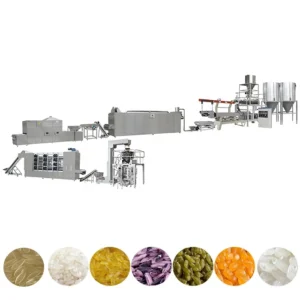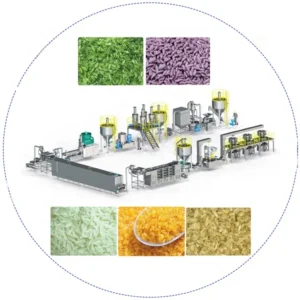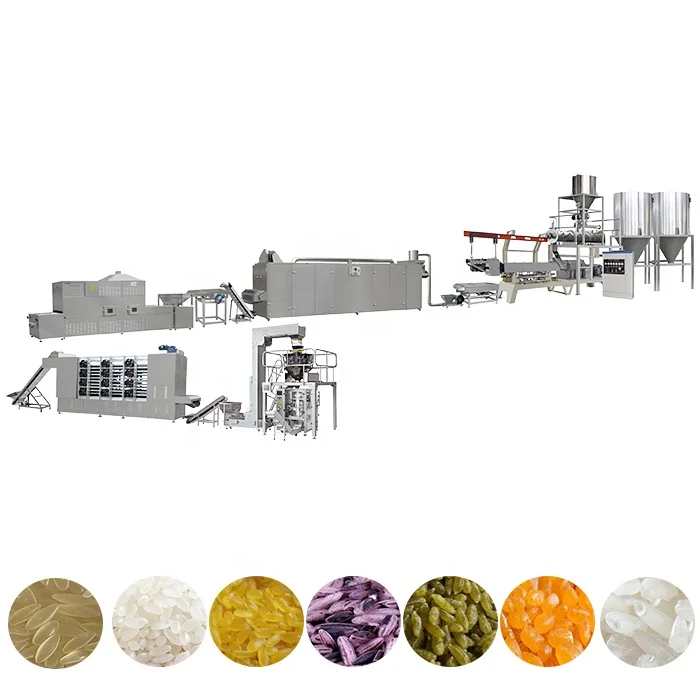
Complete Line Throughput Matching — Every station from raw material mixing through extrusion, shaping, and drying is engineered as one integrated system, preventing the bottlenecks that arise when machines are assembled from separate vendors.
Technical Specifications
| Parameter | Value |
|---|---|
| Product Type | Fortified Artificial Rice & Couscous Production Line |
| Model | MT65 |
| Output Capacity | 100–500 kg/h (basis not stated in source — confirm raw material, moisture content, and product format) |
| Voltage & Frequency | 380V / 50Hz (other options available on request) |
| Control System | Fully automatic production control |
| Construction Material | Food-grade stainless steel contact surfaces |
| Screw Type | Twin-screw |
| Assembly State | Complete production line with integrated stations |
| Standards | CE, ISO |
| Customization | Logo, packaging, graphic design, drawing-based and sample-based adjustments |
Application Suitability
| Application | Material or Output |
|---|---|
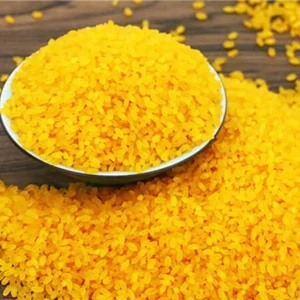
| Fortified Rice Kernel (FRK) production | Rice flour, vitamin and mineral premix, binding agents |
| Artificial rice manufacturing | Broken rice flour, starch base with fortification additives |
| Couscous processing | Semolina, wheat flour, water-based hydration blends |
| Nutrition-enhanced grain products | Multi-grain flour blends with micro-nutrient incorporation |
| Institutional feeding programme supply | Standardized fortified kernels meeting programme specifications |
Why the Voltage Question Must Come Before the Line Layout
Confirming your factory’s electrical supply before production prevents weeks of on-site rewiring and delayed commissioning.
I have seen food extrusion lines arrive at overseas facilities only to sit idle because the motor was wound for a frequency the local grid does not support. The Fortified Artificial Rice Production Line ships with configurable voltage and frequency, but the specification must be locked before the main extruder motor enters assembly. A mismatched drive or control transformer is not a quick swap once the machine is bolted to the floor [NEED_CITE: voltage and frequency standards by export market]. Buyers often focus on output capacity and leave the electrical confirmation until after the deposit is paid, which is the exact moment scheduling pressure makes corrections expensive.
Station Sequencing and Throughput Balance Across the Line
The complete equipment range on mtfoodmachinery.com starts with raw material mixing and ends at the finished product, and every intermediate station — extrusion, shaping, drying — must carry the same mass flow. The Fortified Artificial Rice Production Line is configured so that dryer residence time and conveyor speed match the extruder output, rather than forcing a generic dryer to handle whatever volume the screw pushes through. This matching matters most when the recipe changes moisture content or kernel density.
How Screw and Die Geometry Determine Kernel Shape and Density
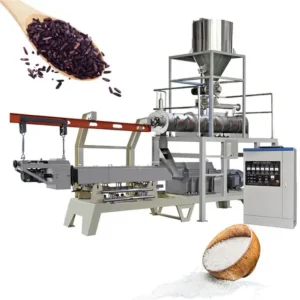
The twin-screw configuration allows operators to adjust shear profile, residence time, and barrel temperature zone by zone, which directly controls starch gelatinisation and the expansion ratio of each FRK kernel. Die aperture and land length set the cross-section, while post-die cutting defines the grain length. These parameters must be specified against the buyer’s actual flour blend and target kernel density — a generic screw build that works on pure rice flour may fail to produce acceptable texture when vitamin premix alters the viscosity [NEED_CITE: twin-screw extrusion screw configuration principles for food applications].
Reading the Specification Sheet: What the Numbers Actually Mean
The 100–500 kg/h range on this line depends entirely on what you are running and at what moisture level. A low-moisture couscous recipe moves through the barrel differently from a high-fortification FRK blend loaded with mineral premix, so capacity should be verified on your actual material before the line is finalized. The fully automatic production control maintains consistent feed rate, barrel temperature, and screw speed across shifts, which is what keeps kernel dimensions and fortification uniformity within tolerance from batch to batch. Food-grade stainless steel on all product contact surfaces simplifies wash-down between recipe changeovers and meets the hygiene expectations of institutional nutrition programmes. Voltage configurability from the standard 380V/50Hz to other industrial supply formats means the MCC and drive components can be specified to match the destination factory without post-delivery transformer additions.
The Hidden Cost of Unmatched Line Stations
When a buyer sources an extruder from one vendor and a dryer from another, the dryer is often sized on a nominal figure that does not account for the actual moisture load the extruder delivers. The result is kernels that emerge under-dried, clumping in the packaging, or a dryer running at maximum capacity just to keep up — leaving no headroom for recipe adjustments [NEED_CITE: food extrusion line throughput mismatch consequences]. This bottleneck pattern repeats with mixing systems that cannot replenish the extruder hopper fast enough and with flavouring or coating drums that sit half-empty. Every station on this line is specified together so that the weak link is not discovered during commissioning.
Why Source This Line Through mtfoodmachinery.com
The complete equipment catalogue here covers every station — mixing, extrusion, shaping, drying, cooling, and packing — under one supplier, which means throughput is matched across the entire sequence rather than assembled from disconnected purchase orders. Screw configuration and die design are specified to the buyer’s raw material and target kernel format, not copied from a generic build. An in-house testing workshop runs trial production on your actual flour blend before shipment, so texture and output rate are validated before the line is crated. The MT65 platform supports both small-scale and medium-scale fortified grain production, with voltage and control options configurable for international factory environments. Pre-sales consultation covers line layout and utility planning, followed by on-site installation, commissioning, and operator training.
Documentation & Verification
- Line layout and capacity calculation matched to your flour blend and target FRK kernel density
- Screw and die configuration record documenting barrel zone settings for your recipe
- Electrical schematic and voltage confirmation signed off before production begins
- Trial run report on your raw material verifying kernel shape, texture, and output rate
- CE declaration of conformity and ISO certificate for import compliance
- Operation and maintenance manual with illustrated wear parts replacement procedures
Installation, Commissioning & Support
- Foundation and floor space plan provided based on the MT65 line footprint and dryer length
- Dedicated circuit requirements confirmed for the extruder main motor and drying system heaters
- Modular station delivery allowing phased assembly in factories with limited overhead clearance
- First-run parameter setting on your raw material with barrel temperature and screw speed optimization
- Operator training covering recipe changeover, die replacement, and control system navigation
- Wear parts list with screw elements and die inserts identified for first reorder cycle
What to Include in Your Inquiry
To configure this Fortified Artificial Rice Production Line accurately, share your raw material formulation including flour type and premix ratio, your target kernel shape and density specification, and your local voltage and frequency. If you have an existing drying or packing system that the line must interface with, include those equipment details so the station matching accounts for the connection points.
Frequently Asked Questions
Q: How is the capacity range verified against my specific raw material and moisture content?
A: We run a trial production in our testing workshop using your actual flour blend and fortification premix. The trial measures throughput, kernel density, and texture against your target specification. The resulting report becomes the basis for final line configuration, so the capacity figure you receive is tied to your material rather than a generic benchmark.
Q: What voltage and frequency options are available, and how is compatibility confirmed?
A: The line is available with configurable voltage and frequency beyond the standard 380V/50Hz setup. Before production begins, we issue an electrical schematic and voltage confirmation document for your review. This ensures motor winding, transformer rating, and control component selection match your factory supply, avoiding delays at commissioning.
Q: How are screw configuration and die design selected for my target kernel format?
A: Screw element arrangement and die aperture are chosen based on your flour viscosity, target expansion ratio, and kernel dimensions. The twin-screw platform allows zone-by-zone adjustment of shear and temperature. We document the final configuration in a screw and die record so replacements and recipe adjustments can be made consistently.
Q: How is throughput balanced between stations to prevent bottlenecks?
A: Every station — mixer, extruder, shaper, dryer, and packing interface — is specified together based on the mass flow your recipe demands. Dryer residence time, conveyor speed, and mixer batch cycle are calculated against the extruder output so no single station limits the line or forces the operator to run equipment outside its intended range.
Q: What customization is available beyond the standard line configuration?
A: Customization covers logo and branding on machine panels, layout adjustments for your factory footprint, and drawing-based or sample-based mechanical modifications. Voltage, control language, and packaging format are also configurable. Each option is confirmed during the specification review stage before production starts.