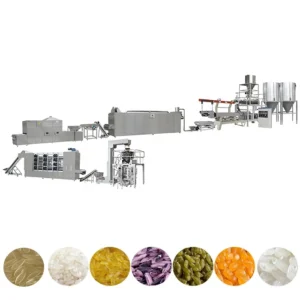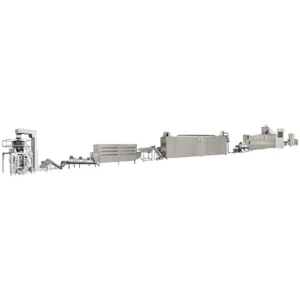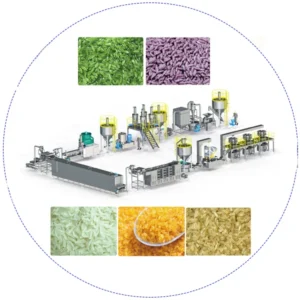
Integrated Station Matching — every mixer, extruder and fryer in the Fortified Nutritional Rice Production Line is capacity-balanced at the design stage, preventing the downstream bottleneck that plagues multi-vendor assemblies.
Technical Specifications
| Parameter | Value |
|---|---|
| Product Type | Fortified Nutritional Rice Production Line |
| Output Capacity | 70–300 kg/h (basis not stated in source — confirm raw material, moisture and grain formulation) |
| Voltage & Frequency | 380V / 50Hz |
| Construction Material | Food-grade stainless steel |
| Control System | Automatic control (PLC / MCC option to be confirmed) |
| Line Stations | Mixer, extrusion system, fryer |
| Assembly State | Complete integrated line |
| Color Options | Silver (stainless steel body) |
| Customization Scope | Minor adjustments, drawing-based, and full customization supported |
Application Suitability
| Application | Material or Output |
|---|---|
| Fortified rice production | Rice flour blended with micronutrient premix |
| Artificial rice from broken grains | Milled broken rice, starch and vitamin additives |
| Multigrain nutritional rice | Sorghum, millet, maize and legume flour blends |
| Institutional feeding programmes | Grain-based fortified kernels for school meal supply chains |
| Parboiled-style reconstituted rice | Pre-gelatinised rice flour with mineral fortification |
Why "70–300 kg/h" Means Nothing Without the Raw Material Context
Capacity figures on any Fortified Nutritional Rice Production Line full equipment range are only meaningful once the exact grain formulation and moisture content are locked in.
I have watched lines rated at a nominal output stall the moment the operator switches from standard white rice flour to a coarse millet-sorghum blend. The extrusion zone cannot reach gelatinisation temperature fast enough, throughput drops, and the fryer sits half-empty waiting for product. Buyers who quote a headline number to their board without confirming the formulation basis end up explaining the gap for months. [NEED_CITE: starch gelatinisation temperature ranges for common African and South Asian grain blends]
Station-by-Station Throughput Visibility
When you survey the Fortified Nutritional Rice Production Line full equipment range, every station — from the ribbon mixer through the twin or single-screw extruder to the continuous fryer — is listed with its own rated throughput. This lets you confirm that no single machine is oversized or undersized relative to its neighbours. A mixer that batches faster than the extruder can accept creates dead time; an extruder that pushes more dough than the fryer can handle creates a wet, unmanageable buffer.
Matching Extrusion Mechanics to Fortified Blends
The extrusion stage is where the entire Fortified Nutritional Rice Production Line full equipment range earns its keep. Screw configuration, barrel heating zones and die aperture must be chosen around the specific flour blend and the percentage of vitamin-mineral premix in the recipe. High fibre content changes melt viscosity; iron salts can accelerate screw wear. Without confirming these variables before build, the die may produce kernels that fracture during frying or fail the density test that institutional buyers require. [NEED_CITE: effect of micronutrient premix loading on extrusion melt viscosity]
Reading the Specification Sheet Beyond Headline Numbers
Voltage and frequency appear straightforward — 380V / 50Hz — yet many grain processing regions operate on 415V / 50Hz or 220V / 60Hz grids. Ordering a Fortified Nutritional Rice Production Line full equipment range without written voltage confirmation delays commissioning while transformers are sourced locally. The control system language matters equally: operators in Francophone West Africa need HMI screens in French, and PLC comments in the original language slow fault diagnosis. Always request the electrical schematic and a voltage declaration matched to the destination country before production begins.
The Hidden Cost of Picking Stations in Isolation
Procuring the mixer from one vendor, the extruder from another, and the fryer from a third often looks cheaper on the quotation sheet. The real expense surfaces during commissioning: mismatched conveyor heights, incompatible control signals, and a dryer or fryer that cannot keep pace. I spent three days on a site in East Africa rewiring relay logic because the fryer’s safety circuit did not communicate with the upstream extruder’s emergency stop. The line finally ran, but the owner had already lost a full production week. [NEED_CITE: integration risks in multi-vendor food processing lines]
Why Buyers Keep the Whole Catalogue Under One Roof
Sourcing the complete Fortified Nutritional Rice Production Line full equipment range from a single builder means throughput is calculated across every station before metal is cut. Screw and die configurations are specified against your actual grain formulation rather than copied from a generic template. Food-grade stainless steel contact surfaces are consistent from mixer to fryer, simplifying hygiene audits. Customization — whether a minor height adjustment, a drawing-based footprint change, or a full line redesign — stays within one engineering team, so revision control does not fragment. In-house trial runs on your raw material before shipment mean the first bag of product you see is not the first the machine has ever made.
Documentation & Verification
- Line layout drawing showing every station footprint and conveyor route for your workshop
- Capacity calculation sheet tied to your grain formulation and target moisture
- Electrical schematic with confirmed voltage, frequency and HMI language
- Factory test record run on your premix blend before dispatch
- Wear parts list covering screws, dies and fryer mesh belts
- Operation and maintenance manual with preventive service intervals
Installation, Commissioning & Support
- Foundation plan matching the line’s overall footprint and fryer exhaust requirements
- Dedicated circuit schedule for 380V main extruder motor and fryer heating elements
- Modular shipping configuration allowing container loading and on-site reassembly
- First-run parameter setting for barrel temperature zones and fryer residence time
- Operator training on automatic control interface and emergency stop sequence
- Spare screw and die set plus fryer belt sections stocked for first replacement cycle
What to Include in Your First Enquiry
Share the exact grain formulation — including the percentage of any vitamin-mineral premix — and the moisture content you plan to run. State your target daily output and the shift pattern your factory operates. Provide the local voltage, frequency and the preferred HMI language. If your workshop has height restrictions or an existing upstream milling line, send a dimensioned floor plan so the layout can be tailored before quotation.
Frequently Asked Questions
Q: What stations are included in this fortified rice production line?
A: The standard configuration covers a ribbon mixer, extrusion system and continuous fryer, connected by conveying equipment. Additional downstream stations such as cooling conveyors or packing hoppers can be integrated. Each station’s capacity is balanced during layout design so that no single unit bottlenecks the Fortified Nutritional Rice Production Line full equipment range.
Q: How do I confirm voltage and frequency for my market before ordering?
A: Provide your local supply standard and the installation site’s available amperage. The manufacturer issues an electrical schematic and voltage declaration matched to your grid. This document should be signed off before production begins to avoid transformer add-ons or motor rewinding during commissioning.
Q: Can I order individual stations instead of the full line?
A: Individual mixers, extruders or fryers from the Fortified Nutritional Rice Production Line full equipment range can be quoted separately. However, throughput matching is only guaranteed when the builder has visibility of every upstream and downstream unit. Standalone purchases require the buyer to confirm interface dimensions and control signal compatibility.
Q: What customization levels are available?
A: Three tiers are offered: minor adjustments such as conveyor length changes, drawing-based modifications where the buyer supplies workshop layouts, and full custom redesign of station arrangement and capacity. Each tier is documented in the line layout drawing and confirmed before production starts.
Q: How is the 70–300 kg/h output capacity verified?
A: That range applies under specific raw material and moisture conditions that must be confirmed with the manufacturer. The buyer’s actual grain formulation — including premix loading and moisture percentage — determines achievable throughput. A factory trial run on the customer’s recipe is the only reliable verification before shipment.