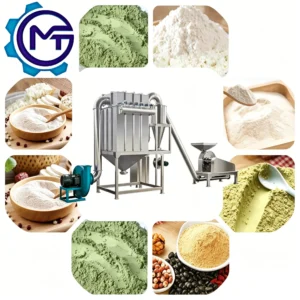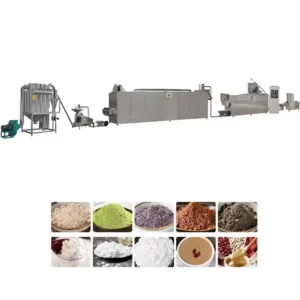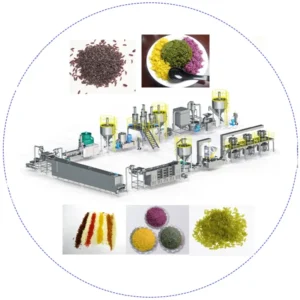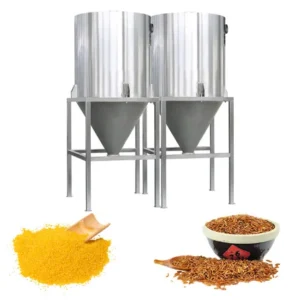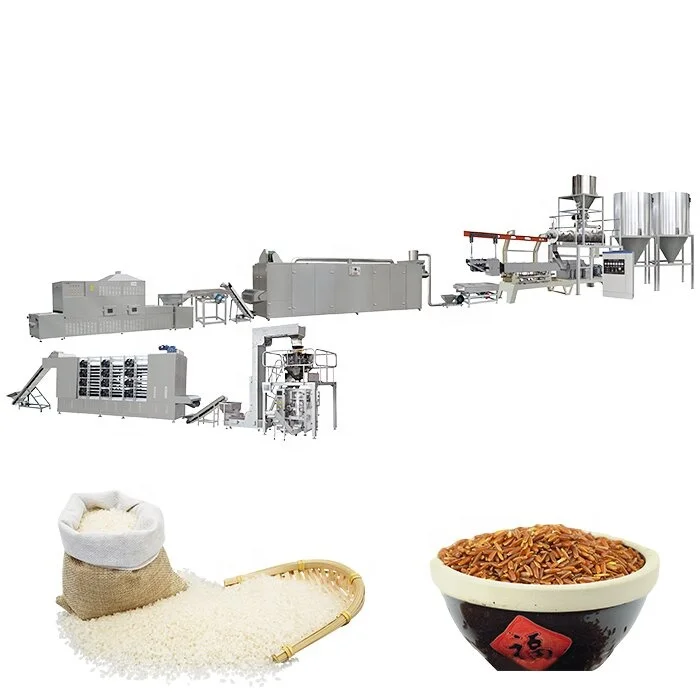
Throughput-Matched Station Design — Every mixer, extruder, dryer, and packing station in the Fortified Rice Kernel Extrusion Production Line is sized to the same real-world capacity, preventing hidden bottlenecks that occur when individual machines are sourced separately.
Technical Specifications
| Parameter | Value |
|---|---|
| Product Type | Fortified Rice Kernel Extrusion Production Line |
| Available Models | MT65 / MT70 / MT85 / MT75 / MT95 |
| Screw Type | Twin-screw |
| Installed Power | 85 kW (MT65) / 120 kW (MT70) / 235 kW (MT85) / 180 kW (MT75) / 260 kW (MT95) |
| Power Consumption | 60 kW (MT65) / 85 kW (MT70) / 165 kW (MT85) / 135 kW (MT75) / 195 kW (MT95) |
| Output Capacity | 80–100 kg/h (MT65) / 100–120 kg/h (MT70) / 200–300 kg/h (MT85) / 300–500 kg/h (MT75) / 800–1000 kg/h (MT95) (basis not stated in source — confirm raw material formulation and moisture content) |
| Overall Dimensions (L×W×H) | 28×1.2×2.2 m (MT65) / 30×1.5×2.2 m (MT70) / 34×3.5×4.3 m (MT85) / 32×3.5×4.3 m (MT75) / 36×3.5×4.3 m (MT95) |
| Control System | Frequency speed control, high automation |
| Drying Oven Heating Source | Electric or gas |
| Drying Oven Feature | Circulation drying, mesh belt speed controlled by frequency motor |
| Feeding System | Single or double screw feeding available based on material |
| Screw Material | Special wear-resistant technology |
| Lubrication System | Automatic lubricating and cooling |
| Voltage & Frequency | Customized to customer’s local supply |
| Assembly State | Complete line from mixing to packing |
| Standards | CE, ISO |
Application Suitability
| Application | Material or Output |
|---|---|
| Fortified rice kernel production | Broken rice, rice bran blended with vitamins and minerals |
| Artificial nutritional rice | Corn, millet, wheat, oats, buckwheat with added micronutrients |
| Starch-based grain analogues | Beans and native starch formulated into rice-shaped kernels |
| Infant and dietary nutrition rice | Grain blends meeting specific programme nutritional specifications |
Why Nominal Capacity Figures Can Mislead Your Line Plan
The stated output only holds when raw material formulation, moisture, and downstream matching are confirmed together.
I once watched a buyer sign off on a line rated for a target throughput, only to discover during commissioning that their high-protein premix required longer residence time in the extruder barrel. The real output dropped significantly because the dryer and cooler had been specified to the original figure. A Fortified Rice Production Line full equipment range must be surveyed station by station against the actual formulation you intend to run [NEED_CITE: impact of raw material protein content on extrusion throughput]. When the feeding system, extruder screw profile, dryer belt length, and cooler capacity are each validated against the same material, the number on the nameplate is the number you get on the floor.
Station-by-Station Equipment Survey
This is the angle where catalogue shopping separates from engineering. The Fortified Rice Production Line full equipment range covers every station from the initial batching mixer through extrusion, vibrating separation, low-temperature drying, cooling, high-temperature roasting, a second cooling stage, and final packing. Each piece of equipment carries its own capacity envelope, and the line only performs when those envelopes overlap cleanly at your target throughput.
How Throughput Matching Prevents Silent Bottlenecks
A dryer that is slightly undersized forces the extruder to run below its rated speed to prevent moisture carry-over into packing. A cooler that cannot shed heat fast enough causes kernels to clump before bagging. These mismatches rarely show up in a brochure because each machine, tested in isolation, meets its own spec. The problem surfaces only when they are linked in sequence. Reviewing the complete Fortified Rice Production Line full equipment range as one system — rather than as individual line items — is the only way to catch these gaps before fabrication begins [NEED_CITE: throughput balancing across consecutive processing stations].
Decoding the Core Extrusion Parameters
The twin-screw configuration handles a wider range of grain and starch blends than a single screw because intermeshing flights create positive conveying and self-wiping action, reducing dead zones where high-protein or high-fibre premixes can scorch. The automatic lubricating and cooling system keeps barrel temperature stable across long production runs, which directly affects starch gelatinisation consistency — a critical factor when the end product must hold a precise rice-kernel shape after drying. The frequency-controlled feeding system, selectable as single or double screw, ensures that material enters the barrel at a rate matched to the screw speed, preventing surges that cause uneven expansion. Drying oven circulation with a variable-speed mesh belt allows moisture removal to be tuned to kernel density; too fast and the surface case-hardens while the core stays wet, too slow and throughput suffers. These are the parameters that determine whether fortified kernels survive shipping and cooking intact.
The Hidden Cost of Undersized Downstream Stations
When a dryer or cooling conveyor is specified to a nominal output rather than to the actual moisture load leaving the extruder, the consequence is not a machine failure — it is a slow, cumulative loss of saleable product. Kernels that exit the dryer above target moisture develop mould in storage. Kernels that are over-dried fracture during packing, generating waste that is only noticed at end-of-month yield reconciliation. These losses are difficult to trace back to equipment sizing because they appear as raw material variance [NEED_CITE: moisture content tolerance in packaged grain products].
What Differentiates This Equipment Range
The full station list is engineered under one supplier, meaning throughput calculations are cross-checked between extruder output and dryer capacity before any machine is built. Screw configuration and die design are specified to the buyer’s raw material and target kernel shape rather than copied from a generic build. An in-house testing workshop allows trial runs on the customer’s actual premix before shipment, so product development happens at the factory, not on the buyer’s floor. Voltage, frequency, and control interface language are confirmed before production begins, avoiding commissioning delays. Every CE and ISO certificate is documentation the buyer receives, not a marketing claim [NEED_CITE: CE conformity documentation requirements for food processing machinery].
Documentation & Verification
- Line layout and capacity calculation showing throughput at every station
- Screw and die configuration record matched to your grain formulation
- Trial run report on your actual raw material before dispatch
- Electrical schematic with confirmed voltage and frequency
- Machine specification sheet for each station in the line
- Factory test record documenting pre-shipment performance
Installation, Commissioning & Support
- Floor plan accounts for the full line footprint from 28 m to 36 m length depending on model
- Electrical supply must match confirmed voltage and frequency with dedicated circuit for main extruder motor
- Equipment ships in modular sections for container loading and on-site assembly
- Commissioning includes screw speed, barrel temperature, and dryer belt calibration on your material
- Operators trained on frequency drive adjustment and automatic lubrication system monitoring
- Wear parts list covers screws, dies, and mesh belts with reorder specifications
What to Include in Your Enquiry
To size each station correctly, we need your intended base grain blend and the vitamin-mineral premix ratio, the target hourly output on that specific formulation, and the local voltage and frequency at the installation site. If you are integrating this line into an existing facility, share the available floor length and ceiling height so the layout can be drafted around your constraints. If you want a trial run on your material before commitment, send a representative sample batch to the testing workshop.
Frequently Asked Questions
Q: Which extruder model fits my target output and raw material?
A: Model selection depends on both the hourly capacity you need and the specific grain-protein formulation you will run. The MT65 through MT95 range covers small-batch to continuous industrial output, but the correct choice requires confirming your raw material’s moisture and protein behaviour under twin-screw extrusion. A trial run on your actual premix is the most reliable way to match model to material.
Q: How are downstream stations sized to match extruder throughput?
A: The dryer, cooler, and packing stations are each calculated against the moisture load and kernel volume leaving the extruder at your confirmed output. This means belt length, airflow, and packing speed are specified to the same real throughput, not to a generic nominal figure that may not apply to your formulation.
Q: What utility requirements does each station need?
A: The extruder requires a dedicated electrical circuit sized to its installed power, the drying oven runs on either electric or gas heating, and compressed air is needed for pneumatic controls and cleaning. Exact utility loads depend on the model selected and are confirmed in the electrical schematic before production.
Q: Can individual stations be ordered separately for an existing line?
A: Individual machines such as the extruder, drying oven, or cooling conveyor can be supplied standalone. However, throughput matching must still be verified against your existing upstream and downstream equipment to prevent capacity mismatches at the integration points.
Q: What spare wear parts are included and how are replacements sourced?
A: The initial shipment includes a wear parts list identifying screws, dies, and dryer mesh belts specific to your configuration. Replacement parts are manufactured to the same specification and can be ordered with the original part number recorded in your screw and die configuration document.