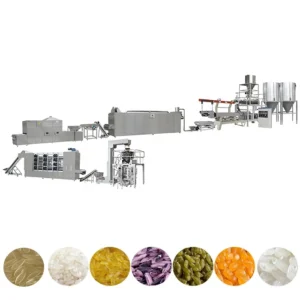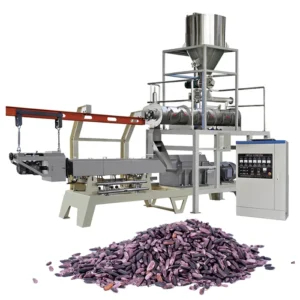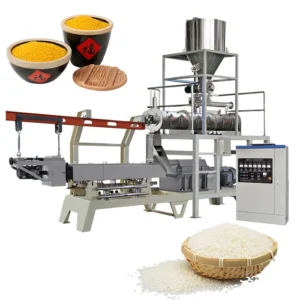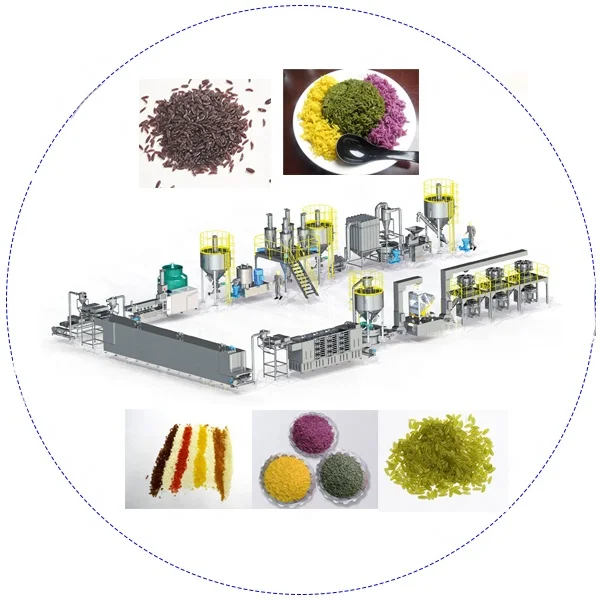
Throughput-Matched Station Design — every mixer, extruder, dryer, and cooler in the line is calculated against the same raw material basis so no single link bottlenecks the Fortified Rice Kernel Extrusion Production Line.
Technical Specifications
| Parameter | Value |
|---|---|
| Product Type | Fortified Rice Kernel Extrusion Production Line |
| Model Range | MT65 / MT70 / MT75 / MT85 / MT95 |
| Screw Type | Twin-screw |
| Installed Power | 85 kW (MT65) / 120 kW (MT70) / 180 kW (MT75) / 235 kW (MT85) / 260 kW (MT95) |
| Power Consumption | 60 kW (MT65) / 85 kW (MT70) / 135 kW (MT75) / 165 kW (MT85) / 195 kW (MT95) |
| Output Capacity | 80–100 kg/h (MT65, basis not stated in source) / 100–120 kg/h (MT70, basis not stated) / 300–500 kg/h (MT75, basis not stated) / 200–300 kg/h (MT85, basis not stated) / 800–1000 kg/h (MT95, basis not stated) |
| Feeding System | Single or double screw feeding, selected according to material |
| Speed Control | Frequency inverter (VFD) for extruder and dryer mesh belt |
| Lubrication | Automatic lubricating and cooling system |
| Line Stations | Mixing → Extruding → Vibrating → Low-temperature Drying → Cooling → High-temperature Roasting → Cooling → Packing |
| Dryer Heating Source | Electric or gas |
| Control System | PLC and MCC control |
| Voltage & Frequency | Customized to buyer’s local supply |
| Overall Dimensions (L×W×H) | 28×1.2×2.2 m (MT65) / 30×1.5×2.2 m (MT70) / 32×3.5×4.3 m (MT75) / 34×3.5×4.3 m (MT85) / 36×3.5×4.3 m (MT95) |
| Standards | CE, ISO certified |
Application Suitability
| Application | Material or Output |
|---|---|
| Fortified rice kernel production | Broken rice, corn, millet, wheat, oats, buckwheat, and bean base with vitamin and mineral premix |
| Artificial rice manufacturing | Alternative grains including corn, millet, buckwheat, and oats reprocessed into rice-shaped kernels |
| Grain reprocessing | Broken rice and rice bran converted into high-nutritional-value kernels with natural viscosity and elasticity |
| Nutritional food programs | Staple food fortification projects for institutional and humanitarian distribution |
Why "Nominal Capacity" Tells Only Part of the Story on a Fortified Rice Kernel Extrusion Production Line Equipment Manufacturer
Real output depends on your raw material blend, moisture content, and fortificant ratio — not the number on the nameplate.
I once watched a nutritional powder producer unbox a line that ran beautifully on standard rice flour during the factory test, only to see expansion collapse when they loaded their own high-fat multigrain premix. The screw combination had to be scrapped and rebuilt from scratch. That kind of mismatch happens more often than equipment catalogs suggest [NEED_CITE: common extrusion failures from untested raw material substitution]. When you evaluate a Fortified Rice Kernel Extrusion Production Line Equipment Manufacturer, the question is never just what the extruder can push through in an hour — it is whether every station from mixer to packer has been balanced against your actual formula.
Station Sequence and Where Each Link Fits
The line follows a deliberate sequence: mixing, extruding, vibrating, low-temperature drying, cooling, high-temperature roasting, a second cooling stage, and packing. Each station exists for a reason. The vibrating conveyor separates kernels that exit the die plate slightly stuck together. Low-temperature drying removes surface moisture without case-hardening the exterior, while the high-temperature roasting stage develops the final texture and cooking behavior that consumers expect from rice. Skipping or undersizing any one of these stages creates a bottleneck that the rest of the Fortified Rice Kernel Extrusion Production Line Equipment Manufacturer catalogue cannot compensate for.
Throughput Balance Across the Full Equipment Range
A twin-screw extruder rated at a given capacity means little if the downstream dryer can only handle a fraction of that volume. The equipment on mtfoodmachinery.com is configured so that mesh belt width, dryer length, and cooling conveyor capacity track the extruder output tier you select [NEED_CITE: principles of line throughput balancing in extrusion plants]. The frequency inverter on the dryer belt lets operators fine-tune residence time without changing the extruder screw speed, keeping product density stable even when ambient humidity shifts between seasons.
Reading the Specs: What Power and Dimensions Actually Mean for Your Floor
The five models — MT65, MT70, MT75, MT85, and MT95 — span from pilot-scale trials to large-volume production. Installed power climbs from 85 kW to 260 kW, but actual consumption runs roughly 65–75% of that figure during steady-state operation, which matters for your transformer sizing and monthly utility budget. Line footprint grows from a 28-meter run on the MT65 to a 36-meter layout on the MT95, and the wider models (MT75 and above) require a 3.5-meter width that influences column spacing in your building plan. The twin-screw design across the range ensures consistent shear and mixing action whether you run pure starch or a fibrous buckwheat blend. Automatic lubrication and cooling keep barrel temperature within tolerance during extended shifts, reducing the chance of starch gelatinisation drift that would alter kernel density from morning to evening production.
The Hidden Cost of Mismatched Configurations
When a buyer sources the extruder from one vendor and the dryer from another, the two machines rarely speak the same throughput language. I have seen rice kernel lines where the extruder pushed product faster than the dryer could remove moisture, leaving kernels with a soft core that crumbled during packing. Downstream rejects climbed, and the operator blamed the extruder when the real problem was an undersized drying section [NEED_CITE: impact of station mismatch on product integrity in extrusion lines]. Specifying the entire line from one equipment range avoids this failure mode because every station is selected against the same capacity target.
Why Buyers Specify from This Equipment Range
Complete station coverage from mixing through packing under one supplier means throughput is matched across every link rather than assembled from separate vendors. Screw configuration and die design are specified to the buyer’s actual raw material and target kernel size, not copied from a generic build. An in-house testing workshop allows trial runs on customer-supplied ingredients before shipment, catching formulation surprises early. The range covers pet food, aquatic feed, snack, cereal, starch, and protein applications, so cross-category experience informs screw and barrel selection. Pre-sales consultation extends through engineer design, on-site installation, commissioning, and ongoing maintenance support.
Documentation & Verification
- Line layout and capacity calculation showing balanced throughput for each station on your Fortified Rice Kernel Extrusion Production Line
- Screw and die configuration record matched to your specific grain and fortificant blend
- Trial run report on customer raw material conducted before dispatch
- Electrical schematic and voltage confirmation aligned to your factory supply
- Operation and maintenance manual with wear parts list for screw elements and dies
- CE declaration of conformity and ISO certificate included with shipment documentation
Installation, Commissioning & Support
- Floor space requirement spans 28 to 36 meters depending on model; confirm column clearance for the 4.3-meter peak height on MT75/MT85/MT95
- Dedicated power circuit sized to the installed power rating of your selected model, up to 260 kW for the MT95
- PLC and MCC control panels arrive pre-wired; on-site commissioning includes voltage and phase rotation verification
- First-run parameter setting covers barrel temperature zones, screw speed, and dryer mesh belt frequency
- Operator training addresses screw element replacement intervals and automatic lubrication system monitoring
- Wear parts list covers screws, dies, and barrel liners with recommended stock quantities for continuous operation
What to Prepare Before Requesting a Quote
To size the line correctly, share your base ingredient list with approximate ratios — broken rice, corn flour, buckwheat, or whatever your formula calls for — along with the vitamin and mineral premix percentage. Confirm your target daily output and whether you plan single-shift or continuous operation. Provide your factory voltage, frequency, and preferred control language so the electrical schematic matches local standards from the start. If you have existing upstream batching or downstream packing equipment, note the connection points so the Fortified Rice Kernel Extrusion Production Line Equipment Manufacturer can align conveyor heights and signal interfaces.
Frequently Asked Questions
Q: How do I verify that every station in the line matches in throughput?
A: Request the line layout and capacity calculation document, which lists each station’s design throughput based on your raw material. The calculation shows mixer batch size, extruder output, dryer belt load, and packing speed aligned to one target, so you can see where each station sits relative to the others rather than relying on a single extruder number.
Q: Which extruder model fits my target capacity?
A: The MT65 suits pilot and small-batch work, the MT70 and MT85 cover mid-range commercial volumes, the MT75 handles higher output in a slightly more compact footprint than the MT85, and the MT95 targets large-scale production. Actual output depends on your raw material and moisture, so request a trial run to confirm capacity on your blend.
Q: What does each station in the sequence actually do?
A: Mixing blends grain and fortificants. Extruding gelatinises starch and forms kernel shape through the die. Vibrating separates stuck kernels. Low-temperature drying removes surface moisture. Cooling stabilizes the kernel before high-temperature roasting, which develops final texture. A second cooling stage brings temperature down before packing to prevent condensation in bags.
Q: Electric or gas dryer — how should I decide for my factory?
A: Electric heating offers simpler installation and precise zone control but demands higher electrical capacity. Gas heating reduces electrical load and can lower running costs where gas tariffs are favorable. The choice affects your utility planning and the transformer or gas line you need to arrange before the Fortified Rice Kernel Extrusion Production Line Equipment Manufacturer ships the equipment.
Q: What supporting equipment should I specify alongside the extrusion line?
A: Beyond the extrusion stations, consider whether you need a dedicated batching and weighing system for accurate fortificant dosing, a packing line with multi-head weighers for bag filling, and utility connections such as compressed air and water supply. Confirming these items early ensures the line layout accounts for all connection points.