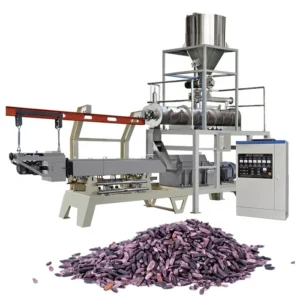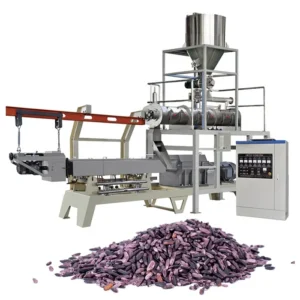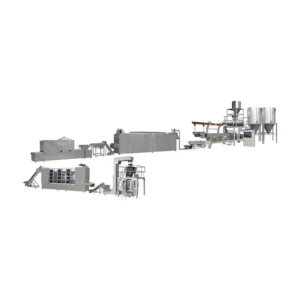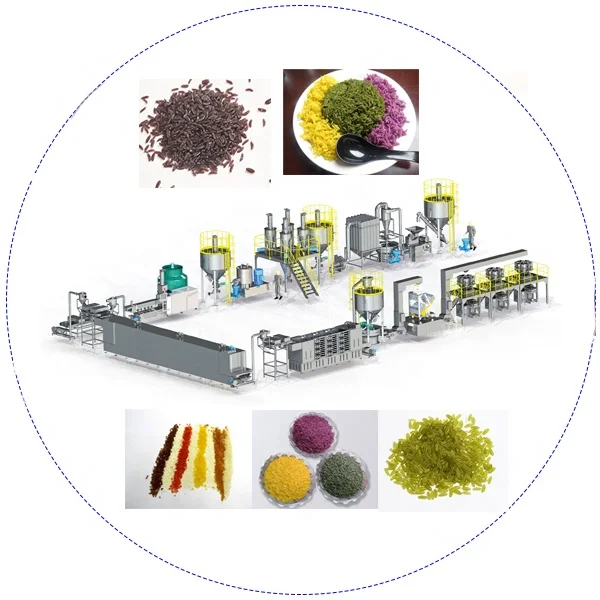
Throughput Matched End-to-End — every station from batching to packing is sized to hold the same output on your actual grain formulation rather than assembled from mismatched vendors.
Technical Specifications
| Parameter | Value |
|---|---|
| Product Type | Fortified Rice Production Line |
| Models Available | MT65 / MT70 / MT85 / MT75 / MT95 |
| Installed Power | 85 kW (MT65) / 120 kW (MT70) / 235 kW (MT85) / 180 kW (MT75) / 260 kW (MT95) |
| Power Consumption | 60 kW (MT65) / 85 kW (MT70) / 165 kW (MT85) / 135 kW (MT75) / 195 kW (MT95) |
| Output Capacity | 80–100 kg/h (MT65) / 100–120 kg/h (MT70) / 200–300 kg/h (MT85) / 300–500 kg/h (MT75) / 800–1000 kg/h (MT95) (basis not stated in source — confirm raw material formulation / moisture content) |
| Voltage | 220V / 380V (frequency configurable to 50Hz or 60Hz) |
| Control System | PLC controlled with frequency speed control |
| Overall Dimensions (L×W×H) | 28 × 1.2 × 2.2 m (MT65) to 36 × 3.5 × 4.3 m (MT95) |
| Screw Type | Twin screw (single or double screw feeding system available) |
| Lubrication | Automatic lubricating and cooling system |
| Heating Source (Dryer) | Electric or gas |
| Dryer Feature | Circulation drying with frequency motor-controlled mesh belt speed |
| Material | Stainless steel (food-grade contact) |
| Color | Silver |
| Warranty | 1 year (core components: motor) |
| Assembly State | Complete line (mixing, extruding, vibrating, low-temperature drying, cooling, high-temperature roasting, cooling, packing) |
| Machinery Test Report | Provided |
| Video Outgoing Inspection | Provided |
Application Suitability
| Application | Material or Output |
|---|---|
| Fortified rice kernel production | Broken rice, rice bran, corn, millet, wheat, oats, buckwheat, beans, starch with added vitamins and minerals |
| Nutritional rice for food programmes | Vitamin- and mineral-enriched rice kernels for relief and institutional supply |
| Value-added artificial rice for retail | Reconstituted grain kernels for food & beverage factories, restaurants, and food shops |
| Grain processing diversification | Artificial rice line alongside existing milling operations using milled by-products |
Why "Rated Capacity" Means Nothing Without Your Recipe
The Fortified Rice Production Line full equipment range only holds its stated output when the extruder, dryer, and roaster are all sized to your actual grain blend and moisture target.
I have stood in front of extruders that looked perfect on paper, only to watch throughput drop the moment the operator switched from standard rice flour to a multi-grain formulation loaded with bran and bean flour. The screw speed that worked on white rice burned the product on a high-fiber mix. The dryer that kept up at low moisture could not remove enough water when the feed entered at a higher percentage. These mismatches do not show up in a brochure — they appear on your factory floor during commissioning. [NEED_CITE: grain formulation effects on extrusion throughput and drying load]
How Each Station Connects to the Next
A Fortified Rice Production Line full equipment range is only as productive as its slowest station. If the extruder pushes 300 kg/h of wet, expanded kernels but the dryer can only handle 200 kg/h, the line backs up and operators start cycling the extruder on and off. That stop-start pattern introduces density variation in the finished rice kernel and wastes energy on repeated thermal ramp-up. Every conveyor, dryer belt, and cooling fan in this lineup is selected so that material flows continuously from the mixer through to packing without manual buffering.
Matching Dryer and Roaster to Extruder Output
The circulation drying oven uses a frequency-controlled mesh belt, meaning belt speed adjusts independently of extruder speed. This matters because different grain blends exit the die at different moisture levels. A formulation heavy in broken rice may need a shorter dwell time than one loaded with oat and buckwheat flour. The roaster downstream then applies high-temperature finish to develop colour and shelf stability. If the roaster is undersized, kernels pile up on the belt and scorch on one side while remaining pale on the other. [NEED_CITE: drying uniformity requirements for extruded grain kernels]
Reading the Spec Sheet for What It Actually Tells You
The twin-screw design across the MT65 through MT95 models gives operators independent control over shear and residence time. A longer barrel section with a specific screw element arrangement allows starch gelatinisation at lower barrel temperatures, which protects heat-sensitive vitamin premixes. The automatic lubricating and cooling system keeps the gearbox within operating limits during continuous shifts — without it, thermal expansion in the bearing housing can shift screw alignment and create uneven wear on the flight edges. The PLC with frequency speed control means both screw speed and feeder speed adjust on the fly, so if a new batch of rice bran arrives at a different moisture level, the operator compensates without stopping the line. Stainless steel food-grade contact surfaces throughout the product zone prevent iron contamination that would otherwise catalyse fat oxidation in any added micronutrient oils.
What Happens When the Line Is Assembled from Separate Vendors
I have seen buyers source the extruder from one factory and the dryer from another, then discover during installation that the dryer inlet height does not match the extruder discharge. Adapters get welded on site, which means the line runs for weeks before anyone notices the vibration from the mismatch is cracking the die plate. When throughput is mismatched, the bottleneck station forces every upstream machine to idle periodically, and those start-stop cycles shorten screw and bearing life. [NEED_CITE: mechanical fatigue from cyclic loading in extrusion drive trains]
Why Buyers Source the Full Range Here
The line layout document you receive shows calculated throughput at every station, not just at the extruder. Screw and die configuration is specified against the grain blend you send us, so the kernel shape and density match what your market expects. Voltage and control language are confirmed before production starts, so the PLC boots in your operator’s language on day one. A trial run on your actual raw material happens in our testing workshop before the machines ship, and the parameters from that run are documented in your delivery file. Spare screws, dies, and wear seals are listed with part numbers so you can reorder without reverse-engineering components on site.
Documentation & Verification
- Line layout with throughput calculation at every station from mixer to packer
- Screw and die configuration record matched to your grain blend and kernel shape
- Electrical schematic with voltage, frequency, and control language confirmed for your market
- Trial run report on your actual raw material conducted before shipment
- Machinery test report and video outgoing inspection provided with dispatch
Installation, Commissioning & Support
- Foundation plan provided for the 34 m to 36 m line footprint depending on model selected
- Dedicated circuit sizing specified for the 85 kW to 260 kW installed power range
- Machines arrive in modular sections for assembly inside standard industrial doorways
- First-run parameter set loaded from the factory trial into the PLC before handover
- Operator training covers screw speed, feeder rate, and dryer belt frequency adjustment
- Wear parts list with reorder codes for screws, dies, and gearbox seals included at delivery
What We Need to Size Your Line Accurately
Send us the grain blend you intend to run — including the percentage of broken rice, bran, starch, and any vitamin premix — along with the moisture content at the mixer outlet. Tell us your target hourly output and the number of shifts per day. Share your local voltage, frequency, and the language your operators read. If you already have upstream milling or downstream packing equipment, give us the interface dimensions so we can match the infeed and discharge heights.
Frequently Asked Questions
Q: How is line capacity verified against my specific raw material formulation?
A: We run your actual grain blend through the extruder in our testing workshop before shipment. The trial records screw speed, barrel temperature profile, moisture input, and output rate. Those parameters are written into your delivery file so commissioning starts from a proven baseline rather than generic defaults.
Q: Which extruder model fits my target output?
A: Models span from the MT65 at lower throughputs to the MT95 at higher volumes, each rated with installed and consumed power. Selection depends on your formulation and daily shift plan. Single or double screw feeding is available across the range to match how your premix behaves in the hopper.
Q: How are dryer and roaster capacities matched to the extruder?
A: The circulation drying oven and high-temperature roaster are specified so that belt speed, heating capacity, and dwell time handle the full extruder output without product backing up. Frequency motor control on the dryer belt lets operators fine-tune residence time for different grain blends.
Q: What voltage and control language options are available?
A: The line supports 220V and 380V configurations, with frequency set to 50Hz or 60Hz for your market. The PLC interface and HMI labels are configured in your operator’s language before the machines leave the factory, confirmed during the pre-shipment documentation review.
Q: Which spare wear parts are included and how are replacements supplied?
A: The delivery includes a wear parts list identifying screws, dies, and gearbox seals with part numbers. Replacement components are manufactured to the same configuration record used for your original setup, so fit and performance remain consistent across changeouts.