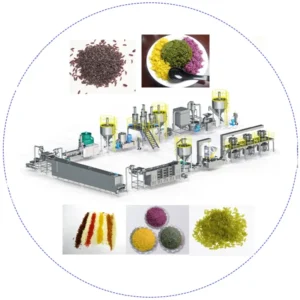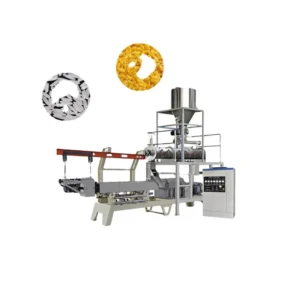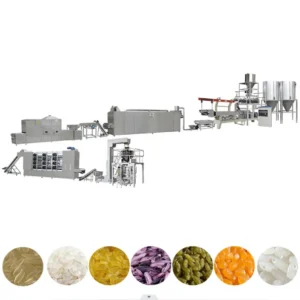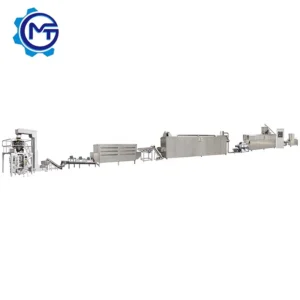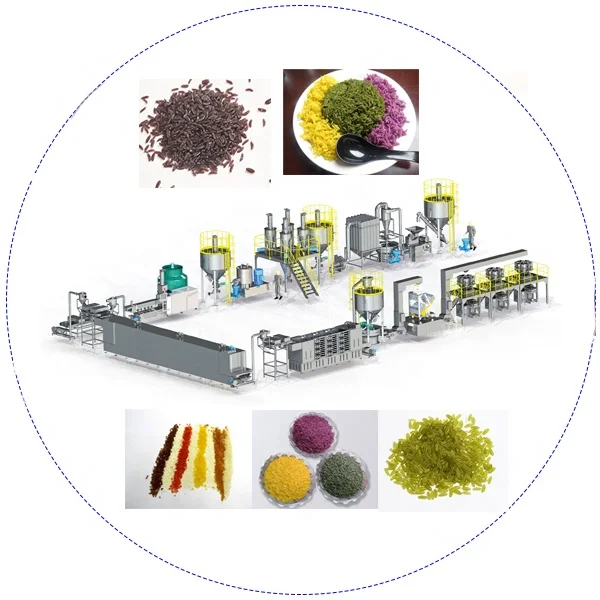
Single-Source Line Build — Every station from batching through packing is sized against the extruder’s real throughput on your grain blend, preventing the dryer or cooler from capping your artificial rice production line for sale below nameplate.
Technical Specifications
| Parameter | Value |
|---|---|
| Product Type | Fortified Artificial Rice Production Line |
| Available Models | MT65 / MT70 / MT85 / MT75 / MT95 |
| Extruder Type | Twin-screw (single or double screw feeding system selectable) |
| MT65 Installed / Consumed Power | 85 kW / 60 kW |
| MT70 Installed / Consumed Power | 120 kW / 85 kW |
| MT85 Installed / Consumed Power | 235 kW / 165 kW |
| MT75 Installed / Consumed Power | 180 kW / 135 kW |
| MT95 Installed / Consumed Power | 260 kW / 195 kW |
| Output Capacity (basis to be confirmed) | 80–1000 kg/h depending on model and raw material formulation |
| Voltage | 220V / 380V (frequency configurable) |
| Control System | Frequency speed controlling with high automation |
| Lubrication & Cooling | Automatic lubricating and cooling system |
| Drying Oven Heating Source | Electric or gas |
| Drying Method | Circulation drying, mesh belt speed controlled by frequency motor |
| Line Stations | Mixing → Extruding → Vibrating → Low-temperature drying → Cooling → High-temperature roasting → Cooling → Packing |
| Contact Material | Stainless Steel (food-grade contact parts) |
| Machine Test Report | Provided |
| Video Outgoing-Inspection | Provided |
| Warranty | 1 Year (core component: motor) |
Application Suitability
| Application | Material or Output |
|---|---|
| Nutritional rice kernel production | Broken rice, rice bran, corn, millet, starch with vitamin and mineral premix |
| Fortified staple grain processing | Wheat, oats, buckwheat, beans blended with micronutrient supplements |
| Value-added rice recovery | Broken rice fractions reconstituted into uniform, market-grade kernels |
| Institutional nutrition programmes | Fortified rice kernels meeting government or NGO micronutrient density specifications |
| Retail consumer packaged goods | Shelf-stable artificial rice kernels for food shops and supermarket channels |
Why the Stated kg/h Figure Means Nothing Without Your Recipe
The capacity number on the spec sheet is only valid when the raw material formulation, moisture content, and target kernel density are defined together.
When a buyer evaluates an artificial rice production line for sale based purely on a headline kg/h number, the first real test on site often tells a different story. I have watched a fortified rice line grind to a halt because the buyer’s local starch blend gelatinised at a different rate than the supplier’s test material. The extruder pushed volume, but the downstream dryer could not pull moisture evenly, and cracked kernels accumulated by the kilo over four days of troubleshooting [NEED_CITE: starch gelatinisation behaviour across grain blends]. Until the recipe was locked and every station was re-balanced to that specific blend, the line never reached its nameplate output.
How Each Station Links to the Next
A complete artificial rice making machine full equipment range is only as reliable as its weakest throughput match. The mixer must feed the twin-screw extruder at a rate that keeps the barrel fill consistent; the vibrating conveyor must spread kernels in a single layer before they enter the low-temperature drying zone; the circulation drying oven must remove moisture uniformly before the high-temperature roasting stage sets the final kernel structure. If any one of these stations is undersized, material piles up or starves the next step. Sourcing every station from a single build allows the line layout to be calculated as one system rather than assembled from independent vendor quotes.
What the Screw and Die Configuration Actually Controls
The twin-screw extruder in this artificial rice production line for sale is configured with a screw profile and die geometry matched to the buyer’s exact grain blend and target kernel shape. Screw element arrangement — conveying, kneading, and reverse-flight sections — determines residence time, shear intensity, and the degree of starch gelatinisation inside the barrel. Die aperture and land length govern kernel density and surface finish. A configuration pulled from a generic build may produce kernels that fracture during drying or fail to hold the added micronutrient premix evenly through the matrix [NEED_CITE: twin-screw extrusion die design for shaped food products].
Reading the Power and Drying Specs for Real-World Planning
Installed power across the model range runs from 85 kW on the MT65 up to 260 kW on the MT95, while actual consumption sits roughly 25–30 percent lower. That gap matters when sizing the main breaker and dedicated circuit for the extruder drive. The drying oven offers electric or gas heating; gas significantly lowers running cost in markets where industrial tariffs are high, but requires on-site gas plumbing and combustion ventilation. Mesh belt speed on the dryer is frequency-controlled, allowing operators to tune dwell time to the moisture curve of their specific formulation rather than running a fixed cycle. Selectable single or double screw feeding on the extruder inlet lets the line handle both free-flowing grain flour and sticky, high-moisture premixes without bridging in the hopper.
The Cost of Skipping the Trial Run
I once shipped a fortified rice line where the buyer approved the order on a sample made from the supplier’s standard rice-starch blend. When the line arrived and ran on the buyer’s locally sourced broken rice and bean flour, kernel fracture rates climbed sharply because the gelatinisation window was narrower than expected. Four days of on-site parameter adjustment were needed before output stabilised within acceptable limits. Since then, I insist that a trial run on the buyer’s actual raw material happens in the testing workshop before the line leaves the factory, and the resulting report is attached to the shipping documents [NEED_CITE: pre-shipment trial run documentation standards].
Why Buyers Source the Full Range Here
Every station is engineered under one roof, so the extruder output, dryer belt area, and cooler air volume are calculated together rather than quoted from separate catalogues. Screw and die configuration is specified to the buyer’s grain formulation and kernel target, not copied from a default build. An in-house testing workshop runs the buyer’s raw material before shipment, generating a trial report that travels with the machine. Frequency-controlled drives across the extruder, dryer mesh belt, and cooling conveyors give operators the adjustment range to dial in new recipes without hardware changes. Food-grade stainless steel contact parts and CE documentation support regulatory submissions in export markets [NEED_CITE: CE machinery directive for food processing equipment].
Documentation & Verification
- Line layout with throughput calculation matched to your grain formulation
- Screw and die configuration record for your target kernel shape
- Trial run report on your raw material from the in-house workshop
- Electrical schematic with confirmed voltage and frequency
- Factory test record and video outgoing-inspection before dispatch
Installation, Commissioning & Support
- Floor plan and utility load list based on the selected model’s overall dimensions and installed power
- Dedicated circuit sizing for 220V or 380V supply with confirmed frequency
- Assembly sequencing for multi-section drying oven and cooling conveyors
- First-run parameter setting on your grain blend, referencing the trial run report
- Operator training on frequency-controlled drives and automatic lubrication system
- Wear parts list covering screws and dies with recommended first replacement interval
What to Prepare Before Requesting a Quote
Share your primary grain ingredients and any micronutrient premix composition so the screw configuration can be matched to your blend. Confirm your local voltage, frequency, and preferred control panel language to avoid wiring and programming rework on site. Provide the available workshop footprint and ceiling height so the line layout — including the drying oven and cooling conveyors — can be arranged without compromising maintenance access.
Frequently Asked Questions
Q: How is the quoted kg/h output verified for my specific formulation?
A: Output is confirmed by running your raw material blend in the in-house testing workshop before shipment. The trial run report records actual throughput, kernel density, and moisture at each station, so the capacity figure you receive reflects your recipe rather than a generic starch baseline.
Q: Can the dryer and cooler match the extruder’s real throughput on my material?
A: Yes. Every station in the line is sized during the layout phase using the extruder’s proven output on your grain blend, not its maximum nameplate rating. This prevents downstream bottlenecks that would otherwise cap production below expectations.
Q: What voltage, frequency, and control language options are available?
A: The line supports 220V or 380V with configurable frequency to match your local grid. Control panel labels, HMI interface language, and electrical schematics are confirmed during the specification stage before production begins.
Q: Is a trial run on my raw material conducted before shipment?
A: A full trial run using your supplied grain blend and premix is completed in the testing workshop. The resulting report — covering extruder parameters, drying curve, and kernel quality — is included in the shipping documentation for your reference.
Q: What spare wear parts come with the line, and when should they first be replaced?
A: The shipment includes a wear parts list specifying screws and dies matched to your configuration. A recommended first replacement schedule is provided based on the abrasiveness of your grain blend and the trial run operating hours recorded before dispatch.