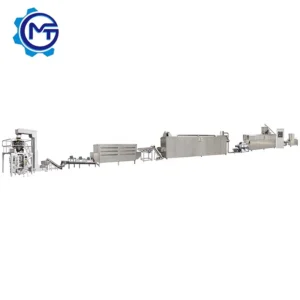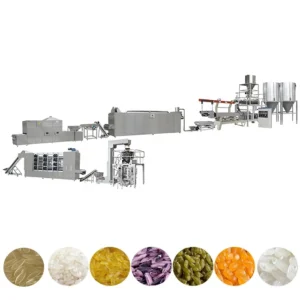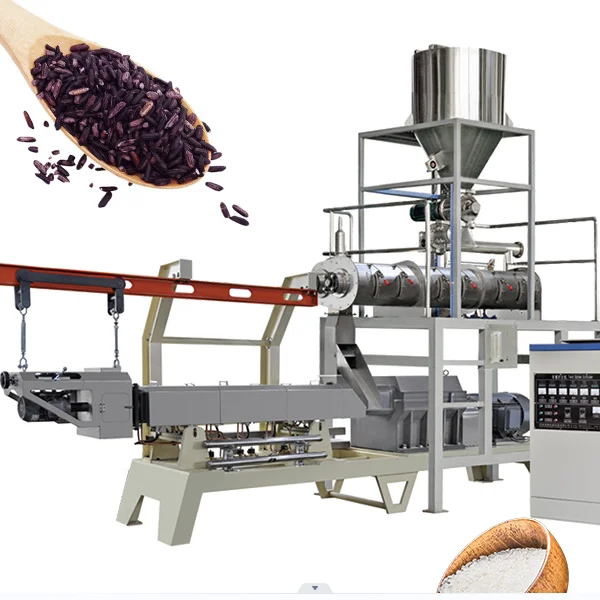
Matched station throughput across mixing, extrusion, drying, roasting and packing — every segment of the fortified rice production line is specified to the buyer’s grain blend so no single machine bottlenecks the next.
Technical Specifications
| Parameter | Value |
|---|---|
| Model | MT65 / MT70 / MT85 / MT75 / MT95 |
| Product Type | Fortified Rice Production Line / Nutritional Rice Extruder Line |
| Extruder Type | Twin-screw |
| Overall Capacity Range | 100–1000 kg/h with different model machines (basis not stated in source — confirm raw material formulation / moisture content) |
| Installed Power | 85 kW (MT65) / 120 kW (MT70) / 235 kW (MT85) / 180 kW (MT75) / 260 kW (MT95) |
| Power Consumption | 60 kW (MT65) / 85 kW (MT70) / 165 kW (MT85) / 135 kW (MT75) / 195 kW (MT95) |
| Output Capacity | MT65: 80–100 kg/h; MT70: 100–120 kg/h; MT85: 200–300 kg/h; MT75: 300–500 kg/h; MT95: 800–1000 kg/h (basis not stated in source — confirm raw material / moisture) |
| Dimensions (L × W × H) | MT65: 28 × 1.2 × 2.2 m; MT70: 30 × 1.5 × 2.2 m; MT85: 34 × 3.5 × 4.3 m; MT75: 32 × 3.5 × 4.3 m; MT95: 36 × 3.5 × 4.3 m |
| Basic Raw Materials | Broken rice, rice, corn, millet, wheat, oats, buckwheat, bean, starch, vitamin and mineral additives |
| Final Products | Artificial rice, fortified rice kernels |
| Production Procedure | Mixing → Extruding → Vibrating → Low Temperature Drying → Cooling → High Temperature Roasting → Cooling → Packing |
| Drying Oven Heating Source | Electric or gas |
| Drying Method | Circulation drying with frequency motor-controlled mesh belt speed |
| Control System | Frequency speed control; automated operation |
| Extruder Construction | Automatic lubricating and cooling system |
| Assembly State | Complete line configuration |
| Standards | CE; ISO |
Application Suitability
| Application | Material or Output |
|---|---|
| Grain reprocessing into fortified rice kernels | Broken rice and rice bran blended with vitamin and mineral premix |
| Artificial rice manufacturing | Corn, millet, wheat, oats, buckwheat or bean-based flour formulations |
| Food nutrition programme supply | Enriched rice kernels with controlled micronutrient dosing for institutional distribution |
| Value-added staple food production | Starch-based raw material blends targeting specific cooking and rehydration behaviour |
What "300 kg/h" Leaves Out About Your Grain Formula
Nominal output figures assume a reference material that is almost never the buyer’s actual recipe.
When a fortified rice production line equipment supplier quotes a capacity number, that number typically comes from a trial run on a standard rice starch formulation at a specific moisture percentage. Switch the blend to include buckwheat, bean flour or a heavy vitamin premix load and the extruder behaviour changes. Gelatinisation temperature shifts, die pressure climbs and the real throughput drops — sometimes substantially. I once watched a line stall on a brown rice recipe because the configuration was set for white rice starch behaviour. Before any capacity claim is accepted, the buyer needs to see that figure tied to their exact raw material and moisture level [NEED_CITE: starch gelatinisation behaviour across grain types in twin-screw extrusion].
Every Station Mapped From Batching Through Packing
This nutritional rice extruder for sale is specified as a full sequence: mixing, extruding, vibrating, low temperature drying, cooling, high temperature roasting, a second cooling stage and packing. Each station connects to the next with conveying equipment sized to the same throughput target. The advantage of sourcing the fortified rice production line equipment from a single manufacturer is that the dryer belt width, the roaster chamber volume and the cooling conveyor length are all calculated against the extruder output rather than ordered independently and hoped to match.
How the Drying and Roasting Stages Shape the Final Kernel
After extrusion, the rice kernels enter a low temperature drying oven where circulation air and a frequency-controlled mesh belt gradually reduce moisture without cracking the kernel surface. This stage determines whether the kernels survive handling and storage. The subsequent high temperature roasting step develops the colour, aroma and cooking behaviour that end users expect. Both stages offer electric or gas heating options, and the belt speed on the dryer is adjustable through a frequency motor so drying residence time can be tuned to the formulation [NEED_CITE: moisture migration and surface integrity during low-temperature grain kernel drying].
Reading the Power and Capacity Figures Against Your Recipe
The MT65 draws 60 kW during operation and the MT95 draws 195 kW, but those consumption values assume a reference load on a standard grain blend. Installed power is higher across every model to cover startup torque and peak shear events when denser ingredients pass through the screw section. The twin-screw design with automatic lubrication and cooling keeps barrel temperature stable across long runs. Frequency speed control on the main drive means screw RPM can be adjusted without stopping the line, which matters when switching between a corn-dominant formula and a bean-dominant formula that each demand different shear profiles. The dimension range from 28 m to 36 m total line length also dictates floor space planning well before the equipment arrives.
The Cost of Mismatched Stations in a Grain Extrusion Line
When the dryer is undersized relative to the extruder, wet kernels pile up at the transition point, surface moisture causes clumping and the roasting stage receives inconsistent input. When the roaster is oversized, kernels over-dry and crack during packing. These imbalances rarely show up during a short factory test on standard material — they appear weeks into production when the buyer switches to their commercial recipe. Resolving them after installation means replacing or reconfiguring equipment while the line sits idle [NEED_CITE: throughput bottleneck diagnosis in multi-stage food processing lines].
Why Sourcing the Full Line From One Builder Matters
Every station from the mixer to the packing conveyor is configured under one engineering scope, so throughput calculations reference the same raw material data across all segments. Screw and die selection is recorded against the buyer’s ingredient blend rather than copied from a generic build. The in-house testing workshop runs the buyer’s actual grain formulation before the line ships, producing a trial report that confirms capacity, kernel density and drying behaviour on real material. Pre-sales consultation covers electrical schematic review, voltage and frequency confirmation and control language specification. After delivery, on-site installation includes commissioning and operator training by engineers who assembled and tested that same line configuration.
Documentation & Verification
- Line layout and capacity calculation matched to your grain formulation and target kernel weight
- Screw and die configuration record tied to your specific ingredient blend and moisture level
- Trial run report on your raw material produced in the testing workshop before shipment
- Electrical schematic with confirmed voltage, frequency and control language for your facility
- Factory test record documenting output and power draw on your recipe before dispatch
Installation, Commissioning & Support
- Floor space planning based on line length from 28 m to 36 m depending on selected model
- Dedicated power circuit sized to installed power between 85 kW and 260 kW at confirmed voltage
- Line arrives in sections with plastic bubble film wrapping and wooden cases for spare parts
- On-site commissioning covers extruder parameter setting, dryer belt speed and roaster temperature profiling
- Operator training addresses screw configuration changes when switching grain formulations
- Wear parts list and reorder procedure provided for screws, dies and dryer belt segments
What to Prepare Before Requesting a Quote
Share your raw material recipe including the grain types, starch content and vitamin or mineral premix percentages. Specify the target kernel dimensions, cooking behaviour and daily production volume. Provide your workshop floor dimensions, ceiling height, local voltage and frequency standard, and the preferred control panel language. If you have existing upstream milling or downstream packing equipment, include the model and interface specifications so the line can be configured to connect without modification.
Frequently Asked Questions
Q: How is the capacity of each model verified against my specific grain formulation?
A: Each extruder model from MT65 to MT95 carries a stated capacity range, but those figures depend on raw material and moisture content. Before shipment, the testing workshop runs your actual grain blend and produces a trial report documenting real output, kernel density and drying behaviour on your recipe rather than a generic starch reference.
Q: Which stations are included, and how is throughput matched across the line?
A: The complete sequence covers mixing, extruding, vibrating, low temperature drying, cooling, high temperature roasting, a second cooling stage and packing. Each station is sized against the same throughput target derived from your formulation, so the dryer, roaster and cooler capacities align with extruder output.
Q: Is a trial run performed on my raw material before shipment?
A: Yes. The in-house testing workshop runs your grain formulation on the configured extruder and documents kernel shape, density, moisture reduction through the dryer and roasting colour development. The trial run report is shared before dispatch so any screw, die or temperature adjustments are made at the factory, not on your floor.
Q: What voltage, frequency and control options are available for my facility?
A: Electrical schematics are confirmed before production begins. Voltage, frequency and control panel language are specified to match your local grid standard and operator requirements. This confirmation is documented and included in the delivery package to avoid commissioning delays.