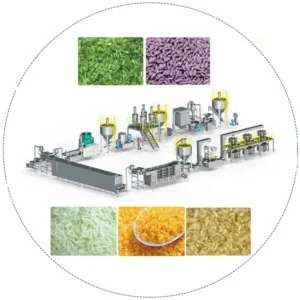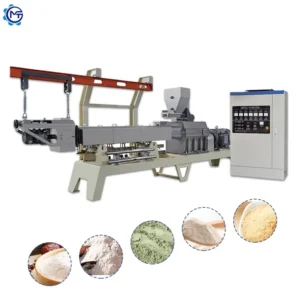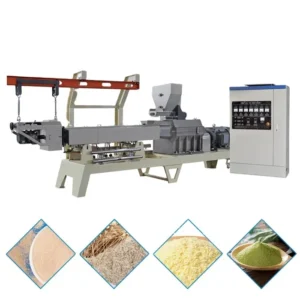
Throughput-Matched Stations — every segment from mixing to packing is sized to the extruder output so no single dryer or cooler chokes the Fortified Rice Processing Line.
Technical Specifications
| Parameter | Value |
|---|---|
| Product Type | Fortified Rice Processing Line |
| Models Available | MT65 / MT70 / MT75 / MT85 / MT95 |
| Screw Type | Twin-screw (single or double screw feeding system optional per material) |
| Control System | Frequency speed control with high automation |
| Lubrication | Automatic lubricating and cooling system |
| Drying Oven Heating Source | Electric or gas |
| Drying Oven Feature | Circulation drying process, frequency motor controlled mesh belt speed |
| Line Stations | Mixing → Extruding → Vibrating → Low temperature drying → Cooling → High temperature roasting → Cooling → Packing |
| Raw Materials | Broken rice, rice, corn, millet, wheat, oats, buckwheat, bean, starch, vitamin and mineral premix |
| MT65 Installed Power / Consumption | 85 kW / 60 kW |
| MT65 Output Capacity | 80–100 kg/h (basis not stated in source — confirm raw material formulation and moisture content) |
| MT65 Overall Dimensions (L×W×H) | 28 × 1.2 × 2.2 m |
| MT70 Installed Power / Consumption | 120 kW / 85 kW |
| MT70 Output Capacity | 100–120 kg/h (basis not stated in source — confirm raw material formulation and moisture content) |
| MT70 Overall Dimensions (L×W×H) | 30 × 1.5 × 2.2 m |
| MT75 Installed Power / Consumption | 180 kW / 135 kW |
| MT75 Output Capacity | 300–500 kg/h (basis not stated in source — confirm raw material formulation and moisture content) |
| MT75 Overall Dimensions (L×W×H) | 32 × 3.5 × 4.3 m |
| MT85 Installed Power / Consumption | 235 kW / 165 kW |
| MT85 Output Capacity | 200–300 kg/h (basis not stated in source — confirm raw material formulation and moisture content) |
| MT85 Overall Dimensions (L×W×H) | 34 × 3.5 × 4.3 m |
| MT95 Installed Power / Consumption | 260 kW / 195 kW |
| MT95 Output Capacity | 800–1000 kg/h (basis not stated in source — confirm raw material formulation and moisture content) |
| MT95 Overall Dimensions (L×W×H) | 36 × 3.5 × 4.3 m |
| Assembly State | Complete line |
Application Suitability
| Application | Material or Output |
|---|---|
| Fortified rice kernel production | Broken rice, rice flour blended with vitamin and mineral premix |
| Artificial rice manufacturing | Corn, millet, wheat, buckwheat, oat starch bases |
| Nutritional instant rice porridge feedstock | Extruded kernels requiring low-temperature drying and high-temperature roasting |
| Value-added reprocessing of rice mill by-products | Rice bran and broken rice streams blended with bean or starch |
Why "800 kg/h" Means Nothing Without the Dryer Behind It
A Fortified Rice Machine is only as fast as its slowest downstream station.
I once stood in a humid workshop in Southeast Asia watching a production line stall because the dryer could not keep up with extruder output. Moisture-laden kernels backed up on the cooling conveyor, operators shoveled product into makeshift bins, and three days of scheduled runs evaporated. The extruder was rated for a certain throughput, but the drying oven and cooling belt had been sourced separately and sized to a different assumption [NEED_CITE: matching dryer capacity to extruder output in rice kernel lines]. This bottleneck pattern repeats across nutritional grain projects whenever stations are assembled from separate vendors rather than engineered as one system.
Every Station in the Fortified Rice Processing Line Catalogue
The sequence runs from mixing through extruding, vibrating, low-temperature drying, cooling, high-temperature roasting, a second cooling stage, and finally packing. Each station is specified against the extruder’s output envelope so that the mesh belt speed on the drying oven and the roasting drum residence time are calculated for the same kilogram-per-hour flow. The Fortified Rice Processing Line is presented here as a full equipment catalogue, letting you see where each machine sits and what role it fills before you commit to a layout.
Drying and Roasting: The Stages That Decide Kernel Integrity
Extruded fortified rice kernels leave the die with elevated moisture and a gelatinized starch matrix that is still soft. The low-temperature drying stage uses a circulation drying process with frequency-controlled mesh belt speed to draw moisture down gradually without cracking the kernel surface. After the first cooling pass, the high-temperature roasting stage sets the final texture and seals the outer layer so the kernels survive transport and cooking [NEED_CITE: starch retrogradation and moisture gradients in extruded rice analogues]. Electric or gas heating options are available depending on your plant’s utility infrastructure, and the oven length is matched to the extruder model selected.
Reading the Extruder Specifications for Fortified Rice
The twin-screw design across the MT65 through MT95 range gives processors control over shear and residence time, both critical when blending starch bases with vitamin and mineral premixes that degrade under excessive heat. Installed power ranges from 85 kW on the MT65 to 260 kW on the MT95, but the power consumption figures — 60 kW and 195 kW respectively — better reflect actual running cost. The automatic lubricating and cooling system on the gearbox supports continuous operation without manual grease intervals interrupting a batch. Frequency speed control allows operators to adjust screw RPM independently of feeder rate, which is how you tune expansion ratio and kernel density when switching from a rice-dominant formula to one heavy in oat or buckwheat flour.
The Hidden Cost of Undersized Supporting Equipment
When a dryer or cooling conveyor is too short for the extruder’s output, the immediate symptom is wet product reaching the packing station. The longer consequence is inconsistent moisture across the batch, which leads to cracking during storage or, worse, mold growth in sealed bags [NEED_CITE: moisture content thresholds for shelf stability in extruded grain products]. Operators compensate by slowing the extruder, which means the installed capacity is never realized and the per-kilogram energy cost climbs. On a fortified rice project meant to supply institutional feeding programs, that shortfall can mean failing to meet delivery contracts.
Why Source the Full Equipment Range From One Supplier
A single supplier configuring the Fortified Rice Processing Line from mixer to packer can calculate the throughput balance at every transfer point. Screw configuration and die design are specified against your actual raw material formulation rather than copied from a generic build. An in-house testing workshop allows trial runs on your broken rice or starch blend before the line ships, so product density and shape are confirmed in advance. Electrical schematics and voltage are verified against your facility’s supply before production begins, avoiding commissioning delays. Pre-sales consultation carries through to on-site installation and operator training so the team running the line understands how extruder RPM, dryer temperature zones, and roasting time interact.
Documentation & Verification
- Line layout and capacity calculation for your chosen model and raw material
- Screw and die configuration record matched to your target kernel shape
- Electrical schematic and voltage confirmation before production starts
- Trial run report on your raw material from the in-house testing workshop
- Factory test record documenting output and moisture at each station
- Operation and maintenance manual with wear parts replacement schedule
Installation, Commissioning & Support
- Floor space planning based on line dimensions from 28 m to 36 m total length depending on model
- Dedicated power circuit sized to installed power up to 260 kW on the MT95
- Drying oven heating source confirmed as electric or gas before foundation work
- Frequency drive calibration for mesh belt speed and extruder screw RPM at commissioning
- Operator training covering screw configuration changes for different starch formulations
- Wear parts list with first replacement interval for screws, dies, and mesh belt sections
What to Share When Requesting a Quotation
Provide your raw material formulation — the ratio of broken rice or starch base to vitamin and mineral premix — along with the target kernel dimensions and daily output requirement. Confirm your facility’s voltage, frequency, and preferred control language so the electrical schematic is finalized before build. If you have existing upstream milling or downstream packing equipment, share the interface specifications so the line stations are configured to connect without gap.
Frequently Asked Questions
Q: How is output capacity verified against my specific raw material formulation?
A: Trial runs are conducted in the in-house testing workshop using your actual raw material blend. The resulting report documents throughput, kernel density, and moisture content at each station. Capacity figures quoted initially are adjusted if your formulation behaves differently than the standard test basis.
Q: What supporting stations are included and how is throughput matched across the line?
A: The line includes mixing, extruding, vibrating, low-temperature drying, cooling, high-temperature roasting, a second cooling stage, and packing. Each station’s belt speed, oven length, and residence time are calculated against the selected extruder model’s output to prevent bottlenecks.
Q: What voltage, frequency, and control language options are confirmed before shipment?
A: Electrical schematics are prepared and reviewed with the buyer before production begins. Voltage, frequency, and the control interface language are confirmed in writing so the frequency drives, motor ratings, and PLC labels match your facility’s standards upon arrival.
Q: Which spare wear parts ship with the line and when is first replacement due?
A: A wear parts list is provided with the quotation, specifying screws, dies, and mesh belt sections included at shipment. The operation manual notes the expected service interval for each component based on your raw material’s abrasiveness so you can plan procurement.
Q: Can I arrange a trial run on my raw material before the line ships?
A: Yes. The in-house testing workshop runs your formulation through the extruder and downstream stations before dispatch. You receive a trial run report covering kernel shape, density, and moisture, allowing adjustments to screw configuration or die design before final assembly.