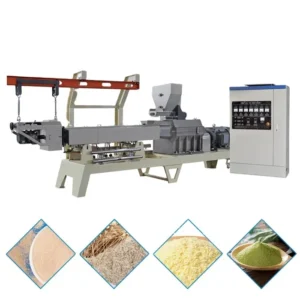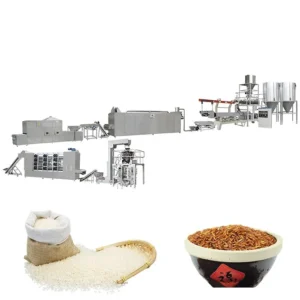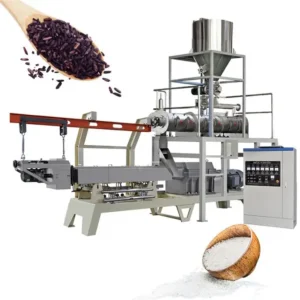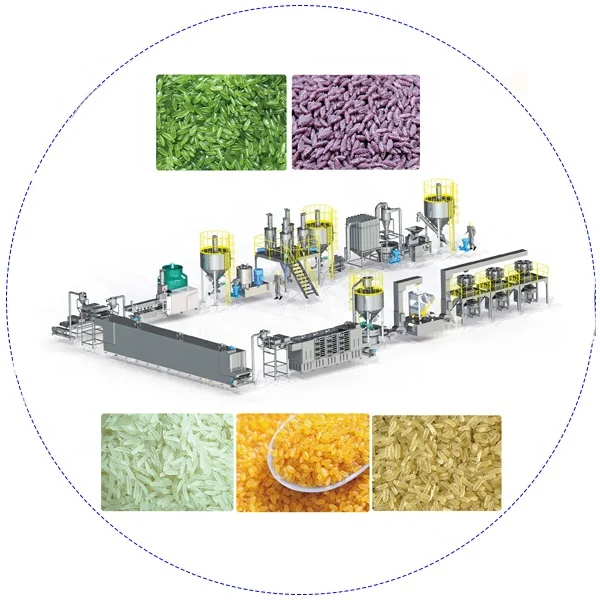
Line Throughput Matched Across Every Station — the MT series fortified rice line balances extruder, dryer, and packing output to eliminate bottlenecks at each processing stage.
Technical Specifications
| Parameter | Value |
|---|---|
| Model | MT65 / MT70 / MT85 / MT75 / MT95 |
| Product Type | Fortified Rice Processing Line / Artificial Rice Making Machine |
| Screw Type | Twin Screw |
| Installed Power | 85 kW (MT65) / 120 kW (MT70) / 235 kW (MT85) / 180 kW (MT75) / 260 kW (MT95) |
| Power Consumption | 60 kW (MT65) / 85 kW (MT70) / 165 kW (MT85) / 135 kW (MT75) / 195 kW (MT95) |
| Output Capacity | 80–100 kg/h (MT65) / 100–120 kg/h (MT70) / 200–300 kg/h (MT85) / 300–500 kg/h (MT75) / 800–1000 kg/h (MT95) (basis not stated in source — confirm raw material formulation, moisture content and die configuration) |
| Overall Dimensions (L×W×H) | 28×1.2×2.2 m (MT65) / 30×1.5×2.2 m (MT70) / 34×3.5×4.3 m (MT85) / 32×3.5×4.3 m (MT75) / 36×3.5×4.3 m (MT95) |
| Control System | Frequency speed controlling with high automation |
| Heating System | Electric or Gas (for drying oven) |
| Line Stations | Mixing → Extruding → Vibrating → Low Temperature Drying → Cooling → High Temperature Roasting → Cooling → Packing |
| Certification | CE, ISO 9001 |
Application Suitability
| Application | Material or Output |
|---|---|
| Nutritional fortified rice kernel production | Broken rice, rice bran with added vitamins and minerals |
| Artificial rice from mixed grains | Corn, millet, wheat, oats, buckwheat, beans, starch blends |
| Public health nutrition programmes | Vitamin- and mineral-enriched rice kernels for food fortification initiatives |
| Value-added rice processing | Upgrading broken rice and rice bran into high-value nutritional rice products |
Why "Nominal Capacity" Rarely Survives Contact With Your Actual Grain Blend
The number on the quote sheet means nothing unless the screw configuration and die geometry are matched to your specific grain base and moisture content.
I spent years on assembly floors before moving into technical sales across the Yangtze Delta region, and the most expensive mistake I have watched a buyer make was trusting a capacity figure without asking what formulation it was based on. One client ordered a line rated for standard rice flour, then ran broken rice mixed with coarse millet. The gelatinisation never stabilised, the extruded kernels crumbled under light pressure, and two full batches were scrapped before we reworked the screw profile. A Fortified Rice Processing Line for sale only delivers its stated throughput when the extrusion parameters reflect what you are actually feeding into the hopper [NEED_CITE: twin-screw extrusion gelatinisation behaviour on mixed grain formulations].
How Screw Configuration Determines Kernel Integrity
The twin-screw design in the MT series allows operators to adjust the screw element sequence — conveying, kneading, and reverse elements — to match the starch composition and particle size of the incoming grain blend. A formulation heavy in broken rice behaves very differently from one based on oat or buckwheat flour, because each grain gelatinises at a different temperature and moisture threshold. Getting this wrong means the extruded kernels either expand too much and fracture, or remain dense and fail the cooking test downstream.
Why Drying and Cooling Must Track Extruder Output
A frequent line imbalance occurs when the drying oven cannot remove moisture fast enough to keep pace with the extruder. The low temperature drying station in this Fortified Rice Processing Line for sale uses a circulation drying process with adjustable mesh belt speed, allowing operators to tune residence time to the actual moisture load leaving the die plate. If the belt runs too fast, kernels retain internal moisture and crack during the high temperature roasting stage. Too slow, and product backs up at the vibrating conveyor [NEED_CITE: moisture gradient control in multi-stage cereal drying systems].
Reading the Power and Capacity Figures Correctly
The installed power ranges from 85 kW on the MT65 to 260 kW on the MT95, but actual power consumption sits considerably lower — 60 kW and 195 kW respectively — because the frequency speed controlling system modulates motor draw based on real-time barrel load. The capacity figures in the table assume a grain formulation and moisture level that must be confirmed before the line is configured. Barrel length relative to screw diameter affects residence time: longer barrels give the starch more time to fully gelatinise, which matters when processing high-fibre additions like rice bran or buckwheat. The die plate aperture and land length together set the kernel shape and density, and these are specified per product target rather than supplied as a generic default.
The Hidden Cost of Skipping the Trial Run
Buyers who skip the pre-shipment trial run often discover formulation problems only after the line is bolted to their factory floor. At that point, adjusting the screw configuration means halting production, pulling the screws, and swapping elements while installation engineers wait on site. In the worst cases I have encountered, the die geometry was entirely wrong for the buyer’s target kernel shape, requiring a replacement die to be manufactured and shipped — adding weeks of downtime before the first saleable batch was produced [NEED_CITE: typical cost of post-installation screw reconfiguration on food extrusion lines].
What Makes This Supplier Different for Equipment Buyers
Every station on this line — from the batching mixer through the extruder, vibrating conveyor, dryer, roaster, cooler, and packing station — is sourced from one equipment range, meaning throughput is calculated across the full chain rather than assembled from mismatched vendors. Screw configurations and die designs are specified against your raw material sample, not copied from a generic build. An in-house testing workshop allows trial runs on your actual grain blend before the equipment leaves the factory. The line carries CE and ISO 9001 certification, and electrical schematics are confirmed against your facility voltage before production begins.
Documentation & Verification
- Line layout showing throughput calculation between extruder, dryer, and packing stations
- Screw and die configuration record matched to your grain blend and nutrient additives
- Trial run report produced on your raw material in the testing workshop
- Electrical schematic with voltage and frequency confirmed for your facility
- Operation and maintenance manual with wear parts list for screw elements and dies
Installation, Commissioning & Support
- Foundation and floor space planned around the line footprint (up to 36×3.5×4.3 m for the MT95)
- Dedicated power circuit sized to the installed power rating (up to 260 kW) and local voltage
- Frequency speed controlling system calibrated on site to match your production targets
- Operator training covers screw element changes, die swaps, and dryer belt speed adjustment
- Wear parts list specifies screw elements, die plates, and mixer blades with reorder codes
What We Need to Configure Your Line
Before we can propose a layout, share your primary grain base (broken rice, corn, millet, or a blend), the vitamin or mineral additives you plan to introduce, and your target daily output in kilograms. We also need your facility voltage, frequency, and preferred control panel language, along with available floor space and ceiling height to plan the dryer and roaster station placement.
Frequently Asked Questions
Q: How do you verify the line capacity is achievable on my specific grain formulation?
A: We run your actual raw material — including any vitamin or mineral additives — through the extruder in our testing workshop before shipment. The trial run report documents the screw configuration, barrel temperature profile, and die geometry used, along with the measured output rate and kernel quality. This confirms the capacity figure applies to your formulation, not just a standard test flour.
Q: What voltage, frequency, and control language options are available?
A: Electrical schematics are confirmed with you before production begins. We configure the motor, heating elements, and control panel to match your facility’s voltage and frequency supply. Control panel language is specified during the quotation stage so operators can read the interface in their working language from day one [NEED_CITE: industrial machinery voltage and frequency standards by region].
Q: How do you match screw and die configuration to different raw materials?
A: Each grain — broken rice, corn, millet, wheat, oats, buckwheat — gelatinises at a different temperature and moisture point. We select the screw element sequence (conveying, kneading, reverse) and die aperture based on your specific blend and target kernel density. The configuration record is documented and shipped with the machine.
Q: Do you conduct trial runs with my actual raw material before shipment?
A: Yes. Our in-house testing workshop runs your grain blend through the extruder with the configured screw and die setup. You can witness the trial in person or review the documented test report, which includes output rate, kernel appearance, moisture content after drying, and the exact machine settings used.