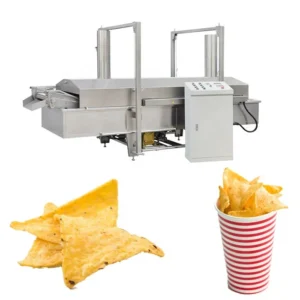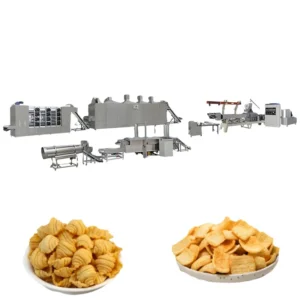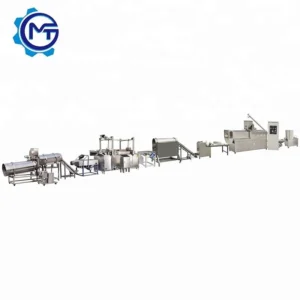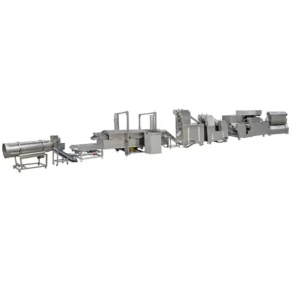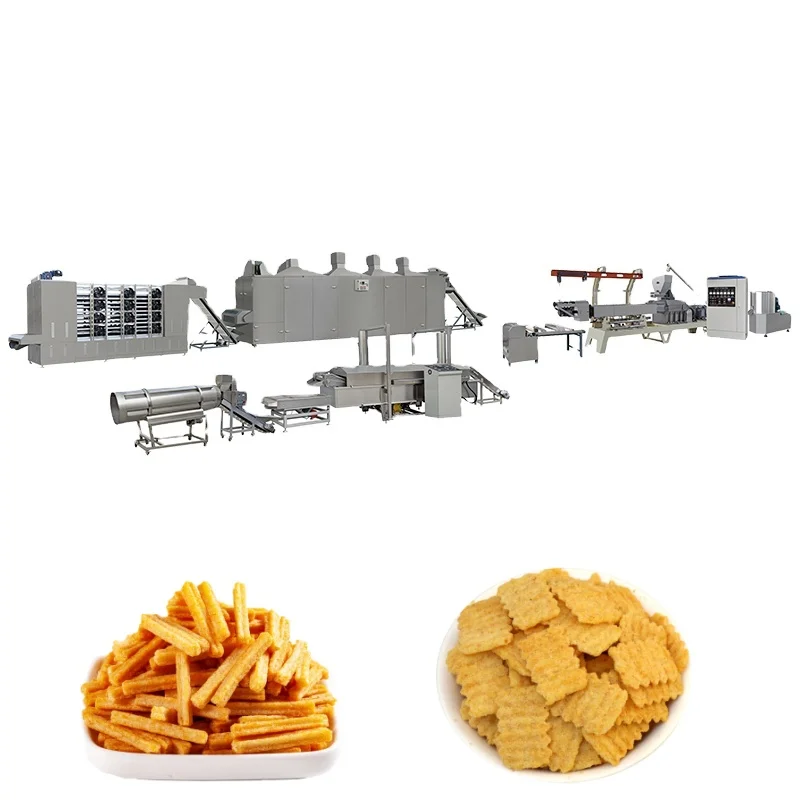
Complete line stations matched for throughput — Every mixer, twin-screw extruder, cutter, and fryer in the Fried Bugles Chips Production Line for Tortilla Snack Food is specified individually so bottlenecks are eliminated before the layout is drawn.
Technical Specifications
| Parameter | Value |
|---|---|
| Product Type | Fried Snack Food Extrusion Production Line |
| Screw Type | Twin Screw, co-rotating with sectional modules |
| Model Options | MT-65 / MT-70 / MT-85 / MT-75 / MT-95 |
| Main Motor (MT-65) | 100 kW |
| Main Motor (MT-70) | 130 kW |
| Main Motor (MT-85) | 180 kW |
| Main Motor (MT-75) | 185 kW |
| Main Motor (MT-95) | 280 kW |
| Output Capacity (MT-65) | 120–150 kg/h (basis to be confirmed) |
| Output Capacity (MT-70) | 200–250 kg/h (basis to be confirmed) |
| Output Capacity (MT-85) | 300–500 kg/h (basis to be confirmed) |
| Output Capacity (MT-75) | 400–500 kg/h (basis to be confirmed) |
| Output Capacity (MT-95) | 800–1000 kg/h (basis to be confirmed) |
| Drying / Fryer Heating | Gas / Electric / Diesel |
| Fryer Belt Width | 600 mm stainless steel mesh belt |
| Mixer Power Options | 4 kW / 7.5 kW / 15 kW |
| Cutting Machine Power | 1.47 kW |
| Cutting Machine Dimension | 2500 × 600 × 1100 mm |
| Voltage & Frequency | Customizable (e.g., 3ph 380V 50Hz, 3ph 415V 60Hz, 3ph 220V 60Hz) |
| Control System | PLC and MCC control |
| Raw Material Compatibility | Corn flour, wheat flour, potato starch, potato powder, corn starch |
| Line Stations | Mixing → Extrusion → Cutting → Frying → Flavouring / Packing (optional) |
| Warranty | 1 year with lifetime maintenance service |
| Certification | CE, ISO |
Application Suitability
| Application | Material or Output |
|---|---|
| Fried Bugles corn chips | Corn flour, corn starch with controlled moisture feed |
| Doritos-style tortilla chips | Wheat flour and corn flour blends |
| Ribbed and wavy fried pellets | Potato starch, potato powder blends |
| Shell, screw, and pillow shapes | Mixed grain flours via die and roller change |
| Diamond and square sheet chips | Corn and wheat starch composite formulations |
| Crisp pea and round tube snacks | Starch-rich formulations with protein supplement |
Why Nominal Output Numbers Fail at Your Actual Raw Material
Throughput is only real when measured against the specific flour blend, fat content, and moisture level you will run every day.
I have watched buyers commit to a fried snack line based on a headline capacity figure, only to discover during commissioning that their locally sourced corn flour carries a fat percentage that collapses the extrudate structure inside the fryer. The extruder keeps pushing product, but half of it blisters or sinks, and the effective sellable output drops sharply. A Fried Snack Food Extrusion Production Line must be evaluated against your actual recipe, not a generic starch benchmark. [NEED_CITE: raw material moisture and fat variability in extrusion snack processing]
Extruder Models Mapped to Production Scale
The co-rotating twin-screw platform spans five frame sizes, each matched to a different output band. Smaller units suit pilot production or niche snack formats where frequent die changes are expected. Larger frames serve continuous high-volume runs where the fryer belt width and drying capacity must keep pace without material queuing upstream.
How the Fryer Belt Integrates with Upstream Stations
The 600 mm stainless steel mesh belt inside the fryer sets the pacing constraint for the entire line. If the extruder pushes product faster than the belt can carry it through the oil bath at the correct residence time, chips overlap, fry unevenly, and emerge with inconsistent colour. Matching fryer belt speed to the Bugles Chips Making Machine output is the single most critical station-to-station calculation in the layout. [NEED_CITE: continuous fryer belt speed and residence time correlation in snack lines]
Reading the Specs That Actually Matter
The sectional screw module design matters more than motor power alone. Different screw element arrangements control how long the dough stays inside the barrel, how much shear it receives, and how completely the starch gelatinises before the die. For high-fat formulations, a gentler shear profile prevents oil separation inside the barrel, while lean corn flour recipes need aggressive mixing elements to achieve uniform expansion. The PLC control system logs barrel temperature zones and screw speed in real time, which directly governs batch-to-batch density consistency — something a basic relay panel simply cannot maintain across shift changes. Die and roller interchangeability on a single extrusion platform means you can produce bugles, tortilla triangles, and ribbed chips without buying separate machines, though each shape change requires recalibrating the cutter timing and fryer belt speed.
The Cost of Mismatched Station Capacity
When the mixer is undersized relative to the extruder feed rate, the barrel runs starved and the extrudate density fluctuates every few minutes. When the fryer is oversized for a small extruder, oil degradation accelerates because the thermal load is too low, producing off-flavours that taint the finished chips. These mismatches do not show up in a quotation — they surface weeks after start-up as inconsistent product weight per bag and rising oil replacement costs. [NEED_CITE: fryer oil degradation rate under low thermal load conditions]
What Sets This Equipment Range Apart
The full station catalogue — mixer, extruder, cutter, fryer, flavouring drum, and packing conveyor — comes from one engineering source, so throughput calculations are done across every transfer point rather than stitched together from separate vendor data sheets. Screw configuration and die selection are specified against the buyer’s raw material sample, not copied from a default build. An in-house testing workshop allows trial runs on the customer’s actual flour blend before any machine is crated for shipment. Voltage, frequency, and control language are confirmed against the destination market’s electrical standards before production begins.
Documentation & Verification
- Machine specification sheet listing motor power, dimensions, and output band for each extruder model
- Screw and die configuration record matched to your raw material sample and target chip shape
- Electrical schematic with voltage and frequency confirmed for your facility’s supply standard
- Factory test record and trial run report on your flour blend before dispatch
- CE declaration of conformity and ISO certificate included with shipment documentation
- Wear parts list specifying screw elements, die inserts, and cutter blades for your configuration
Installation, Commissioning & Support
- Foundation and floor space planning based on the selected extruder model’s footprint and fryer length
- Dedicated electrical circuit sizing per the confirmed motor power, up to 280 kW on the MT-95 frame
- Assembly sequence from sectional screw insertion through belt alignment and fryer oil fill
- First-run parameter logging via PLC, capturing barrel zone temperatures and cutter timing for your recipe
- Operator training covering die changeover, screw module replacement, and fryer belt tensioning
- Recommended spare screw elements and die inserts shipped with initial order to cover early wear cycles
- Daily and weekly maintenance checklists tied to specific mixer bearing, fryer filter, and cutter blade inspection intervals
What We Need Before Quoting Your Line
To configure a Fried Snack Food Extrusion Production Line that actually matches your situation, send your raw material formulation including flour type, fat percentage, and target moisture content. Confirm your daily production target in kilograms of finished fried chips. Specify your facility’s voltage, phase, and frequency, as well as any preferred control panel language for the PLC interface.
Frequently Asked Questions
Q: How is output capacity verified for each extruder model?
A: Output figures listed for the MT-65 through MT-95 are reference ranges that must be confirmed against your specific raw material blend, moisture content, and target chip density. We run a trial in our testing workshop using your flour sample to establish the actual sustainable throughput before finalising the line quotation.
Q: Which voltage and frequency configurations can the line support?
A: The control system and all motors are built to match your facility’s supply. Common configurations include 380V 50Hz, 415V 60Hz, and 220V 60Hz three-phase. We confirm the exact specification and label all MCC panels and PLC interfaces in the language your operators will use.
Q: How do I choose the right extruder model for my target chip shape?
A: Selection depends on both target capacity and shape complexity. Intricate shapes like shells or screws may require slower throughput to maintain die definition, so a larger frame running at reduced speed can outperform a smaller unit pushed to its limit. We match the screw configuration and die design to your specific shape requirement.
Q: What supporting stations are included and how are they matched?
A: The line covers mixing, extrusion, cutting, frying, and optional flavouring and packing. Each station’s capacity is calculated against the extruder’s verified output so that no single station creates a bottleneck. Fryer belt speed, mixer batch cycle, and cutter timing are all coordinated in the layout proposal.
Q: What spare wear parts should I order with the initial line?
A: We provide a wear parts list specific to your screw configuration and die set. Typically, buyers order enough replacement screw elements, die inserts, and cutter blades to cover two to three years of operation. Lead times for these parts can be lengthy, so initial stocking avoids unplanned downtime later.