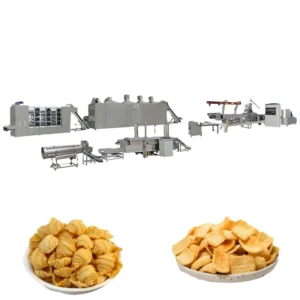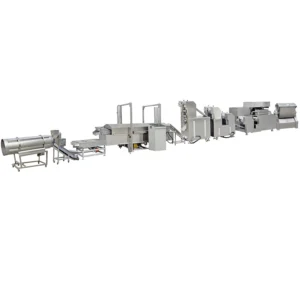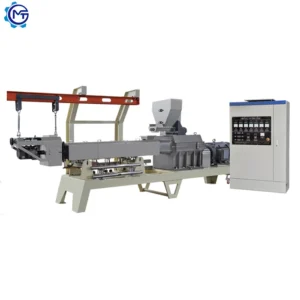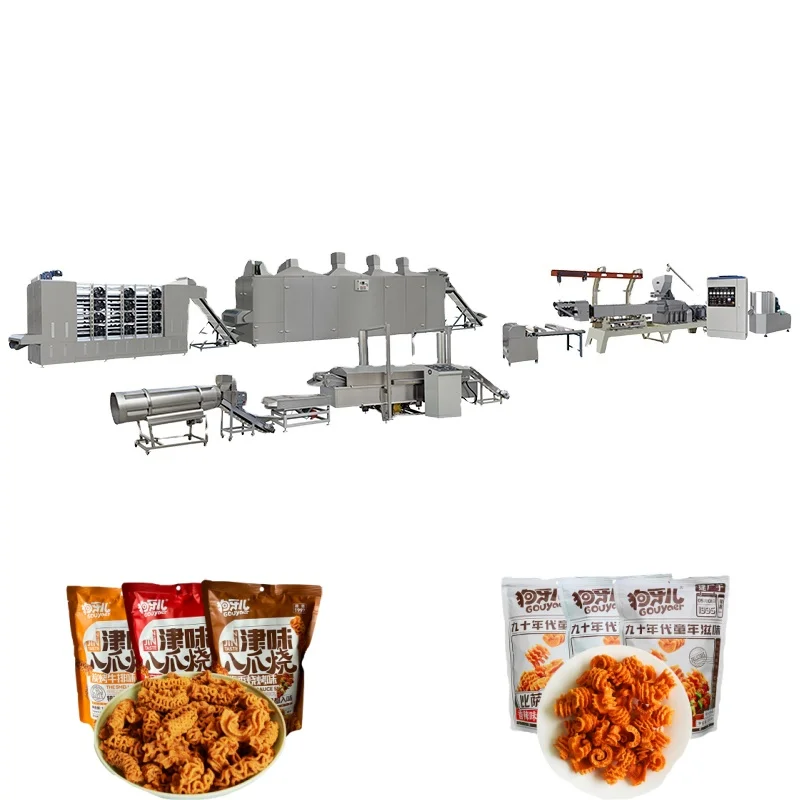
Integrated Throughput Matching — every station from the batching mixer through the twin-screw extruder, cutter, and 600 mm belt fryer is sized against the others so no single unit bottlenecks the fried snack food extrusion machine full equipment range.
Technical Specifications
| Parameter | Value |
|---|---|
| Model | MT-65 / MT-70 / MT-85 / MT-75 / MT-95 |
| Product Type | Twin Screw Extruder Production Line for Fried Snack Food (Bugles, Chips, Pellets) |
| Screw Type | Twin-screw, co-rotating, modular screw elements |
| Main Motor Power | 100 kW (MT-65) / 130 kW (MT-70) / 180 kW (MT-85) / 185 kW (MT-75) / 280 kW (MT-95) |
| Output Capacity | 120–150 kg/h (MT-65, basis to be confirmed) |
| Output Capacity | 200–250 kg/h (MT-70, basis to be confirmed) |
| Output Capacity | 300–500 kg/h (MT-85, basis to be confirmed) |
| Output Capacity | 400–500 kg/h (MT-75, basis to be confirmed) |
| Output Capacity | 800–1000 kg/h (MT-95, basis to be confirmed) |
| Line Stations | Mixer → Twin Screw Extruder → Cutting Machine → Fryer |
| Fryer Belt Width | 600 mm stainless steel |
| Drying / Heating Method | Gas / Electric / Diesel heating options |
| Control System | PLC and MCC integrated |
| Overall Dimensions (L×W×H) | 22000×1200×2200 mm (MT-65) / 24000×1500×2200 mm (MT-70) / 26000×1500×2300 mm (MT-85) / 26000×1500×2800 mm (MT-75) / 30000×1500×2800 mm (MT-95) |
| Warranty | 1 year complete warranty with lifetime maintenance service |
| Standards | CE, ISO certified |
Application Suitability
| Application | Material or Output |
|---|---|
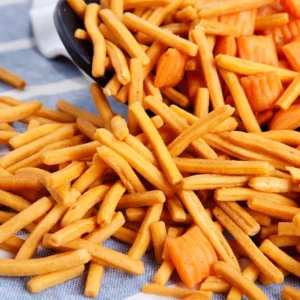
| Bugles and corn chips production | Corn flour, corn grits at varying moisture levels |
| Doritos-style triangular chips | Wheat flour and corn flour blends |
| Pellet snacks and pillow-shaped chips | Potato starch, potato powder, corn starch |
| Wavy, diamond, and square sheet rib chips | Mixed grain flours with adjustable die and cutter setup |
| Stick-format fried snacks | Rice flour and wheat flour formulations |
When Nominal Line Capacity Meets Your Actual Raw Material
A rated throughput figure means nothing unless it was established on the same flour or starch formulation you will run in your own facility.
I spent two weeks on a commissioning job in Colombia where the trial run report back at the factory looked flawless. The moment we fed local corn grits into the extruder, expansion dropped sharply because the moisture content was noticeably higher than the standard test material. The fried chips came out with hard centres, and we had to reconfigure the screw combination, swap die inserts, and recalibrate barrel temperatures before the line ran at a stable rhythm. That gap between catalog numbers and workshop reality is something a fried snack food extrusion machine full equipment range buyer should investigate before signing a purchase order [NEED_CITE: typical variance between standard test materials and buyer-supplied raw materials in extrusion].
How Co-Rotating Modular Screws Shape the Dough
The twin-screw configuration on every model in this range uses co-rotating modular elements that can be rearranged along the shaft. This lets the process engineer dial in specific shear and residence time profiles for corn flour, wheat flour, or potato starch. Continuous gelatinisation happens inside the barrel while de-gassing vents release trapped steam, so the extrudate exits the die at a consistent density rather than pulsing between over-expanded and under-cooked segments.
Die Geometry and Cutting Precision Across Formats
Switching from bugles to flat chips or pellet shapes involves changing the die plate and adjusting the rotary cutter timing. The 600 mm stainless steel fryer belt then carries each geometry through hot oil at a speed matched to its thickness, so thin wavy chips and thicker pillow shapes both reach the target colour and moisture without one batch burning while another stays pale. Having the cutting machine and fryer sourced from the same supplier as the extruder keeps format changeovers predictable [NEED_CITE: die and cutter matching requirements for multi-format extruded snack lines].
Reading the Power and Dimension Data
Main motor ratings span from 100 kW on the MT-65 up to 280 kW on the MT-95, which reflects the torque required to push higher-moisture starch mixes through tighter die openings at greater mass flow. Barrel length-to-diameter ratio grows with model size, giving dough more residence time for complete starch gelatinisation before it reaches the die. Overall line length reaches 30 metres on the largest configuration, so buyers need to confirm floor space and ceiling clearance before finalising the layout. PLC and MCC integration means every motor, heater zone, and conveyor drive reports to a single cabinet, simplifying fault tracing during night shifts when the plant runs with a skeleton crew.
The Hidden Cost of Mismatched Stations
An extruder that delivers a steady extrudate stream is only as useful as the fryer that can accept it. When the fryer belt is too narrow or the oil recovery loop too slow, product piles up at the cutter outlet, cools unevenly, and enters the fryer at inconsistent temperatures. Operators then slow the extruder to match, effectively running a higher-capacity machine at a fraction of its design output while still paying for its full power draw. Voltage mismatches compound the problem: a heater bank specified for 380 V running on a 415 V supply will overshoot barrel zone temperatures, scorching the starch and forcing unplanned downtime for screw pull and clean-out [NEED_CITE: voltage and frequency mismatch consequences in exported food processing machinery].
Why Source the Full Range From One Supplier
Throughput matching across mixer, extruder, cutter, and fryer is calculated during the layout stage rather than discovered during commissioning. Screw and die configuration records are written against the buyer’s specific flour formulation and target chip geometry, not copied from a generic build. The in-house testing workshop runs the buyer’s shipped raw material before the line is crated, so expansion behaviour and frying response are documented in a trial run report rather than guessed at on the factory floor. Electrical schematics confirm voltage, frequency, and control language before the panels are wired, avoiding rewiring delays once the containers arrive. Spare wearing parts — screws, die plates, cutter blades — ship with the first order, and a recommended two-to-three-year spare parts list keeps replacements available when the first changeover falls due.
Documentation & Verification
- Line layout drawing with matched throughput calculation for mixer, extruder, cutter, and fryer stations
- Screw and die configuration record written to your flour type and target chip shape
- Trial run report on your shipped raw material conducted before crating
- Electrical schematic confirming your facility voltage, frequency, and panel language
- CE declaration of conformity and ISO certificate for customs and local inspection
- Wear parts list with part numbers for screws, dies, cutter blades, and fryer belt links
Installation, Commissioning & Support
- Foundation plan showing load points for the 22 to 30 metre line footprint and fryer oil tank
- Dedicated 3-phase circuit sized to the selected model’s main motor, up to 280 kW on the MT-95
- Modular barrel sections and fryer belt shipped in separate crates for on-site assembly
- First-run parameter log covering barrel zone temperatures, screw speed, and fryer belt speed
- Operator training on die changeover and cutter timing adjustment for each snack format
- Spare screw elements and die plates supplied with initial shipment to cover early wear cycles
What to Include With Your Inquiry
Share the specific flour or starch blend you plan to run, including typical moisture content at your local storage conditions. Confirm the daily output target and the shift pattern you intend to operate so the line station sizing reflects real production hours rather than a theoretical single-shift figure. Provide your facility supply voltage, frequency, and preferred control panel language so the electrical design matches your site from day one.
Frequently Asked Questions
Q: How do I choose the right extruder model from the range for my target output?
A: Start with the hourly output you need on your actual flour formulation, not the catalog maximum. The MT-65 suits pilot and small-batch runs, while the MT-85 and MT-95 handle continuous high-volume production. A capacity calculation based on your raw material moisture and target chip density narrows the selection to one or two models before the trial run confirms the choice.
Q: Which supporting stations come with the line and how is throughput balanced?
A: The line includes a mixer, twin-screw extruder, cutting machine, and 600 mm belt fryer. Each station is sized during the layout stage so the extruder output rate matches the cutter cycle and fryer belt speed. This prevents material pile-up between stations and avoids the need to throttle the extruder below its design capacity.
Q: Can the same extruder handle corn flour, wheat flour, and potato starch?
A: Yes. The co-rotating modular screw elements are rearranged to suit each material’s gelatinisation behaviour. Die inserts and cutter settings are swapped for each format. A trial run on your specific flour blend confirms the screw combination and barrel temperature profile before the machine leaves the factory.
Q: What spare wearing parts should I plan for?
A: Free wearing parts ship with the first order. A two-to-three-year supply of screw elements, die plates, and cutter blades is recommended so replacements are on hand when the first changeover is due. The wear parts list included in the documentation package gives exact part numbers for reordering.
Q: Is a trial run on my raw material performed before shipment?
A: Yes. You ship a sample of your flour or starch to the testing workshop, and the line runs your material through extrusion, cutting, and frying. The resulting trial run report documents expansion rate, chip density, and fry colour, and you are welcome to witness the test at the factory before the line is packed.