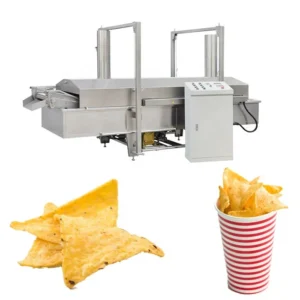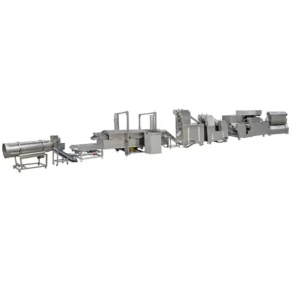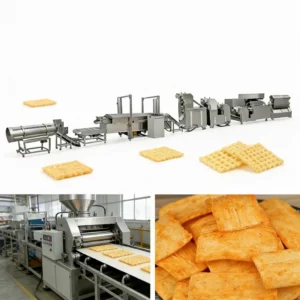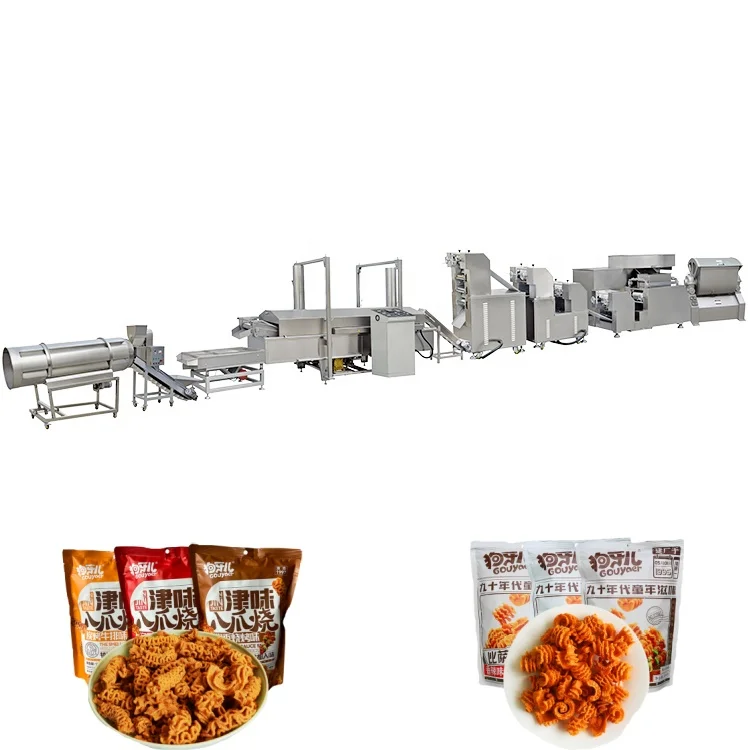
Integrated Line Throughput Matching — every station from the single screw extruder through the fryer and flavoring drum is specified as one system so output holds steady on your actual batter formulation rather than dropping when real production starts.
Technical Specifications
| Parameter | Value |
|---|---|
| Model | MT100/MT120 |
| Product Type | Single Screw Extruder Snack Processing Line |
| Extruder Type | Single screw extruder |
| Screw Configuration | High and low pressure screw |
| Rated Power | 50-70 kW |
| Output Capacity | 120 kg/h (basis not stated in source — confirm raw material and moisture content) |
| Voltage & Frequency | Three phases 380V/50Hz; Single phase 220V/50Hz (customizable to local voltage) |
| Overall Dimensions (L×W×H) | 12000-26000 × 1200 × 2200 mm |
| Material | Food grade stainless steel 201/304 |
| Energy Options | Electricity / Gas / Diesel / Steam |
| Electrical Components | Siemens motor (made in China) or China top brand; Delixi or Delta inverter |
| Line Stations | Mixer → Screw Conveyor → Single Screw Extruder → Pulling and Cutting Machine → Automatic Fryer → Automatic Flavoring Line → Cooling |
| Die Configuration | Adjustable dies for different shapes (screw shell, round tube, square tube, ring, cartoon shapes) |
| Raw Materials | Wheat flour, corn starch, potato starch |
| Certification | CE / ISO 9001 |
| Assembly State | Complete processing line |
| After-sales Service | Engineers available to service machinery overseas |
| Warranty | One year warranty and lifetime technical guidance |
Application Suitability
| Application | Material or Output |
|---|---|
| Golgappa and pani puri production | Wheat flour and corn starch blends at controlled moisture |
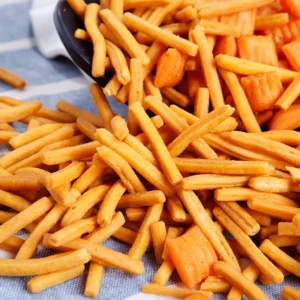
| Secondary puffing snack formats | Potato starch and corn starch mixtures for screw shells, round tubes, and rings |
| Shaped extruded chips for frying | Wheat flour-based doughs cut into cartoon shapes before automatic frying |
| Fried pellet snack lines | Starch-based extrudates requiring downstream frying and flavoring |
What "120 kg/h" Actually Means for Your Batter
Capacity only holds when the raw material moisture, starch ratio, and frying temperature profile all match the trial conditions — a mismatch on any one collapses the puff and scraps the batch.
I have watched a frying chips making machine line run perfectly on a standard squid slurry during factory acceptance, then lose yield the moment the buyer switched to chopped octopus trim with higher moisture on-site. The puff structure collapsed in the fryer, and several tons of trial product went to waste before we re-tuned the die geometry and oil temperature profile. That gap between quoted capacity and real output is where most snack line disputes start [NEED_CITE: typical moisture variation in starch-based batters across suppliers].
Matching Extruder Output to Fryer Residence Time
The single screw extruder pushes shaped dough pieces at a rate that must align exactly with how long each piece needs in the oil bath to achieve full expansion without scorching. When the fryer belt speed and oil temperature are calibrated as a separate system, the extruder may produce faster than the fryer can handle, forcing operators to throttle back and run below nameplate capacity. This frying chips making machine line specifies the pulling and cutting machine, automatic fryer, and cooling conveyor as one integrated sequence so throughput stays consistent across every station.
Die Geometry and Oil Penetration Dynamics
Different snack shapes absorb oil and expand at different rates inside the fryer. A screw shell traps hot oil in its helical grooves, achieving a different texture than a flat ring or a hollow square tube. The adjustable die system on the MT100/MT120 allows switching between screw shell, round tube, square tube, ring, and custom cartoon shapes without changing the extruder barrel, but each geometry demands its own oil temperature and frying duration. Running a new shape without adjusting the fryer profile is the most common cause of inconsistent crunch across a production run [NEED_CITE: oil absorption rates by extruded snack geometry].
Reading the Spec Sheet for Actual Production Conditions
The high and low pressure screw configuration gives the single screw extruder a wider operating window across different starch blends, but the practical implication is that operators can adjust barrel pressure zones to compensate for seasonal moisture variation in wheat flour or corn starch deliveries. The rated power range of 50-70 kW covers the full spread of screw configurations and die restrictions, meaning the motor does not need replacing when you switch from a low-resistance ring die to a high-resistance cartoon shape die. Multi-energy options spanning electricity, gas, diesel, and steam let the buyer match the fryer heat source to whichever utility carries the lowest local cost, which matters when the fryer runs continuously for long shifts. Food grade stainless steel 201 or 304 contact surfaces keep the line compliant for export markets that audit material traceability during food safety inspections.
The Cost of Skipping the Trial Run
Shipping a snack processing line without first running the buyer’s actual raw material through the extruder and fryer means the first weeks of production become an expensive experiment. Die openings that work on one starch blend may produce under-expanded pieces on another, and oil temperature settings that crisp a corn starch ring perfectly may leave a wheat flour screw shell soggy in the center. Buyers who skip the pre-shipment trial often face weeks of adjustment, ingredient waste, and missed delivery windows while the line is tuned from scratch on the factory floor [NEED_CITE: commissioning delays from unverified raw material compatibility].
Why This Line Is Configured as One System
Every station on this line — mixer, screw conveyor, single screw extruder, pulling and cutting machine, automatic fryer, automatic flavoring line, and cooling section — is sized so that none creates a bottleneck for the others. The screw configuration and die design are specified to the buyer’s target product rather than copied from a generic build. An in-house testing workshop runs trial batches on the customer’s own raw material before the line ships, catching moisture and starch ratio problems before they reach the buyer’s floor. Electrical schematics confirm voltage, frequency, and control language to match the destination facility. Wear parts lists ship with the line so screws, dies, and cutting blades are available when the first replacement is due.
Documentation & Verification
- Line layout confirming throughput match from mixer through cooling conveyor
- Trial run report on buyer’s raw material conducted before shipment
- Screw and die configuration record for each ordered snack shape
- Electrical schematic with confirmed voltage, frequency, and control language
- CE declaration of conformity and ISO 9001 factory test record
- Wear parts list specifying screws, dies, and cutting blades included
Installation, Commissioning & Support
- Foundation plan matched to the 12000-26000 mm line footprint and local floor loading
- Dedicated power circuit sized for the 50-70 kW extruder plus fryer heating load
- On-site assembly of all stations with belt alignment and oil bath leveling
- First-run parameter setting for extruder barrel zones and fryer temperature profile
- Operator training covering die changeover and screw configuration adjustment
- Spare screws, dies, and cutting blades supplied with initial shipment
What We Need to Configure Your Line
To specify the right extruder screw, die set, and fryer capacity for your product, share your target snack shape, the exact starch or flour blend you plan to run, and the moisture content you typically see from your supplier. We also need your facility voltage and frequency, preferred control language, and whether your workshop can accommodate a line up to 26 meters long. If you have an existing mixer or packing station you want to integrate, send the throughput and connection details so we can match the interfaces.
Frequently Asked Questions
Q: How is the 120 kg/h capacity verified, and on which raw material and moisture condition?
A: That figure comes from factory testing under specific conditions. Before we quote a guaranteed output, we run your actual flour or starch blend through the extruder and fryer in our testing workshop and document the real throughput at your target moisture level. The trial run report ships with the line so you have a verified baseline.
Q: What voltage, frequency, and control language options are confirmed before shipment?
A: We confirm three-phase 380V/50Hz or single-phase 220V/50Hz as standard, and customize to your local supply if different. The electrical schematic is reviewed and signed off before production. Control panel language — English, Spanish, Arabic, or others — is locked in at the order stage so operators can read every label on day one.
Q: How is the fryer and flavoring drum capacity matched to the extruder output?
A: The automatic fryer belt speed and oil volume are calculated so that every piece exiting the cutting machine has the correct residence time in hot oil before reaching the flavoring drum. If the extruder runs at full rate, the downstream stations keep pace without queuing or starvation, which is where most mismatched lines lose yield.
Q: Can a trial run be performed on my raw material before the line ships?
A: Yes. We require a sample of your actual flour, starch, or batter mix and run it through the complete line in our testing workshop. You receive the trial run report showing extruder settings, fryer temperature, puff expansion, and final product texture before you approve shipment.
Q: What spare wear parts are included and how are replacements sourced?
A: The initial shipment includes spare screws, dies for each ordered shape, and cutting blades. A full wear parts list with part numbers is provided so you can reorder directly. We keep die and screw tooling on file, so replacements are manufactured to your exact configuration without needing to resupply drawings.