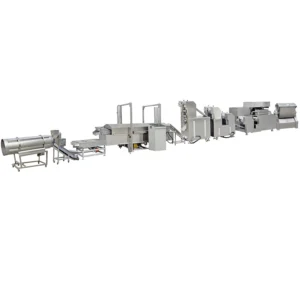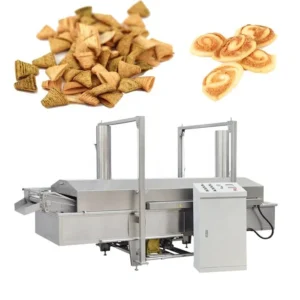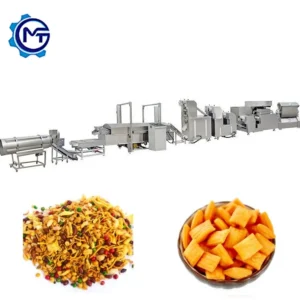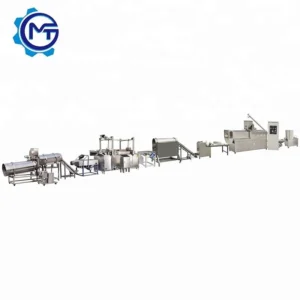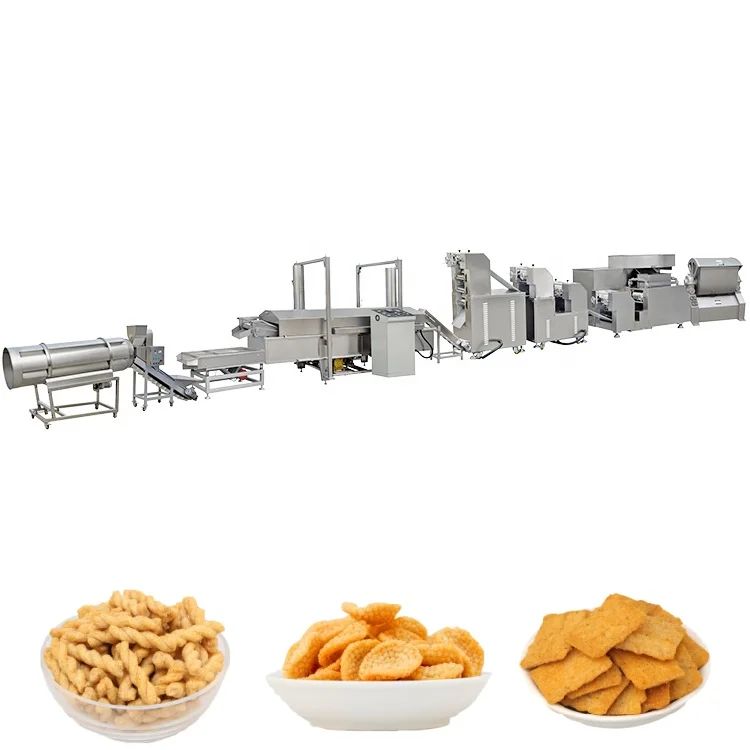
Matching Line Stations to Your Raw Material — Every MT fried pellet chips line configures mixer, extruder, cutting, and frying capacities against the buyer’s confirmed recipe rather than quoting nominal outputs in isolation.
Technical Specifications
| Parameter | Value |
|---|---|
| Product Type | Fried Pellet Chips Snack Food Production Line |
| Available Models | MT-65 / MT-70 / MT-85 / MT-75 / MT-95 |
| Screw Type | Twin screw, co-rotating sectional modules |
| Main Motor (MT-65) | 100 kW |
| Main Motor (MT-70) | 130 kW |
| Main Motor (MT-85) | 180 kW |
| Main Motor (MT-75) | 185 kW |
| Main Motor (MT-95) | 280 kW |
| Mixer Power Range | 4 kW / 7.5 kW / 15 kW |
| Cutting Machine Power | 1.47 kW |
| Cutting Machine Dimensions | 2500 × 600 × 1100 mm |
| Fryer Belt Width | 600 mm |
| Drying / Heating Options | Gas / Electric / Diesel heating |
| Voltage Options | 3ph 380V 50Hz, 3ph 380V 60Hz, 3ph 415V 60Hz, 3ph 220V 60Hz |
| Output Capacity (MT-65) | 120–150 kg/h (basis not stated in source — confirm raw material and moisture content) |
| Output Capacity (MT-70) | 200–250 kg/h (basis not stated in source — confirm raw material and moisture content) |
| Output Capacity (MT-85) | 300–500 kg/h (basis not stated in source — confirm raw material and moisture content) |
| Output Capacity (MT-75) | 400–500 kg/h (basis not stated in source — confirm raw material and moisture content) |
| Output Capacity (MT-95) | 800–1000 kg/h (basis not stated in source — confirm raw material and moisture content) |
| Overall Dimensions (MT-65) | 22000 × 1200 × 2200 mm |
| Overall Dimensions (MT-70) | 24000 × 1500 × 2200 mm |
| Overall Dimensions (MT-85) | 2600 × 1500 × 2300 mm |
| Overall Dimensions (MT-75) | 2600 × 1500 × 2800 mm |
| Overall Dimensions (MT-95) | 3000 × 1500 × 2800 mm |
| Certification | CE |
| Warranty | 1 year complete warranty and lifetime maintenance service |
Application Suitability
| Application | Material or Output |
|---|---|
| Corn bugles and horn-shaped pellets | Corn powder, corn starch |
| Square sheet rib chips and diamond chips | Wheat flour, potato starch |
| Wavy chips and pillow shapes | Potato powder, blended starch formulations |
| Stick, shell, screw, and tube formats | Corn, wheat, potato-based compound flour |
| 3D pellet snacks for frying | Multi-grain starch blends with customized moisture |
What a Mismatched Fryer Belt Does to Your Throughput
The fryer is the station most buyers under-size when they quote extruder capacity alone.
When I was sourcing for a production plant, we once installed a fryer whose belt width and oil volume could not keep pace with the twin-screw extruder upstream. Pellets piled up at the cutting machine, moisture migrated back into the product, and the entire fried pellet chips making machine manufacturer specification sheet became meaningless within the first week. The real bottleneck was never the extruder — it was the 600 mm fryer belt running at a fixed speed while the extruder pushed volume it could not absorb [NEED_CITE: line throughput matching principles in snack food engineering].
Extruder Modules and Starch Gelatinisation
A twin-screw extruder with co-rotating sectional modules controls how long raw material stays inside the barrel. For corn-based pellets, barrel sections are arranged so that starch reaches full gelatinisation before the die face. The screw configuration is specified to the buyer’s flour blend and target moisture level, not copied from a generic build. This is why a fried pellet chips making machine manufacturer that adjusts screw elements per recipe produces more consistent pellet density than one shipping a fixed configuration.
Cutting Precision Before the Fryer
The cutting machine runs at 1.47 kW and uses interchangeable rollers to produce bugles, diamonds, wavy ribs, and other chip geometries. Roller changes take minutes, not hours. Uniform cut length matters because uneven pellets absorb oil at different rates in the fryer, creating colour variation and texture inconsistency on the same batch. When I first audited a line that produced mixed-shape output, the problem traced back to worn roller bearings rather than recipe error [NEED_CITE: cutting uniformity and oil absorption in pellet snack lines].
Reading the Motor Ratings Across the Range
The MT-65 starts at 100 kW for outputs around 120–150 kg/h, while the MT-95 reaches 280 kW for higher-volume installations. Main motor power directly reflects barrel diameter, screw length, and the shear energy required to gelatinise different starch sources. Potato starch requires less mechanical shear than high-amylose corn flour, so two buyers running different recipes on the same model may draw different actual power loads. Selecting a model purely on nameplate output without confirming the raw material baseline leads to undersized motors struggling against viscosity, or oversized motors burning product through excessive shear heat. The mixer power range — 4 kW, 7.5 kW, or 15 kW — is matched to batch size and blending time, ensuring the feed rate into the extruder stays continuous rather than pulsing.
The Cost of Skipping Voltage Confirmation
Voltage and frequency mismatches delay commissioning by weeks, not days. A 380V 50Hz motor wired into a 415V 60Hz supply overheats within the first production shift. Every MT line confirms three-phase voltage and frequency — whether 380V 50Hz, 415V 60Hz, or 220V 60Hz — before production begins, and the electrical schematic documents motor winding specifications for the destination market [NEED_CITE: industrial voltage and frequency standards by region]. Skipping this step means the fried pellet chips making machine manufacturer ships equipment that cannot legally connect to the local grid, leaving the buyer sourcing step-down transformers or rewinding motors on site.
Why the Line Matters More Than the Extruder
The complete production line is built under one supplier, so mixer batch cycle, extruder throughput, cutting speed, and fryer belt capacity are calculated against each other rather than assembled from independent vendors. Screw configuration and die design are specified to the buyer’s exact raw material blend. An in-house testing workshop runs trial production on the customer’s flour before shipment, catching density or texture issues early. CE certification covers the full assembly, and pre-sales engineering includes line layout drawings with utility connection points mapped to the buyer’s floor plan.
Documentation & Verification
- Line layout drawing showing station spacing for the selected model footprint
- Capacity calculation sheet referencing buyer’s raw material and target moisture
- Screw and die configuration record matched to confirmed recipe
- Electrical schematic with voltage and frequency locked to destination market
- Trial run report on customer-supplied flour before shipment
- CE declaration of conformity for the complete line assembly
Installation, Commissioning & Support
- Foundation plan accounts for the MT-95 overall length of 30 m and fryer oil load
- Dedicated electrical circuit sized to the 280 kW main motor plus auxiliary stations
- Line arrives in modular sections; fryer belt and extruder barrel assembled on site
- First-run parameter setting covers barrel temperature profile and fryer belt speed
- Operator training includes roller changeover on the 1.47 kW cutting machine
- Wear parts list covers screws, die plates, and fryer belt segments
Before You Request a Quote
A useful inquiry names the raw material blend — corn, wheat, potato starch, or a combination — along with the target chip shape and required daily output. Confirming the local three-phase voltage, frequency, and control language expectation prevents rewiring after arrival. If existing upstream mixers or downstream seasoning drums are already in place, share their throughput figures so the line can be matched at the boundaries.
Frequently Asked Questions
Q: How is output capacity verified with different raw materials and moisture levels?
A: Capacity figures in the specification table are model-level references. Actual throughput depends on flour composition, starch ratio, and incoming moisture. We run your raw material in our testing workshop before shipment and document the measured output, pellet density, and expansion ratio in a trial report so you know what to expect on your own floor.
Q: What voltage and frequency options are available for my target market?
A: The line is configurable for 3ph 380V 50Hz, 3ph 380V 60Hz, 3ph 415V 60Hz, and 3ph 220V 60Hz. Voltage and frequency are confirmed during the quotation stage, and every motor winding, heating element, and control component is matched to the agreed specification before production begins.
Q: How are fryer capacity and extruder throughput matched to avoid bottlenecks?
A: The 600 mm fryer belt speed and oil volume are calculated against the extruder model’s confirmed output. If the extruder pushes more volume than the fryer can absorb, pellets accumulate and degrade. We match both stations to the same throughput target rather than quoting each independently.
Q: Can I run a trial with my own raw material before shipment?
A: Yes. Send your flour blend to our testing workshop and we run the complete sequence — mixing, extrusion, cutting, and frying — on a pilot scale. The trial report records screw configuration, barrel temperatures, pellet dimensions, and fryer oil temperature so production parameters are established before the line reaches your facility.
Q: What spare parts and wear components are included or recommended?
A: Each line ships with a documented wear parts list covering twin-screw elements, die plates, cutting machine rollers, and fryer belt segments. We recommend stocking the first replacement set before initial installation so that the first scheduled changeover does not halt production while waiting for international freight.