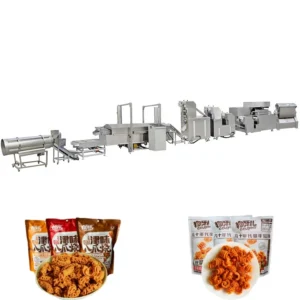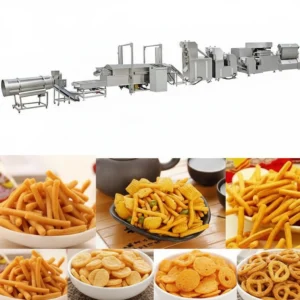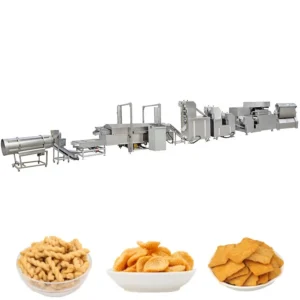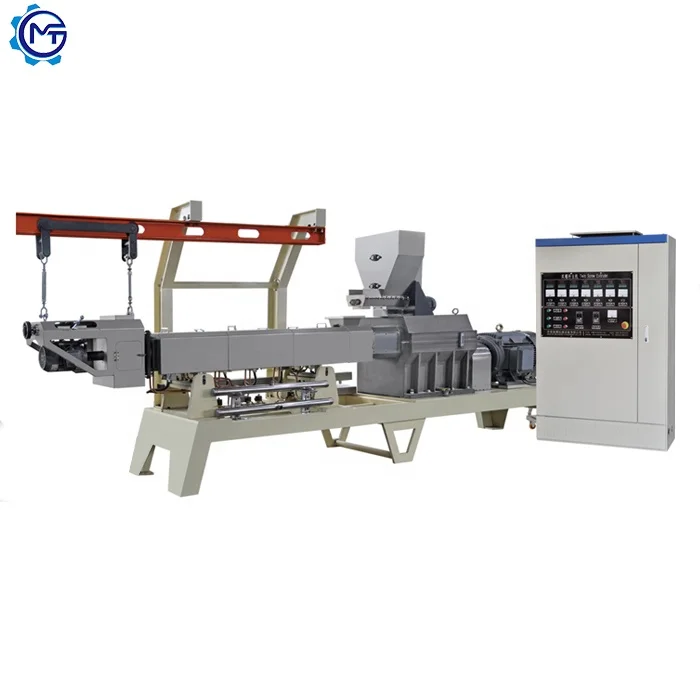
Throughput-Matched Stations — Every unit from the mixer to the flavoring drum is sized to hold the same output rate, preventing the bottleneck that occurs when vendors supply unmatched capacities.
Technical Specifications
| Parameter | Value |
|---|---|
| Product Type | Fried Puffed Snacks Production Line |
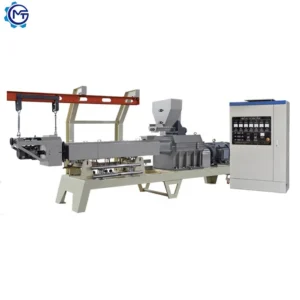
| Extruder Type | Single Screw Extruder |
| Output Capacity | 120 kg/h (basis to be confirmed) |
| Rated Power | 50-70 kW (electricity); 50-60 kW (gas/diesel) |
| Voltage & Frequency | Three phases 380V/50Hz, Single phase 220V/50Hz (customizable) |
| Control System | PLC with inverter (Delta or Delixi) |
| Overall Dimensions (L×W×H) | 12000-26000 × 1200 × 2200 mm |
| Construction Material | Food-grade stainless steel 201/304 |
| Energy Options | Electricity, Gas, Diesel, Steam |
| Motor Brand | Siemens (China) or equivalent top brand |
| Line Stations | Mixer → Screw Conveyor → Extruder → Pulling/Cutting → Fryer → Flavoring → Cooling |
| Assembly State | Complete continuous line |
| Standards | CE, ISO 9001 |
Application Suitability
| Application | Material or Output |
|---|---|
| Hollow and shaped puffed snacks | Wheat flour, corn starch, potato starch blends |
| Pellet chips and fryums | Starch-based dough formed into shell, tube, or ring shapes |
| Golgappa / pani puri shells | Refined wheat flour and semolina for crisp, hollow spheres |
| Cartoon and novelty shapes | Extruded dough cut and fried for confectionery or snack markets |
| Savory fried appetizers | Blends requiring high expansion and low moisture final state |
The Hidden Bottleneck in a Multi-Vendor Snack Line
When an extruder is specified without verifying the downstream fryer and flavoring capacity, the entire line stalls at the weakest link. Matching every station to the same throughput is the only way to achieve the rated output of a fried puffed snacks production line for sale.
I once audited a facility where a high-capacity extruder was feeding into an undersized batch fryer. The result was a pile of raw, cut dough waiting for the oil, leading to moisture loss and inconsistent frying. In my time planning extrusion lines across Shandong, I have seen this mismatch cause more downtime than mechanical failure [NEED_CITE: common causes of downtime in snack food processing lines]. Sourcing the full equipment range from a single supplier ensures the pulling and cutting machine, the continuous fryer, and the automatic flavoring drum are all calculated to handle the exact volume the single screw extruder produces.
Balancing the Extruder and the Fryer
The transition from the extruder to the fryer is the most critical point in this type of processing. The single screw extruder gelatinizes the starch and forms the shape, but the product is still soft and high in moisture. If the pulling and cutting machine drops pieces faster than the automatic fryer can remove their moisture and set the structure, the product will stick together or collapse. This fried puffed snacks production line for sale is configured so the fryer’s belt speed and oil volume are directly scaled to the extruder’s output.
Flavoring Consistency at Continuous Speed
After frying, the product must be seasoned while still warm to ensure the powder adheres correctly. An undersized flavoring drum will cause a backup, forcing the operator to reduce the speed of the entire line. The automatic flavoring line included in this range uses a variable-speed drum and precise powder dosing to maintain a steady flow [NEED_CITE: principles of powder adhesion in snack seasoning]. This prevents the common issue of over-seasoning the first batch and under-seasoning the last.
Interpreting the Drive and Control Specifications
The PLC with inverter control is essential for managing the screw speed of the single screw extruder, which directly dictates the shear force and the residence time of the dough inside the barrel. For products like golgappa or thin-walled tubes, the screw speed must be adjustable to control the expansion ratio before the product enters the oil. The availability of multiple energy options (electricity, gas, diesel, steam) for the fryer and dryer stations allows the line to be adapted to local utility costs and infrastructure. Furthermore, the use of food-grade stainless steel 201/304 ensures compliance with food safety standards and withstands the high-humidity, high-temperature environment of a frying station.
The Cost of Ignoring Utility Compatibility
Overlooking the voltage and frequency requirements before production begins often leads to a motor that burns out on the first day or a control panel that cannot be read by the local operators. When the control language or the electrical schematic does not match the facility’s grid, commissioning is delayed until new components are shipped [NEED_CITE: industrial voltage and frequency standards by export market]. This is a preventable failure that halts production before it starts.
Why Source the Full Range Here
Our approach focuses on the complete equipment catalogue, ensuring every station from the mixer to the packing end is specified together. We provide the complete machine catalogue so you can see where each unit fits in the process. We perform in-house trial runs on your actual raw material in our testing workshop to verify the expansion and frying behavior before the line is shipped. The screw configuration and die design are matched to your specific flour or starch blend, not copied from a generic build. We supply the line layout and capacity calculation document to prove throughput matching. Our documentation includes the CE declaration of conformity and the electrical schematic with confirmed voltage for your market.
Documentation & Verification
- Line layout and capacity calculation showing throughput at the fryer and flavoring stations.
- Machine specification sheet with confirmed voltage, frequency, and control language.
- Trial run report on your specific wheat flour or starch blend before dispatch.
- Wear parts list covering extruder screws, dies, and fryer belt components.
- CE declaration of conformity and ISO certificate for the complete assembly.
Installation, Commissioning & Support
- Foundation plan based on the 12000-26000 mm footprint and fryer load.
- Dedicated circuit planning for the 50-70 kW extruder and heating elements.
- On-site assembly of the continuous fryer and flavoring drum alignment.
- Parameter setting for the PLC inverter to match your specific dough recipe.
- Operator training focused on screw speed adjustment and oil temperature control.
- First-replacement stock of single screw and die sets included at shipment.
Sourcing the Right Configuration
To specify this line correctly, please provide the exact type of flour or starch blend you intend to use and the target moisture content of the final fried product. We also need your facility’s voltage and frequency, along with the preferred language for the PLC touch screen. If you have existing upstream mixers or downstream packing machines, share their throughput so we can match the extruder and fryer to your current flow.
Frequently Asked Questions
Q: How is line throughput verified before the equipment ships?
A: We run a trial using your actual raw material in our testing workshop. This verifies the expansion, cutting, and frying behavior, and we provide a trial run report confirming the output rate and product density on your specific blend.
Q: How are voltage, frequency, and control panel language confirmed?
A: We require your facility’s electrical specifications and operator language preference before production begins. This ensures the motor, the PLC, and the HMI are built to your local standards and are readable by your team upon arrival.
Q: Can the fryer and flavoring drum be resized if I add a second extruder later?
A: Yes, the downstream equipment can be specified with future capacity in mind. We will provide a revised layout and capacity calculation to ensure the new fryer and drum can handle the combined throughput of both extruders.
Q: What spare wear parts ship with the line?
A: The shipment includes a wear parts list covering the single screw, die plates, and cutting blades. We include a set of first-replacement parts for these high-wear items to ensure you can maintain production while new parts are ordered.
Q: Is a trial run on my raw material performed before shipment?
A: Yes, we insist on a trial run using your specific flour or starch formulation. This is the only way to guarantee the correct expansion and texture for products like golgappa or hollow tubes before the line is packed.