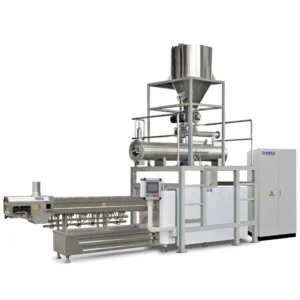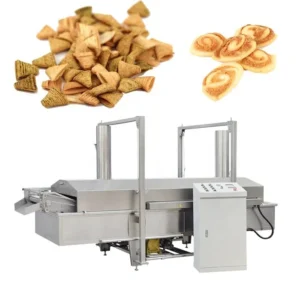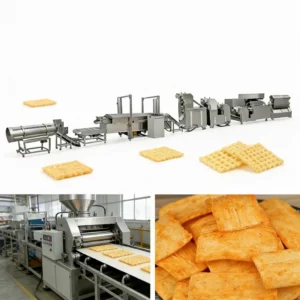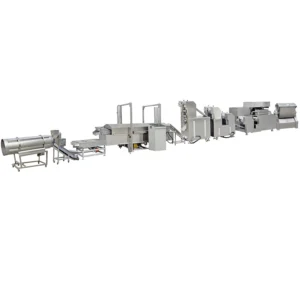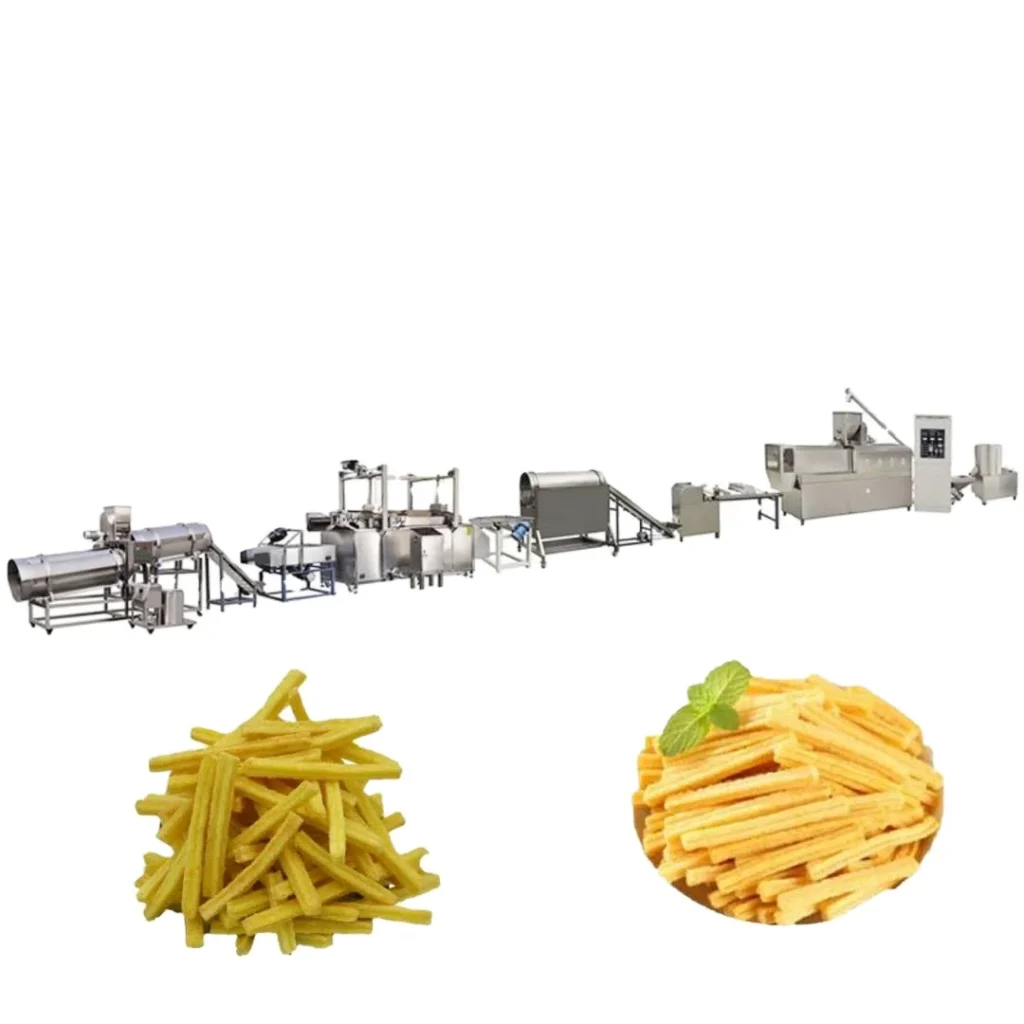
Screw and die configuration specified to your raw material and target shape — every station in this fried snack production line is sized against your actual formulation, preventing throughput mismatches before installation.
Technical Specifications
| Parameter | Value |
|---|---|
| Product Type | Fried Snack Extrusion and Frying Production Line |
| Extruder Type | Single Screw Extruder |
| Screw Configuration | High and low pressure screw |
| Raw Materials | Wheat flour, corn starch, potato starch |
| Output Capacity | 120 kg/h (basis not stated in source — confirm raw material formulation, moisture content, and product shape) |
| Rated Power | 50–70 kW |
| Voltage & Frequency | Three phases 380V/50Hz, Single phase 220V/50Hz (customizable to local voltage) |
| Control System | PLC (source value — verify against manufacturer catalog) |
| Overall Dimensions (L×W×H) | 12000–26000 × 1200 × 2200 mm |
| Material of Construction | Food-grade stainless steel 201/304 |
| Energy Source Options | Electricity, gas, diesel, steam |
| Line Stations | Mixer → Screw conveyor → Single screw extruder → Pulling and cutting machine → Automatic fryer → Automatic flavoring line → Cooling |
| Product Shapes | Screw shell, round tube, square tube, ring, cartoon shapes (die-dependent) |
| Certification | CE / ISO 9001 |
Application Suitability
| Application | Material or Output |
|---|---|
| Secondary puffing fried snacks | Wheat flour and starch-based formulations extruded, cut, fried, and seasoned |
| Golgappa / pani puri production | Thin-walled hollow shapes from wheat flour and corn starch blends |
| Salad strips and millet crust | Flat and tube profiles requiring controlled expansion and oil absorption |
| Pasta-shaped snack extrusion | Starch-based and wheat flour doughs formed through die-change configuration |
Why the Extruder-Fryer Match Matters More Than You Think
An extruder sized without matching fryer capacity will bottleneck the entire fried snack production line full equipment range within the first production shift.
I worked with a buyer who sourced a single-screw extruder from one supplier and a batch fryer from another. The extruder pushed material faster than the fryer could recover oil temperature between batches, so the output dropped and moisture trapped inside the product made the texture chewy instead of crisp. This mismatch is common when stations are assembled independently rather than engineered as a system. [NEED_CITE: thermal recovery rate requirements for continuous frying lines]
Station-by-Station Throughput Alignment
The fried snack production line full equipment range covered here moves material through mixing, screw conveying, single-screw extrusion, pulling and cutting, frying, flavoring, and cooling in sequence. Each station’s throughput is calculated against the next, so the extruder output feeds the fryer at a rate the oil recovery system can sustain, and the fryer discharge rate matches the flavoring drum rotation speed.
Die Configuration and Shape Flexibility
Product shape changes are handled through die swaps at the extruder barrel, not by replacing the entire assembly. The high and low pressure screw configuration supports the range of dough consistencies needed for screw shells, round tubes, square tubes, rings, and cartoon shapes. Switching from a salad strip profile to a hollow pani puri shell involves changing the die and adjusting the pulling cutter speed accordingly. [NEED_CITE: die-change procedures for single-screw snack extruders]
How Screw Configuration Controls Fryer Performance
The high and low pressure screw setup in the single-screw extruder directly influences the expansion and density of the extruded dough before it reaches the fryer. Wheat flour formulations require different shear profiles than pure potato starch blends. If the screw compresses the dough too aggressively, the extrudate becomes too dense and absorbs excessive oil during frying, producing a greasy texture. If compression is too low, the material lacks structural integrity and breaks apart in the fryer basket. Matching the screw profile to your specific raw material formulation — including grain origin, particle size, and moisture content — determines whether the fried output meets your target crunch and color.
What Happens When Voltage and Frequency Are Confirmed Too Late
Commissioning delays from voltage mismatches are more frequent than mechanical failures on this type of line. A buyer installing in a region with 440V/60Hz supply while the line was built for 380V/50Hz will face motor overheating on the extruder drive and incorrect conveyor speeds through the fryer. Confirming local electrical standards and control language before production begins avoids weeks of idle equipment on the factory floor. [NEED_CITE: voltage and frequency standards by export market]
Why Sourcing Every Station From One Manufacturer Reduces Risk
The extruder, fryer, flavoring drum, and cooling conveyor in this line share a common control architecture, so PLC communication between stations is configured at the factory rather than improvised during installation. Throughput calculations are documented across every station, not assembled from separate vendor catalogs with incompatible capacity claims. Trial runs on your actual raw material are conducted before shipment, so screw configuration and frying parameters are validated before the equipment reaches your facility. Energy source selection for the fryer — electricity, gas, diesel, or steam — is matched to your facility utility availability during the engineering phase. CE and ISO 9001 documentation covers the complete line, not individual machines from different compliance backgrounds.
Documentation & Verification
- Line layout and capacity calculation showing throughput match across all seven stations
- Screw and die configuration record matched to your wheat flour or starch formulation
- Trial run report on your raw material conducted in the testing workshop before dispatch
- Electrical schematic with confirmed voltage, frequency, and PLC language for your installation site
- CE declaration of conformity and ISO certificate covering the full fried snack production line full equipment range
- Wear parts list identifying replacement screws, dies, and fryer basket components
Installation, Commissioning & Support
- Floor plan and utility routing prepared for the 12000–26000 mm line footprint depending on station configuration
- Power distribution confirmed for 50–70 kW total load across extruder, fryer heating, and conveyor drives
- Equipment shipped in sectional modules for container loading and reassembled on-site in sequence
- First production run supervised with screw speed, fryer temperature, and flavoring drum parameters set to target product
- Operator training covering die-change procedures, oil filtration cycles, and PLC fault response
- Wear parts inventory including spare screws, dies, and conveyor belt sections recommended for first-year operation
What We Need From You to Configure This Line
Send us the specific raw material formulation you intend to run, including flour or starch type, particle size, and any additives. Specify your target product shape and the hourly output you need to sustain. Confirm the voltage, frequency, and available energy source at your installation site so the fryer and extruder motors are wound correctly before production.
Frequently Asked Questions
Q: How is the output capacity verified and what raw material formulation is it based on?
A: The stated capacity is verified through a trial run using your actual raw material in our testing workshop. Output varies depending on formulation, moisture content, and product shape. We provide a trial run report documenting the achieved throughput and product quality before the line ships.
Q: Which voltage and frequency configurations are available for the target installation country?
A: The line is configurable to local electrical standards, including three-phase 380V/50Hz, single-phase 220V/50Hz, and other regional specifications. Voltage and frequency must be confirmed before production so that extruder motors, fryer heating elements, and conveyor drives are matched to your facility supply.
Q: How are the extruder, fryer, and flavoring stations sized relative to each other?
A: Each station’s throughput is calculated against adjacent stations so the extruder discharge rate matches the fryer’s thermal recovery capacity, and the fryer output aligns with the flavoring drum rotation speed. This prevents bottlenecks that occur when machines are sourced independently.
Q: What die configurations are available and how quickly can product shape be changed?
A: Available shapes include screw shells, round and square tubes, rings, and cartoon shapes. Shape changes involve swapping the die at the extruder barrel and adjusting the pulling cutter speed. The high and low pressure screw configuration supports the dough consistency range needed across different profiles.
Q: Is a trial run conducted before shipment and what does the trial report include?
A: Yes, a trial run is performed on your raw material in our in-house testing workshop. The report documents screw configuration, die selection, frying parameters, product texture, and achieved throughput, giving you validated production data before the line arrives at your facility.