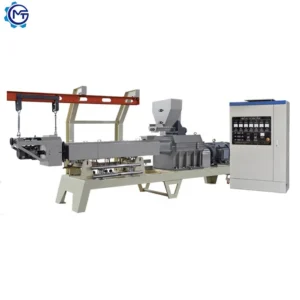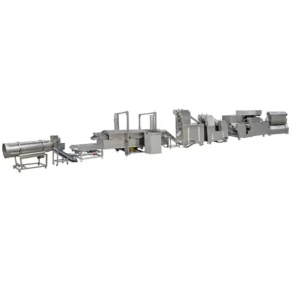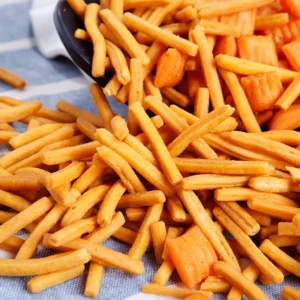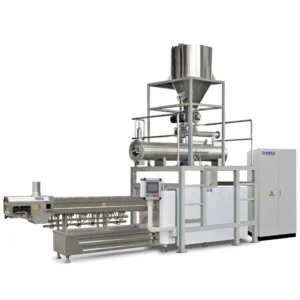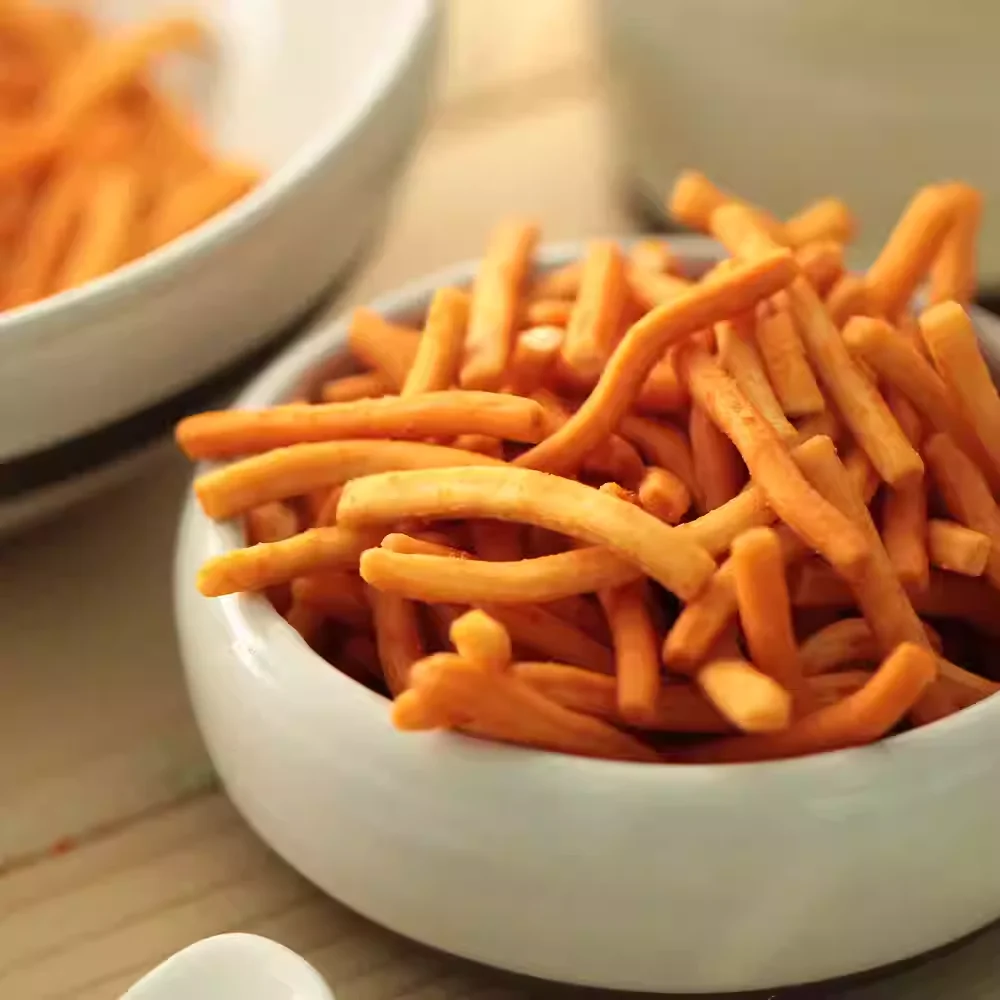
Balanced line integration — Every station from mixer to fryer to packaging is supplied under one roof, ensuring throughput matches across the entire snack food extrusion line.
Technical Specifications
| Parameter | Value |
|---|---|
| Product Type | Automatic Continuous Deep Fryer |
| Heating Method | Electricity Heating / Gas Heating |
| Electric Heating Power | 60 kW |
| Oil Capacity | 320 L |
| Voltage & Frequency | 380V / 50Hz (configurable for target market) |
| Drive Power | 2.6 kW |
| Overall Dimensions (L×W×H) | 6700 × 2200 × 1200 mm |
| Net Weight | 2000 kg |
| Capacity Range | 100–1000 kg/h (basis to be confirmed) |
| Control System | PLC |
| Belt Type | Upper and lower double-layer mesh belt |
| Speed Regulation | Frequency conversion stepless speed regulation |
| Oil Filtration | Automatic oil circulation filtration system |
| Lifting System | Automatic lifting system for upper hood and mesh belt |
| Slag Discharge | Bottom slag discharge system |
| Construction Material | Food-grade 304 stainless steel |
Application Suitability
| Application | Material or Output |
|---|---|
| Corn chips and tortilla chips | Extruded or sheeted corn dough |
| Pellet chips (2D/3D) | Extruded starch-based pellets |
| Puffed snacks | Corn, rice, wheat, or multigrain extrudates |
| Bugles and triangular snacks | Corn grits extrudates requiring oil frying |
| Coated nut and bean snacks | Peanuts, broad beans, or soy nuts |
Why Downstream Throughput Defines Your Actual Line Output
A fryer that cannot match your extruder output turns your fastest machine into the most expensive bottleneck on the floor.
When a snack line is quoted at a nominal capacity, buyers often focus on the extruder. But the continuous frying machine for sale in your specification must handle the exact output that exits the dryer or cooler upstream. If the fryer belt speed, oil volume, and heat recovery cannot absorb the product load, the entire line slows down to the fryer’s pace. That mismatch is rarely caught during the quotation stage — it only appears during commissioning, when the extruder is idling and the fryer is drowning in product. I have seen production floors where operators manually throttle upstream feeders just to keep the oil temperature stable, which is exactly the scenario a proper line layout prevents [NEED_CITE: industrial frying throughput matching principles].
How the Double-Layer Belt Controls Product Density
The upper and lower mesh belt system clamps the product between two surfaces during frying. This prevents lighter snack pieces from floating to the oil surface, which causes uneven colour and inconsistent oil absorption. For extruded snacks like corn chips or pellet chips, maintaining a single layer at controlled spacing ensures every piece experiences the same oil temperature and residence time. The frequency conversion stepless speed regulation lets operators adjust belt speed without stopping the line, making frying time fully controllable for different product formats.
Oil Circulation and Residue Management
The automatic oil circulation filtration system continuously draws oil from the fryer tank, passes it through a filtration stage, and returns it to the cooking zone. During corn chip or pellet chip frying, fine particulates and starch fragments break off and sink. Without continuous filtration, these particles carbonize at the tank bottom, darkening the oil and transferring off-flavours to subsequent batches. The bottom slag discharge system works alongside the filtration loop to remove heavier debris, extending the service life of the cooking oil and maintaining consistent product colour across production runs [NEED_CITE: oil degradation factors in continuous industrial frying].
Reading the Specification Sheet for Line Integration
The 60 kW electric heating capacity and 320 L oil volume define how quickly the fryer recovers temperature after cold product enters the oil bath. When a high-moisture extrudate hits the oil, the temperature drop must be recovered before the next batch arrives on the belt — otherwise product absorbs more oil and emerges undercooked. The 6700 mm overall length determines the maximum belt travel distance and therefore the longest possible frying time at a given speed. For buyers integrating this unit into an existing snack line, the 380V / 50Hz baseline must be verified against the factory power supply; frequency mismatches affect motor speed and PLC timing, and I have personally seen a 200 kg/h line sit idle for weeks because the frequency was confirmed too late. The food-grade 304 stainless steel construction covers all food-contact surfaces, which matters for both hygiene compliance and resistance to hot oil corrosion over years of operation.
The Cost of Skipping Voltage and Frequency Confirmation
An extruder running at full capacity means nothing if the downstream fryer motor cannot turn on arrival. Voltage, frequency, and control panel language are specifications that must be locked before production begins — not discovered during installation. When a 50 Hz motor receives 60 Hz power, the pump and belt drive run faster than designed, altering oil circulation rates and frying time calibration. The PLC may boot with menus in a language the local operators cannot read, adding days to commissioning. These are not edge cases; they represent a recurring category of delays on exported food processing lines [NEED_CITE: electrical specification mismatches in exported food machinery].
Why the Supporting Equipment Range Matters Here
Sourcing an industrial deep fryer manufacturer that also builds the upstream and downstream stations means the fryer capacity is calculated against actual extruder output, not a generic catalogue number. The MT equipment range covers mixers, extruders, dryers, flavouring drums, cooling conveyors, and packing stations — so throughput is matched at every transition point. Screw configuration and die design on the extruder determine the product shape and moisture content that enters the fryer, and those parameters are specified together during the line layout phase. The in-house testing workshop runs trial production on the buyer’s actual raw material before shipment, meaning frying time and oil temperature are validated before the machine leaves the factory. Documentation includes a line layout with capacity calculation, electrical schematic with voltage confirmation, and a trial run report — so commissioning starts with known parameters rather than guesswork.
Documentation & Verification
- Line layout showing fryer position and throughput match to upstream extruder
- Machine specification sheet confirming heating method, voltage, and frequency
- Screw and die configuration record linked to target snack product
- Trial run report on buyer’s raw material with oil temperature and frying time data
- Electrical schematic with PLC language and control voltage confirmed
- Factory test record and outgoing inspection video before dispatch
Installation, Commissioning & Support
- Foundation must accommodate 2000 kg net weight across the 6700 mm frame length
- Dedicated electrical circuit rated for 60 kW heating load plus 2.6 kW drive power
- Oil fill to 320 L capacity with food-grade oil specified for target snack product
- PLC parameter setup for belt speed, oil temperature, and filtration cycle timing
- Mesh belt tension and tracking adjustment during first production run
- Wear parts list covering mesh belt sections and heating element replacements
What to Include in Your Inquiry
To match the continuous frying machine for sale to your specific snack line, share your upstream extruder model and its verified output rate, the product type and target moisture after frying, and your factory voltage and frequency. If you are building a new line rather than adding a fryer to existing equipment, include the full product range you intend to produce and the available floor space for the frying, de-oiling, and flavouring zone.
Frequently Asked Questions
Q: How is fryer capacity matched to upstream extruder output on a snack line?
A: The fryer belt speed and oil volume are calculated against the extruder’s verified output rate on your specific raw material. This ensures the fryer handles the actual product load without becoming a bottleneck, and the matching is documented in the line layout before production begins.
Q: What heating methods are available and how should I choose?
A: The fryer is available with electricity heating or gas heating. Electric heating suits facilities with stable, high-capacity power supply and simpler emission requirements. Gas heating is preferred where electricity costs are high or grid capacity is limited. The choice is confirmed during the line specification stage.
Q: Can voltage, frequency, and PLC language be confirmed before shipment?
A: Yes. Voltage, frequency, and control panel language are locked in the electrical schematic before production. The specification sheet and factory test record document these parameters, ensuring the fryer matches your factory power supply and that operators can read the PLC interface on day one.
Q: What supporting stations should follow the fryer on a snack line?
A: After frying, product typically passes through a de-oiling station to remove surface oil, then a cooling conveyor before entering a flavouring drum or seasoning station. Each downstream station must be sized to handle the fryer output rate so the line remains balanced through to packing.
Q: How is the fryer packed and what documentation supports customs clearance?
A: The fryer ships in a strong plywood case. Accompanying documentation includes the CE declaration of conformity, ISO certificate, commercial invoice, packing list, and customs documentation support to streamline import clearance at the destination port.