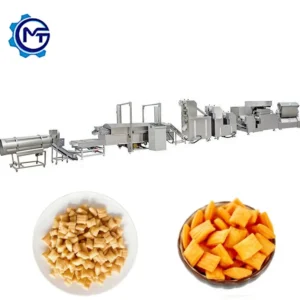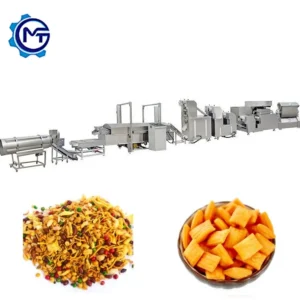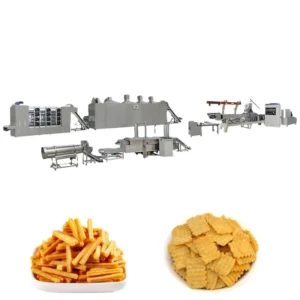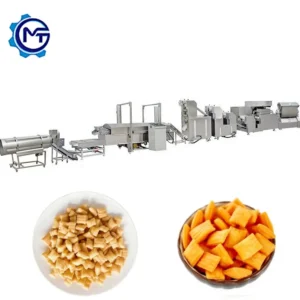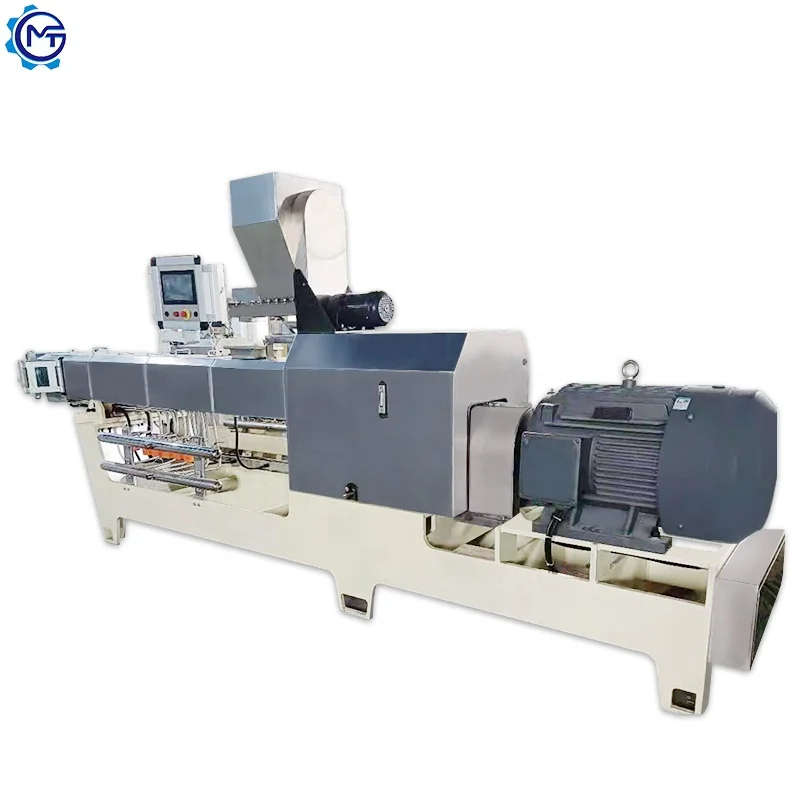
Extrusion-to-Packing Equipment Survey — browse every station from twin-screw extruder through fryer and flavouring drum, so throughput can be matched before a line layout is committed.
Technical Specifications
| Parameter | Value |
|---|---|
| Model | MT65 / MT70 / MT70c / MT75 |
| Product Type | Twin Screw Extruder Nacho Chips Tortilla Doritos Making Machine |
| Main Power | 22 kW (MT65); 30 kW (MT70); 45 kW (MT70c); 55 kW (MT75) |
| Output Capacity | 100–150 kg/h (MT65); 150–200 kg/h (MT70); 200–250 kg/h (MT70c); 200–300 kg/h (MT75) (basis not stated in source) |
| Overall Dimensions (Full Line) | 22000×1200×2200 mm (MT65); 25000×1500×2200 mm (MT70); 30000×3500×4300 mm (MT70c); 33000×3500×4300 mm (MT75) |
| Screw Material | Alloy 38CrMoAl with nitriding process |
| Main Motor Brand | Siemens |
| Feeding System | Food-grade stainless steel twin screw feeder with speed-adjusted converter |
| Cutting System | Knife fixed in die head seat, rotary cutting by V-belt drive |
| Fryer Energy Source | Electric, diesel, or gas (configuration to be confirmed) |
| Gearbox | Automatic lubrication function |
| Control System | Speed-adjusted converter on feeding, extrusion, and cutting systems (PLC/MCC availability to be confirmed) |
| Certification | CE, ISO |
Application Suitability
| Application | Material or Output |
|---|---|
| Nacho chips and tortilla chips | Corn flour or corn powder extruded, shaped, fried, and seasoned |
| Doritos-style triangular snacks | Corn-based dough formed through die and cut into flat triangles before frying |
| Corn puffs and bugles | Extruded tubes or curls fried to a crisp texture and coated with savoury powder |
| Pilled or scoop-format snacks | Die geometry selected to produce curved or concave profiles for dipping applications |
| Contract packaging runs | Multiple chip shapes on a single line with die and knife changeover between batches |
Why the Downstream Station Dictates the Extruder Choice
A Twin Screw Extruder Nacho Chips Making Machine full equipment range only performs when every station keeps pace with the one before it.
Buyers often fixate on the extruder’s output rating and treat the fryer, de-oiling belt, and flavouring drums as afterthoughts. I have watched a line where the fryer pulled product faster than the upstream shaper could deliver, leaving the oil bath half-empty and the temperature cycling wildly. Chips that went in pale came out burnt twenty minutes later. The Twin Screw Extruder Nacho Chips Making Machine full equipment range on this page lets you survey every supporting station — mixer, feeder, shaper, continuous fryer, cooling conveyor, double-drum flavouring — and compare capacities side by side before the layout is drawn [NEED_CITE: throughput matching across extrusion and frying stations in snack lines].
Matching Every Station from Hopper to Seasoning Drum
The Twin Screw Extruder Nacho Chips Making Machine full equipment range begins at the batching point. A twin-shaft mixer blends corn flour with minor ingredients and water, then a stainless steel twin-screw feeder meters the dough into the extruder barrel at a rate governed by a speed-adjusted converter. Downstream, the shaper and rotary cutter produce the target chip geometry, and a continuous fryer — selectable for electric, diesel, or gas heating — takes the raw shapes through the oil bath. After frying, a double-drum flavouring system with an integrated powder hopper and sprayer applies seasoning while the chips still carry enough surface oil for adhesion.
How Barrel Profile and Die Geometry Shape the Final Chip
Extruded fried snacks live or die by the expansion that happens the moment the dough leaves the die. The 38CrMoAl alloy screws, treated with nitriding, maintain tight clearances under the heat and shear needed for corn-based doughs. The barrel is divided into heating zones so the starch gelatinises progressively rather than all at once, which would produce a dense, under-expanded chip. Die insert selection — flat triangle, scoop, tube, or curl — is matched to the buyer’s target format, and the rotary knife at the die face is timed to the extrudate speed so every piece leaves at the same length [NEED_CITE: die and knife synchronisation on twin-screw snack extruders].
Reading the Spec Table Against Your Actual Raw Material
The power figures across the MT65 through MT75 family — from 22 kW up to 55 kW — correlate with the barrel volume and the torque needed to push corn dough through the selected die. Overall dimensions listed span the entire line footprint, not just the extruder, so buyers planning floor space should treat those numbers as the full production envelope. Capacity values are provided per model, but they depend on raw material moisture, the target chip density, and the fryer dwell time required for the chosen format. Requesting a trial run on your specific corn flour grade confirms which model and screw configuration will actually hold the output you need.
When Stations Fall Out of Sync
The most common failure mode on extruded snack lines is not a broken motor or a burnt heater; it is a throughput mismatch that shows up weeks after commissioning. An extruder pushing product faster than the fryer can handle forces the operator to throttle back the feed, which drops barrel pressure and ruins the expansion. A flavouring drum that cannot tumble fast enough leaves chips sitting in the takeaway conveyor, going stale before the seasoning sticks. These are not warranty claims — they are layout errors that surface as product giveaway, excess oil absorption, or packaging line stoppages [NEED_CITE: consequences of throughput mismatch in fried snack production lines].
Why Buyers Survey Here Before Specifying a Line
Every station in this catalogue is built under one supplier, so throughput calculations are cross-checked before the layout is drawn rather than reconciled on the factory floor. Screw configurations and die inserts are specified to the buyer’s corn flour grade and target chip format, not copied from a generic build. An in-house testing workshop runs trial batches on the customer’s actual raw material before any station ships. Electrical schematics and voltage documentation are confirmed against the destination market’s utility standard before the control cabinet is wired. Wear parts — replacement screws, dies, cutting knives, and V-belts — are listed and available at the first service interval rather than back-ordered after the line stalls.
Documentation & Verification
- Machine specification sheet with screw diameter, L:D ratio, and barrel zone count for each model
- Screw and die configuration record matched to buyer’s chip shape and corn flour grade
- Electrical schematic confirming voltage, frequency, and control language for the destination market
- Trial run report produced in the testing workshop on customer-supplied raw material
- CE declaration of conformity and ISO certificate for the extruder and supporting stations
- Wear parts list with part numbers for screws, dies, knives, and V-belts
Installation, Commissioning & Support
- Floor plan showing full line footprint from mixer to flavouring drum, based on selected model dimensions
- Dedicated power circuit sized to the extruder main motor rating, up to 55 kW on the MT75
- Line arrives in modular sections; extruder barrel, fryer, and drums are positioned per the confirmed layout
- First run includes screw speed, barrel temperature, and fryer dwell time calibration on buyer’s corn flour
- Operator training covers die and knife changeover between chip formats and daily nitriding screw inspection
- Replacement screws, dies, V-belts, and cutting knives stocked and shipped against the documented wear parts list
Preparing Your Specification Inquiry
To size the right extruder and supporting stations, share your target chip format, corn flour specification, and the daily output you need to hit. Let us know the factory floor length and ceiling height available, plus the local voltage and frequency so the control cabinet is wired correctly before it ships. If you have existing mixing or packing equipment upstream or downstream, tell us the model and throughput so the new stations are matched to what is already running.
Frequently Asked Questions
Q: How do I choose between MT65, MT70, MT70c, and MT75 for my production target?
A: The choice depends on the daily output you need and the floor space available. Each model scales in main motor power and barrel volume, and the overall line dimensions grow accordingly. Capacity figures per model should be confirmed against your specific corn flour moisture and target chip density through a trial run before selection.
Q: What supporting stations are available, and how is each sized to the extruder?
A: The range includes a twin-shaft mixer, stainless steel twin-screw feeder, shaper, continuous fryer with selectable heating, cooling conveyor, and double-drum flavouring system. Each station is sized so its throughput matches the selected extruder model, preventing bottlenecks at the fryer or seasoning stage.
Q: Can the electrical cabinet be configured for different destination markets?
A: Voltage, frequency, and control language are confirmed before the cabinet is wired. The electrical schematic is documented and cross-checked against the buyer’s local utility standard, so the motor, heating elements, and control panel match what is available at the installation site.
Q: What screw and die options exist for different chip shapes?
A: Flat triangles, scoops, tubes, and curls are produced by swapping die inserts and adjusting the rotary knife timing. The screw configuration is also matched to the corn flour grade and the expansion required for each shape, and the combination is recorded in the configuration document supplied with the line.
Q: Are spare wear parts available when the first replacement is due?
A: Replacement screws, dies, cutting knives, and V-belts are listed on the wear parts schedule provided at delivery. These items are stocked so that the first service interval does not result in unplanned line downtime waiting for parts to arrive.