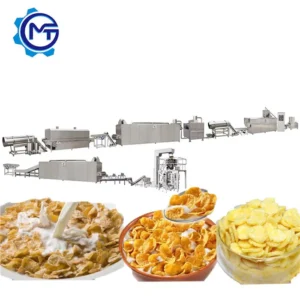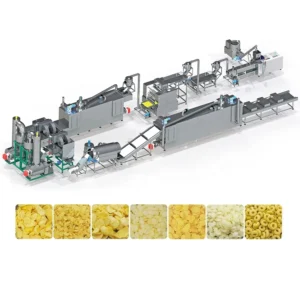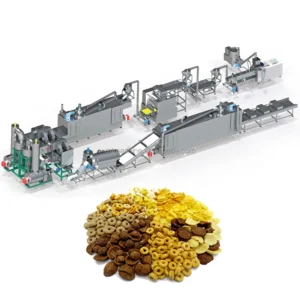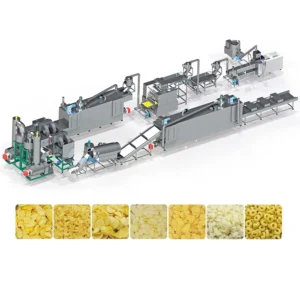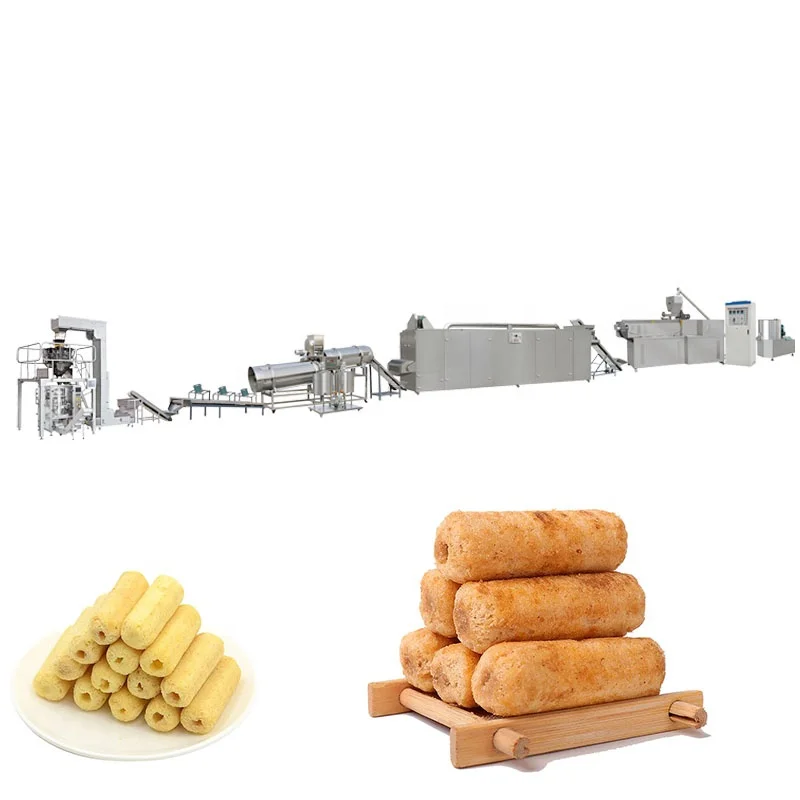
Integrated throughput engineering — every station from mixing to packing is sized to a single confirmed capacity so no single machine bottlenecks the entire corn flakes line.
Technical Specifications
| Parameter | Value |
|---|---|
| Product Type | Corn Flakes Production Line |
| Extruder Type | Twin Screw |
| Extruder Model | MT-75 |
| Installed Power | MT70: 160 kW; MT85: 190 kW; MT75: 210 kW |
| Power Consumption | MT70: 120 kW; MT85: 140 kW; MT75: 150 kW |
| Output Capacity | MT70: 150–200 kg/h (basis to be confirmed); MT85: 300–400 kg/h (basis to be confirmed); MT75: 300–500 kg/h (basis to be confirmed) |
| Extruder Capacity (MT-75) | 200–300 kg/h (basis to be confirmed) |
| Overall Dimensions (L×W×H) | MT70: 41 × 1.5 × 2.2 m; MT85: 43 × 1.5 × 3.2 m; MT75: 45 × 1.5 × 3.5 m |
| Control System | PLC (flaking machinery); full line automation level configurable |
| Basic Materials | Corn, rice, wheat, oat, barley powder |
| Dryer Heating Source | Gas / Electric |
| Flaking System | Hydraulic double-roller, independent dual-motor drive, infrared sensor temperature control |
| Hot Air Roasting Oven | Vibrating pan, conciliation burner, dual circulating fans, cyclone dust removal |
| Coating System | Double tumble melter, elevator, coating drum, spraying nozzle |
| Screw Technology | Wear-resistant, automatic lubricating and cooling |
| Certifications | CE, ISO |
Application Suitability
| Application | Material or Output |
|---|---|
| Natural corn flakes production | Corn powder or corn grits |
| Sugar-coated breakfast cereals | Corn, rice, or multi-grain blends with sugar syrup coating |
| Multi-grain cereal shapes | Wheat, oat, barley powder formed into balls, tubes, rings, fruit loops, stars, wheels, flowers, hearts |
| Fortified cereal lines | Grain blends with added nutritional premix for consistent flake density |
What "Nominal Capacity" Leaves Out About Your Corn Flakes Line
A line rated at a single output figure on paper often fails to hold that number once your actual grain blend enters the extruder.
Many buyers receive a quotation listing a headline capacity for the corn flakes machine full equipment range, only to discover during commissioning that the dryer cannot keep pace with the extruder, or the coating drum creates a backlog that forces the entire line to slow down. The throughput mismatch rarely appears in the brochure [NEED_CITE: throughput balancing across sequential food processing stations]. When stations are sourced from separate vendors, each machine is rated independently under different test conditions, and the weakest link determines your real output.
Matching Every Station to a Single Throughput Target
The corn flakes machine full equipment range covers mixing, twin-screw extrusion, flaking, drying, hot-air roasting, sugar coating, cooling, and packing under one supplier. Because every station is specified together, the extruder output, dryer residence time, flaking roller speed, and coating drum volume are all calculated against the same target throughput and raw material profile. This eliminates the gap where one vendor’s machine runs faster than the next station can accept.
How the Flaking and Roasting Stage Defines Final Texture
The flaking machinery uses a hydraulic double-roller system with independent dual-motor drive, meaning each roller can be adjusted separately to control flake thickness without changing the line speed. Infrared sensors monitor roller surface temperature continuously, keeping the dough sheet at a consistent plasticity before it enters the hot-air roasting oven. The roasting oven itself relies on a vibrating pan with high-temperature spraying tubes and a conciliation burner, while two separate circulating fans and a cyclone dust removal device maintain sanitary conditions and even heat distribution [NEED_CITE: temperature uniformity requirements in breakfast cereal roasting].
Reading the Power and Dimension Data Correctly
The MT75 variant draws 210 kW installed power and 150 kW in typical consumption, which tells a buyer two things: the peak starting load requires dedicated switchgear, and the running cost per hour is predictable for utility planning. Overall dimensions of 45 × 1.5 × 3.5 m for the MT75 line mean a clear ceiling height and a straight-run floor layout are non-negotiable. Twin-screw extrusion with automatic lubricating and cooling keeps barrel temperature stable across long production runs, preventing the starch gelatinisation inconsistency that causes some flakes to blister unevenly while others remain dense. The choice between gas and electric dryer heating sources should be confirmed against local utility costs and available gas pressure before the order is finalised.
The Cost of Skipping the Dryer-Capacity Check
When the dryer is undersized relative to the extruder, partially dried flakes enter the roasting oven carrying too much moisture, and the oven must work harder to drive that water off. The result is a surface that looks toasted but retains a soft centre, leading to complaints about stale texture within weeks of packing. Conversely, an oversized dryer wastes energy and can over-dry the sheet before flaking, causing brittle edges that break during coating [NEED_CITE: moisture content targets before cereal flaking and roasting]. These mismatches are avoidable only when every station is quoted and tested as a single system.
Why Procurement Through a Single Equipment Supplier Matters
The MT75 line is designed so that screw configuration and die geometry are matched to the buyer’s exact grain blend and target flake thickness before production begins. An in-house testing workshop allows trial runs on the buyer’s own raw material, meaning product development happens before shipment rather than during on-site commissioning. PLC control on the flaking machinery provides repeatable roller gap and temperature settings across shifts. Wear parts such as screws, dies, and flaking rollers are documented in a parts list so that first replacements are available when needed, rather than discovered missing after installation. Pre-sales consultation extends through engineer design, on-site installation, commissioning, and ongoing maintenance support.
Documentation & Verification
- Line layout drawing showing every station matched to your confirmed throughput target
- Screw and die configuration record specified to your grain blend and flake thickness
- Trial run report on your raw material produced in the testing workshop before dispatch
- Electrical schematic with voltage, frequency, and control language confirmed to your facility standard
- Factory test record documenting output and product quality at verified running conditions
Installation, Commissioning & Support
- Floor plan must accommodate the MT75 line footprint of up to 45 m length with adequate ceiling clearance
- Dedicated power circuit sized for 210 kW installed load on the MT75 variant, with voltage confirmed before production
- On-site assembly of dryer, roasting oven, and coating drum with alignment to extruder discharge height
- First-run parameter setting including barrel temperature profile, roller gap, and oven zone temperatures
- Operator training covering PLC interface on flaking machinery and daily lubrication checks on twin-screw extruder
- Wear parts list covering screws, dies, and flaking rollers with stocking and lead-time guidance
Preparing Your Inquiry for an Accurate Line Proposal
To receive a configuration that matches your facility, specify the grain blend you intend to run, the target flake thickness, and whether you need natural or sugar-coated output. Confirm your local voltage and frequency standard, the available ceiling height, and whether gas or electric heating is preferred for the dryer. If you have existing upstream milling or downstream packing equipment, note the interface points so the line layout accounts for them.
Frequently Asked Questions
Q: How is the output capacity of each station verified against the same raw material?
A: Every station — extruder, dryer, flaking mill, and coating drum — is specified against the buyer’s confirmed grain blend and target throughput. A trial run in the testing workshop produces actual output data on that material, so the line is balanced before shipment rather than adjusted after installation.
Q: What voltage, frequency, and PLC language are confirmed before production?
A: The electrical schematic and control language are confirmed with the buyer after the order is placed but before manufacturing begins. This covers the PLC interface on the flaking machinery, the extruder control panel, and all motor ratings, preventing commissioning delays caused by incompatible electrical standards.
Q: How are screw and die configurations selected for different grain blends?
A: Screw configuration and die design are specified to the buyer’s exact flour blend and target flake thickness. Corn, rice, wheat, oat, and barley each behave differently under shear and moisture, so the configuration record is prepared after reviewing the raw material data sheet and confirmed during the pre-shipment trial run.
Q: Can a trial run be done on the buyer’s own raw material before shipment?
A: Yes. The in-house testing workshop runs the buyer’s actual grain blend through the extruder and flaking station, producing sample flakes for quality approval. This means product development and process tuning happen before the line arrives on site.
Q: How are wear parts stocked and what is the replacement lead time?
A: A wear parts list covering screws, dies, and flaking rollers is supplied with the line documentation. Replacement availability and typical lead times are confirmed at the time of order so that the first scheduled changeover does not interrupt production.