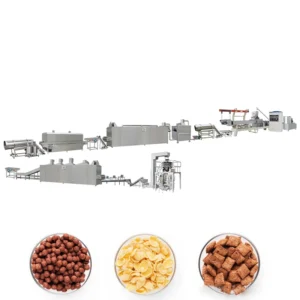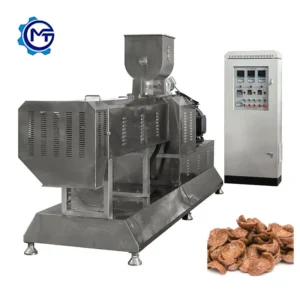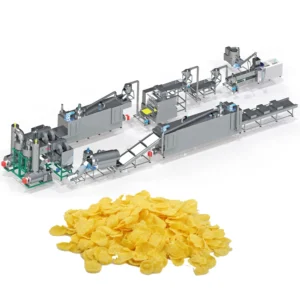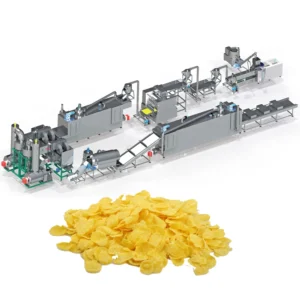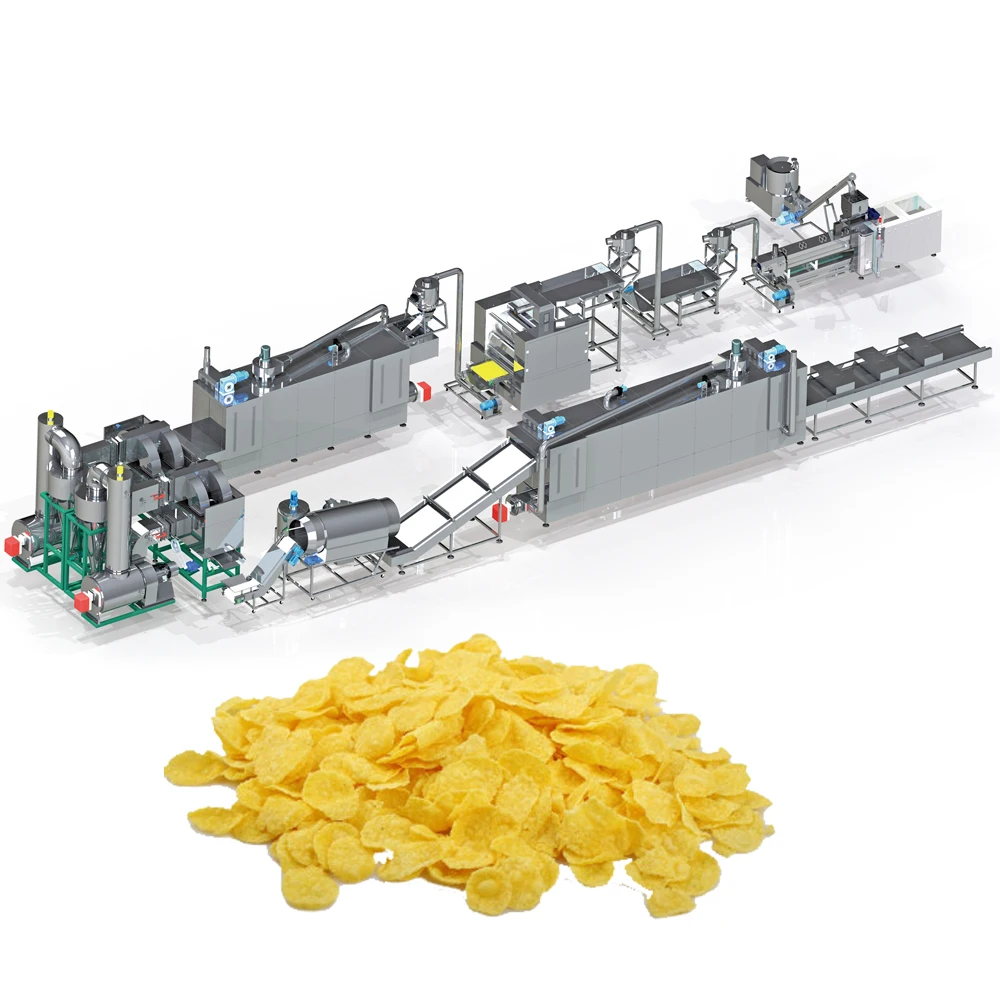
Integrated Line Matching — Every station from mixer to packing is sized against the extruder model you select, so throughput is balanced across the entire corn flakes production line rather than patched from mismatched vendors.
Technical Specifications
| Parameter | Value |
|---|---|
| Product Type | Twin Screw Extruder Corn Flakes Production Line |
| Models Available | MT70 / MT85 / MT75 |
| Screw Type | Twin Screw |
| Installed Power | MT70 — 160 kW; MT85 — 190 kW; MT75 — 210 kW |
| Power Consumption | MT70 — 120 kW; MT85 — 140 kW; MT75 — 150 kW |
| Output Capacity | MT70 — 150–200 kg/h (basis not stated in source — confirm raw material, moisture, pellet size); MT85 — 300–400 kg/h (basis not stated in source); MT75 — 300–500 kg/h (basis not stated in source) |
| Overall Dimensions (L×W×H) | MT70 — 41 × 1.5 × 2.2 m; MT85 — 43 × 1.5 × 3.2 m; MT75 — 45 × 1.5 × 3.5 m |
| Control System | PLC control system; line-level MCC and PLC control |
| Flaking Machinery | Hydraulic double-roller system with separate motors; infrared sensor temperature pipe control |
| Dryer Heating Source | Gas or Electric (selectable) |
| Hot Air Roasting Oven | Conciliation burner combustion chamber; dual circulating fans; cyclone dust removal; vibrating pan with high-temperature spraying tubes |
| Coating System | Double tumble sugar melter; dedicated elevator; coating drum; spraying nozzle |
| Raw Materials | Corn, rice, wheat, oat, barley powder |
| Final Product Shapes | Ball, tube, stick, ring, fruit loop, star, wheel, flower, heart (via extruder mould adjustment) |
| Extruder Advantage | Automatic lubricating and cooling function; wear-resistant screw technology |
| Standards | CE certified (company-level since 2014); ISO certified |
Application Suitability
| Application | Material or Output |
|---|---|
| Natural corn flakes for breakfast cereal market | Corn powder with controlled moisture content through full drying and roasting stages |
| Sugar-coated corn flakes with glazed finish | Corn or wheat powder with sugar spraying and tumble coating stages |
| Shaped morning cereals (fruit loops, stars, rings) | Corn, rice, oat, or barley powder with extruder mould change |
| Puffed snack diversification on same extruder platform | Rice, wheat, and multigrain blends with adjusted screw configuration |
Why "Nominal Capacity" Doesn’t Tell You the Whole Story
A corn flakes line rated at a certain throughput on pure corn grits can drop significantly when the buyer switches to a high-fibre, high-bran formulation without a corresponding screw reconfiguration.
When a buyer surveys the breakfast cereal corn flakes machine full equipment range, the first number that catches the eye is output capacity. But that number was established under specific conditions — a particular grain, a set moisture level, a defined pellet geometry. I remember a customer who ordered a breakfast cereal line based on sample capacity figures, then ran a high-fibre oat blend on it. The screw shear was insufficient for that formulation, expansion fell short, and nearly half the flakes came out fragmented. The extruder was not at fault; the configuration simply did not match the raw material [NEED_CITE: material-dependent throughput variation in twin-screw extrusion].
This is why capacity figures in the specification table carry a note asking buyers to confirm their actual raw material and moisture content. The breakfast cereal corn flakes machine full equipment range is not a single fixed machine — it is a set of stations that must each be matched to what you are actually putting into the hopper.
How Each Station Is Sized to the Extruder Model
When reviewing the breakfast cereal corn flakes machine full equipment range, the starting point is extruder selection. Three models — MT70, MT85, and MT75 — cover different production brackets. Once the extruder is chosen, every downstream station must process the volume that extruder delivers at steady state. An undersized dryer will hold back the entire line, leaving wet flakes accumulating upstream. An oversized roasting oven wastes thermal energy and floor space. The catalogue approach here is to specify each station — flaking machinery, dryer, hot air roasting oven, coating drum, cooling conveyor, and packing interface — so that throughput is balanced across the chain.
The Flaking and Roasting Stages Determine Final Texture
Flake thickness and surface crispness are decided long after the extruder. The flaking machinery uses a hydraulic double-roller system driven by separate motors, with infrared sensor temperature pipe control to maintain consistent roller surface conditions. This matters because uneven roller temperature produces flakes with variable density — some too dense to toast properly, others too thin and fragile to survive coating. The hot air roasting oven then finishes the texture with a conciliation burner, dual circulating fans, and a cyclone dust removal device [NEED_CITE: thermal uniformity requirements in cereal roasting ovens]. A vibrating pan with high-temperature spraying tubes ensures even heat exposure across the full bed of flakes.
Reading the Specs Against Your Actual Production Target
Installed power across the three extruder models ranges from 160 kW to 210 kW, with running power consumption between 120 kW and 150 kW. These figures matter when sizing the electrical supply and dedicated circuit for the extrusion zone. The overall line length stretches from 41 metres on the MT70 configuration to 45 metres on the MT75, which directly affects workshop layout planning and utility routing. The twin-screw design gives operators control over shear and residence time, which is critical when switching between corn, rice, wheat, oat, or barley formulations. Screw configuration and die design should be specified to the buyer’s actual raw material blend rather than carried over from a generic build. The PLC and MCC control system at line level lets operators monitor each station from a single interface, keeping batch-to-batch variation within acceptable limits.
The Hidden Cost of Undersized Supporting Stations
I have seen situations where a buyer focused entirely on the extruder and treated the rest as commodity equipment. The dryer was too short, the roasting oven had a single fan, and the coating drum was borrowed from a snack line with different throughput. The result was a bottleneck that surfaced only after commissioning — wet flakes reaching the roaster, uneven sugar coverage, and packing speeds that could not keep up with extruder output [NEED_CITE: line bottleneck analysis in cereal production facilities]. These problems do not show up in a brochure. They show up on the first production day when the buyer realises the line cannot hold its rated pace because one station is choking the flow.
What Sets This Equipment Range Apart for Line Planning
The complete line runs from mixing and batching through extrusion, flaking, drying, hot air roasting, sugar coating, cooling, and packing — all specified under one supplier, so throughput matching is calculated before the first machine is built. Screw configuration and die design are set to the buyer’s raw material and target product shape, not copied from a default template. An in-house testing workshop allows trial runs on the buyer’s actual formulation before shipment, catching expansion or density issues at the factory rather than during on-site commissioning. Twin-screw expertise spans corn flakes alongside pet food, aquatic feed, snack, and cereal applications, meaning screw geometry decisions are informed by cross-category experience. Pre-sales engineering consultation covers line layout, utility planning, and phased installation scheduling, not just equipment quotation.
Documentation & Verification
- Line layout and capacity calculation showing throughput balance across every station in the corn flakes line
- Machine specification sheet for each station with installed power, dimensions, and utility requirements
- Screw and die configuration record matched to your corn, rice, wheat, oat, or barley formulation
- Electrical schematic with voltage and frequency confirmation for your target market supply
- Trial run report on your actual raw material processed in the testing workshop before dispatch
- CE declaration of conformity and ISO certificate for export compliance documentation
Installation, Commissioning & Support
- Floor space planning based on the selected model’s overall line length of 41 to 45 metres, including utility corridor clearance
- Dedicated electrical circuit sized to the extruder’s installed power ranging from 160 kW to 210 kW plus downstream station loads
- Assembly from shipped modules with station-by-station alignment verification for flaking rollers and conveyor interfaces
- First-run parameter setting on your raw material, including barrel temperature profile and hydraulic roller pressure
- Operator training covering PLC and MCC control interface, screw speed adjustment, and coating drum operation
- Wear parts list covering screws, dies, and roller surfaces with recommended replacement intervals
What to Include in Your Inquiry
To configure the right breakfast cereal corn flakes machine full equipment range for your facility, the most useful starting information is your target raw material blend and the formulation ratios you plan to run. Your workshop length and ceiling height determine which extruder model and line layout will fit. Local voltage and frequency standards, along with your preferred control language, should be confirmed before electrical schematics are drawn. If you have existing upstream or downstream equipment that the new line must integrate with, sharing those specifications early prevents interface mismatches during commissioning.
Frequently Asked Questions
Q: How do I choose between the MT70, MT85, and MT75 extruder models for my corn flakes line?
A: Selection starts with your target output range and the raw material formulation you intend to run. Each model covers a different capacity bracket, but actual throughput depends on your grain type, moisture level, and pellet geometry. The right approach is to share your formulation details so that capacity can be recalculated against your specific conditions, then match the downstream stations accordingly.
Q: Which supporting stations do I need for natural corn flakes versus sugar-coated corn flakes?
A: Natural corn flakes require mixing, extruding, flaking, drying, hot air roasting, cooling, and packing. Sugar-coated corn flakes add sugar spraying and sugar coating stations between the roasting and final drying stages. The coating system includes a double tumble sugar melter, elevator, coating drum, and spraying nozzle, all sized to the extruder model you select.
Q: How is dryer and roasting oven capacity matched to the extruder to avoid line bottlenecks?
A: Each downstream station is calculated based on the steady-state output of the chosen extruder model. The dryer heating source can be gas or electric depending on your facility. The roasting oven uses dual circulating fans and a conciliation burner to handle the full volume. Throughput matching is documented in the line layout and capacity calculation before production begins.
Q: What raw material powders are compatible with this production line?
A: The line processes corn, rice, wheat, oat, and barley powders, individually or in blends. Screw configuration and die design are adjusted to each formulation to control shear, expansion, and pellet density. A trial run on your actual raw material in the testing workshop confirms the configuration before the line ships.
Q: How is product shape variety achieved across the cereal range?
A: Shape variation is achieved by adjusting the mould in the extruder. Available shapes include ball, tube, stick, ring, fruit loop, star, wheel, flower, and heart. Each shape change may require minor adjustments to screw speed, moisture input, and die configuration, all of which are documented in the screw and die configuration record for repeatable production runs.