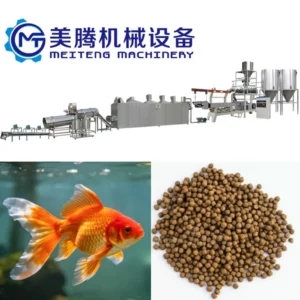
Screw and die matching — Every barrel zone and die plate in this fish feed processing line is configured around your specific formula and target pellet density, not copied from a generic aquatic feed build.
Technical Specifications
| Parameter | Value |
|---|---|
| Product Type | Fish Feed Processing Line |
| Output Capacity | 4–5 t/h (basis not stated in source — confirm raw material, moisture, pellet size and species) |
| Extruder Type | Twin-screw extruder |
| Construction Material | 304 stainless steel |
| Target Species | Trout, salmon, catfish (multi-species) |
| Control System | source value — verify against manufacturer catalog |
| Voltage & Frequency | source value — verify against manufacturer catalog |
| Overall Dimensions (L×W×H) | source value — verify against manufacturer catalog |
| Net Weight | source value — verify against manufacturer catalog |
| Rated Power (kW) | source value — verify against manufacturer catalog |
| Screw Diameter | source value — verify against manufacturer catalog |
| L:D Ratio | source value — verify against manufacturer catalog |
| Barrel Zones | source value — verify against manufacturer catalog |
| Die Configuration | source value — verify against manufacturer catalog |
| Moisture Range | source value — verify against manufacturer catalog |
Application Suitability
| Application | Material or Output |
|---|---|
| Floating trout feed | Fish meal, corn starch, vitamin premix, 3–6 mm pellets |
| Sinking catfish feed | Soybean meal, rice bran, fish oil, 4–8 mm pellets |
| Salmon grower pellets | High-protein marine meal blends, lipid coating, 5–9 mm pellets |
| Multi-species changeover production | Formula swaps between floating and sinking densities on the same line |
Why Nominal Tonnage Means Nothing Without the Raw Material
A fish feed processing line manufacturer that quotes capacity without your formula in hand is guessing.
I once stood in a humid workshop watching a twin-screw extruder push out barely half its nameplate tonnage because the local fish meal had lower protein and higher ash than the test sample. The dryer ran half-empty while the coating drum backed up, and the whole shift rhythm fell apart. That line was rated at a certain output on a standard reference formula, but the buyer’s actual ingredients behaved completely differently under shear and heat [NEED_CITE: raw material variability in aquatic feed extrusion].
When buyers survey a fish feed processing line manufacturer, the first question should never be "what is your max capacity." It should be "will you run my material before you ship."
How Each Station Maps to the Next
This catalogue lays out every piece of equipment from the batching station through extrusion, drying, coating and packing so that throughput is visible at each hand-off point. A twin-screw extruder pushing a certain volume of wet, expanded pellets into a dryer requires that dryer to have matching belt area and residence time. If the dryer is undersized, pellets pile up, cool unevenly and crack before they reach the coating drum. The fish feed processing line manufacturer role here is to show the full sequence and where each machine sits, so buyers can inspect the logic before signing a project contract.
Matching Dryer and Coater to Extruder Output
Drying is where most aquatic feed lines lose their rhythm. Expanded pellets leave the die at high moisture and must be brought down to a safe storage level without case-hardening the surface. A belt dryer with insufficient length or wrong air temperature profile will seal moisture inside, leading to mould in the bag within weeks [NEED_CITE: moisture migration in extruded aquatic pellets]. The coating drum downstream then needs to apply lipid or flavour slurry at a rate that matches the dried pellet flow. This equipment range shows each station’s nominal position in the chain, letting buyers compare station sizes and flag mismatches before production begins.
Reading the Specs That Actually Matter
The twin-screw configuration is the processing core here, and it earns that role through shear control and self-wiping action, both critical when switching between a high-starch trout formula and a high-protein catfish mix. Screw diameter and L:D ratio together determine how long material stays in the barrel and how much mechanical energy it absorbs, which directly controls the degree of starch gelatinisation and the final pellet buoyancy. Barrel zones allow staged heating so that protein denaturation and starch cooking can be managed independently along the barrel length. The 304 stainless steel contact surfaces prevent corrosion from the salt and lipid content typical in aquatic formulations, an issue that rules out carbon steel in any food-grade feed environment [NEED_CITE: food-contact material standards for feed processing equipment].
The Cost of Skipping the Station-by-Station Check
Buyers who focus only on the extruder and treat the rest as "standard supporting equipment" regularly run into bottlenecks that no amount of operator tweaking can fix. An undersized cooler means pellets enter the packing station above ambient temperature, causing condensation inside the bag. A coating drum that runs faster than the dryer can feed it creates a buffer pile that crushes the pellets at the bottom. These are not defects in any single machine; they are gaps in line-level thinking [NEED_CITE: line throughput balancing in feed mill design].
Why Procurement Starts Here
Every station from batching through packing is listed under one equipment range, so throughput matching happens on paper before metal is cut. Screw and die configurations are specified against the buyer’s raw material, not pulled from a standard aquatic feed template. An in-house testing workshop allows trial runs on customer-supplied ingredients before the extruder leaves the factory. Electrical schematics and voltage documentation are confirmed against the destination market before production starts. Pre-sales engineering through installation and operator training stays with the same team, so the people who designed the layout are the ones answering the phone during commissioning.
Documentation & Verification
- Line layout showing throughput at every station from batching to packing
- Screw and die configuration record matched to your raw material
- Electrical schematic with voltage and frequency for your target market
- Factory test record on your formulation before dispatch
- CE declaration of conformity and ISO certificate on file
- Wear parts list covering screws, dies and barrel liners
Installation, Commissioning & Support
- Foundation plan sized to the twin-screw extruder’s weight and vibration profile
- Dedicated electrical circuit matching confirmed voltage and frequency
- Modular station delivery allowing phased assembly in low-headroom workshops
- First-run parameter logging across all barrel zones during commissioning
- Operator training on formula changeover between floating and sinking pellets
- Wear parts inventory covering initial screw and die replacement cycle
What to Prepare Before You Enquire
Send your raw material formula, including protein and starch percentages and the target moisture at packing. Specify the pellet diameter range and whether you need floating, sinking or both. Provide your workshop floor area and ceiling height, along with local voltage and frequency. If you have existing upstream mixers or downstream packing machines, share their throughput ratings so the line can be matched to them.
Frequently Asked Questions
Q: What equipment stations are included from batching through to packing?
A: The range covers raw material batching and mixing, twin-screw extrusion, belt drying, lipid or flavour coating, counter-flow cooling and packing. Each station is listed with its position in the sequence so buyers can see how throughput flows from one machine to the next and identify any gaps in their existing setup.
Q: How do I match dryer and coating capacity to the extruder output?
A: Dryer belt area and air volume must handle the wet pellet volume leaving the die without creating a backlog. Coating drum speed and spray rate then follow the dried pellet flow. This catalogue lists each station so buyers can compare capacities and request adjustments before the line is built.
Q: Can each station be ordered separately or only as a complete line?
A: Individual stations can be specified and ordered on their own, which suits feed mills adding capacity to an existing line or replacing a single underperforming unit. The catalogue format lets buyers identify the exact machine they need without committing to a full project scope.
Q: How is throughput balanced between extrusion, drying and flavouring stations?
A: Throughput balancing starts with the extruder output on the buyer’s actual formula, then the dryer residence time and coater drum volume are calculated backward from that number. The equipment range shows each station’s capacity position so mismatches are visible before any purchase order is placed.