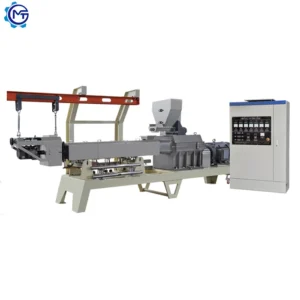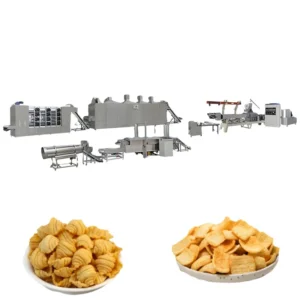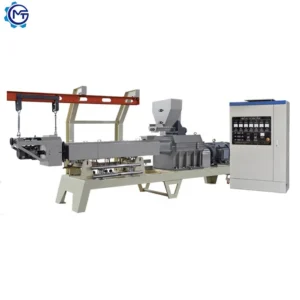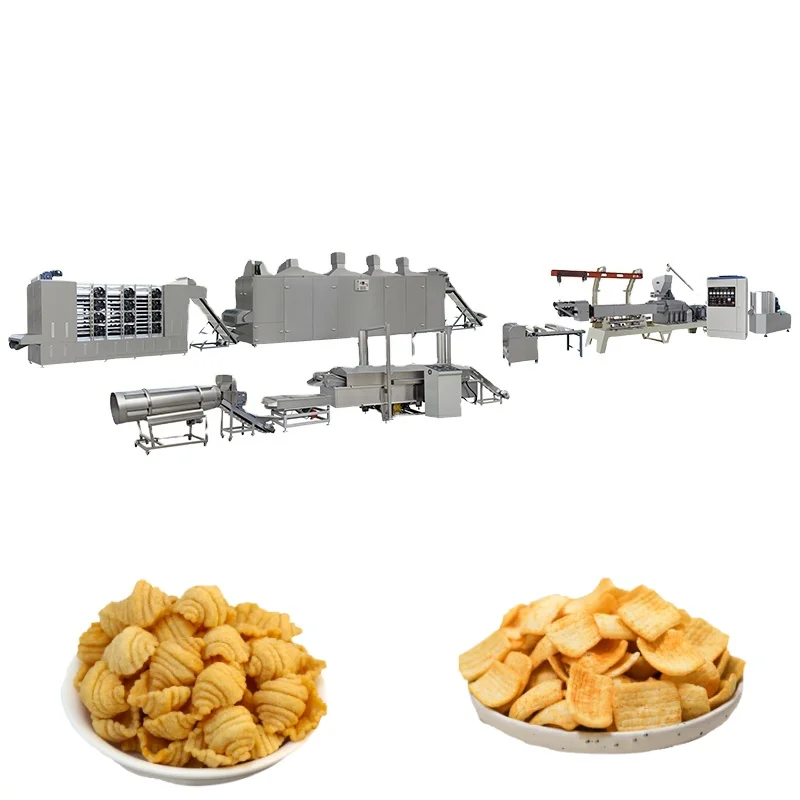
Throughput-Matched Line Engineering — Every station from mixer through extruder, fryer, and seasoning drum is sized so the slowest link never bottlenecks your actual output on your specific raw material formulation.
Technical Specifications
| Parameter | Value |
|---|---|
| Product Type | Fried Snack Food Processing Line |
| Models Available | MT-65 / MT-70 / MT-85 / MT-75 / MT-95 |
| Screw Type | Twin screw, co-rotating sectional modules |
| Main Motor (MT-65) | 100 kW |
| Main Motor (MT-70) | 130 kW |
| Main Motor (MT-85) | 180 kW |
| Main Motor (MT-75) | 185 kW |
| Main Motor (MT-95) | 280 kW |
| Output Capacity (MT-65) | 120–150 kg/h (basis to be confirmed) |
| Output Capacity (MT-70) | 200–250 kg/h (basis to be confirmed) |
| Output Capacity (MT-85) | 300–500 kg/h (basis to be confirmed) |
| Output Capacity (MT-75) | 400–500 kg/h (basis to be confirmed) |
| Output Capacity (MT-95) | 800–1000 kg/h (basis to be confirmed) |
| Line Stations | Mixer → Twin Screw Extruder → Cutting/Shaping Machine → Fryer → Flavouring/Coating |
| Fryer Belt Width | 600 mm stainless steel belt |
| Fryer Energy Options | Electricity / Fuel / Gas |
| Drying Method | Gas / Electric / Diesel heating |
| Cutting Machine Power | 1.47 kW |
| Control System | PLC and MCC control |
| Voltage & Frequency | Customizable (e.g., 3ph 380V 50Hz, 3ph 415V 60Hz, 3ph 220V 60Hz) |
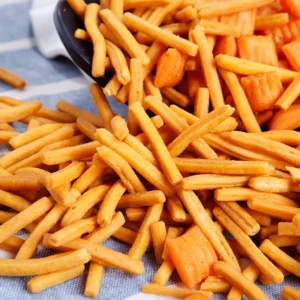
| Die/Shaping Options | Sticks, square sheet, rib chips, diamond chips, wavy chips, pillow shapes, bugles, shells, screws, round/wave tubes |
| Raw Materials | Corn powder, wheat flour, potato starch, potato powder, corn starch |
| Assembly State | Complete turnkey production line |
| Standards | CE (certified since 2014), ISO |
| Warranty | 1 year complete warranty, lifetime maintenance service |
Application Suitability
| Application | Material or Output |
|---|---|
| Fried puff snack production (bugles, corn chips, pillow shapes) | Corn powder, wheat flour, potato starch formulations |
| Pellet-based fried snack production (shell, screw, tube shapes) | Corn starch, potato powder blends |
| Extruded chip manufacturing (diamond, wavy, rib chips) | Wheat flour and corn starch base with adjustable moisture |
| Snack food producers launching new fried product formats | Multi-grain and composite starch formulations for retail or food-service |
Why Nominal Capacity Numbers Mislead Buyers in Fried Snack Extrusion
Your actual throughput depends on what you put into the hopper, not what the brochure claims.
I spent years watching buyers sign contracts based on a single capacity figure, only to discover during commissioning that their local corn flour — higher in fat or coarser in grind than the test standard — absorbed oil at a rate that dragged the fryer to a crawl. The extruder kept running, but the fryer fell behind, and within an hour the seasoning drum was starved while half-cooked product piled up on the conveyor. That fried snack food processing line full equipment range you are evaluating is only as fast as its slowest matched station, and matching must account for your exact raw material, moisture level, and frying time requirements [NEED_CITE: throughput matching principles in continuous food processing lines].
Matching Extruder Output to Fryer Residence Time
A twin-screw extruder pushes product through the die and into the fryer at a continuous rate, but the fryer belt speed and oil temperature determine how long each piece must remain submerged to reach the target colour and moisture content. If your formulation requires a longer fry time — common with dense potato starch blends — the 600 mm stainless steel belt must either slow down or extend, which caps the entire fried snack food processing line full equipment range at a lower throughput than the extruder’s motor could otherwise support. The PLC and MCC control system coordinates belt speed with extruder feed rate so operators can adjust one variable without destabilising the other.
Die Geometry and Oil Absorption Behaviour
The die and shaping station sits between the extruder and the fryer, and its configuration directly determines how much surface area each piece exposes to hot oil. A thin wavy chip absorbs oil faster and reaches colour change sooner than a thick pillow-shaped piece, meaning the same fryer setting produces different effective throughputs depending on which die you install. The available die options — from sticks and diamond chips to bugles and shell shapes — each require a distinct frying profile, and the fryer’s adjustable belt speed and temperature zoning must be tuned to whichever shape is running [NEED_CITE: oil absorption rates by extruded snack geometry and thickness].
Screw Module Configuration for Your Starch Base
The co-rotating sectional screw modules inside the barrel handle transport, mixing, de-gassing, cooking, and forming in a single continuous path, but the arrangement of those modules changes how aggressively the machine shears your raw material. A high-fat corn powder blend needs a gentler mixing zone to prevent oil separation before the die, while a pure wheat flour formulation benefits from higher shear to achieve full starch gelatinisation. Each fried snack food processing line full equipment range is configured with a screw and die record matched to the buyer’s specific formulation before the machine leaves the factory.
What Happens When Voltage and Frequency Are Assumed
I have seen commissioning delays stretch into weeks because the control panel arrived wired for 380V 50Hz in a region running 415V 60Hz, and every motor on the line — the 100 kW extruder, the 1.47 kW cutter, the fryer circulation pumps — ran at the wrong speed. The extruder screw turned faster than designed, the dough cooked unevenly, and the fryer oil temperature controller could not hold a stable setpoint. Confirming voltage, frequency, and control language before production prevents a situation where the fried snack food processing line full equipment range sits idle while replacement contactors and transformer taps are air-freighted across continents [NEED_CITE: voltage and frequency standards by export market].
The Cost of Skipping the Trial Run
When a line ships without being tested on the buyer’s actual flour and starch formulation, the first weeks of production become an expensive experiment. Oil absorption rates, expansion ratios, and final product density are all functions of raw material behaviour under heat and shear, and no generic test on standard corn grits can predict how a buyer’s local potato powder will respond. Lines that skip this step often produce product that is either too greasy or too dense for the target market, leading to rejected batches and lost shelf space while the operator dials in parameters through trial and error.
Why Procurement from a Single Supplier Reduces Integration Risk
Every station on this line — mixer, twin-screw extruder, cutting and shaping machine, fryer, seasoning drum — is selected and sized by the same engineering team that designs the layout. The extruder output is matched to fryer belt capacity, and the fryer discharge rate is matched to the seasoning drum’s tumble volume, so no single machine throttles the others. The in-house testing workshop runs your raw material through the actual line configuration before shipment, generating a trial run report that confirms achievable throughput and product quality. Electrical schematics with confirmed voltage, frequency, and control language accompany every delivery. The fryer supports electricity, fuel, and gas heating, allowing adaptation to local energy cost structures. Screw configuration and die design records are documented and included with the machine so operators know exactly which module arrangement produced the approved sample.
Documentation & Verification
- Line layout and capacity calculation matched to your raw material formulation and target shape
- Screw and die configuration record specifying module arrangement for your starch or flour base
- Trial run report on customer-supplied raw material conducted in the testing workshop before dispatch
- Electrical schematic with voltage, frequency, and control language confirmed prior to production
- CE declaration of conformity and ISO certificate included with shipment documentation
- Wear parts list covering screws, dies, and fryer belt sections for first replacement cycle
Installation, Commissioning & Support
- Foundation and floor space planning based on the longest configuration reaching up to 24 m line length
- Dedicated power circuit sized for the selected extruder motor, up to 280 kW on the MT-95
- Sectional assembly and alignment of extruder barrel, fryer, and seasoning drum on site
- First-run parameter tuning for screw speed, barrel temperature, and fryer belt rate
- Operator training covering die changeover, fryer oil management, and PLC interface navigation
- Scheduled spare parts supply for twin-screw modules, die inserts, and stainless steel belt segments
What We Need to Size Your Line Correctly
Share your primary raw material — corn powder, wheat flour, potato starch, or a blend — along with its typical moisture content and any fat percentage data from your supplier. Tell us your target daily output and the specific product shapes you intend to run, since die configuration affects both throughput and fryer residence time. Include your local voltage, frequency, and preferred control panel language so the electrical design matches your facility from day one.
Frequently Asked Questions
Q: How is output capacity verified against my specific raw material and moisture level?
A: Before shipment, your raw material is run through the extruder and fryer in the in-house testing workshop. The trial run report documents actual throughput, product density, and oil absorption on your formulation. Capacity figures in the specification table are starting points; the verified output after trial is what you receive in the documentation package.
Q: What voltage, frequency, and control language options are confirmed before production?
A: The PLC and MCC control system is configured to your local supply, including 380V 50Hz, 415V 60Hz, or 220V 60Hz among other options. Control panel language is set to your operator’s preference. Electrical schematics reflecting these choices are reviewed and approved before manufacturing begins, preventing commissioning delays on site.
Q: How are extruder, fryer, and seasoning stations throughput-matched to prevent bottlenecks?
A: Each station is sized based on the target product shape and your raw material’s frying time requirement. The extruder’s feed rate is balanced against the fryer’s 600 mm belt speed and the seasoning drum’s tumble capacity so that no single machine forces the others to idle or overflow under continuous operation.
Q: Can a trial run on my flour or starch formulation be completed before the line ships?
A: Yes. The in-house testing workshop runs your supplied raw material through the configured line, producing samples that demonstrate final product texture, colour, and oil content. This trial run report is included with your shipment documentation and serves as the baseline for commissioning parameters when the line is installed at your facility.
Q: What spare wear parts are included and how are replacements supplied?
A: The initial delivery includes a documented wear parts list covering twin-screw modules, die inserts, and fryer belt sections. Replacement parts are manufactured to the same specifications as the originals and can be ordered based on the configuration record included with your documentation package.