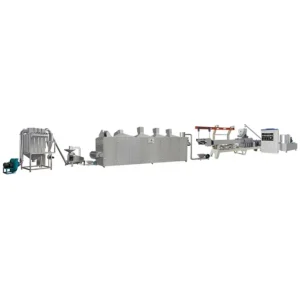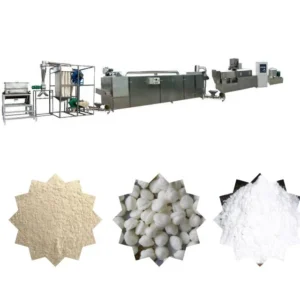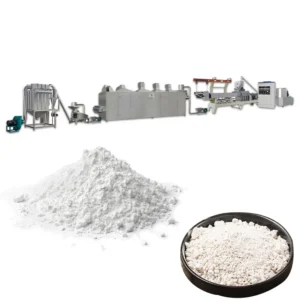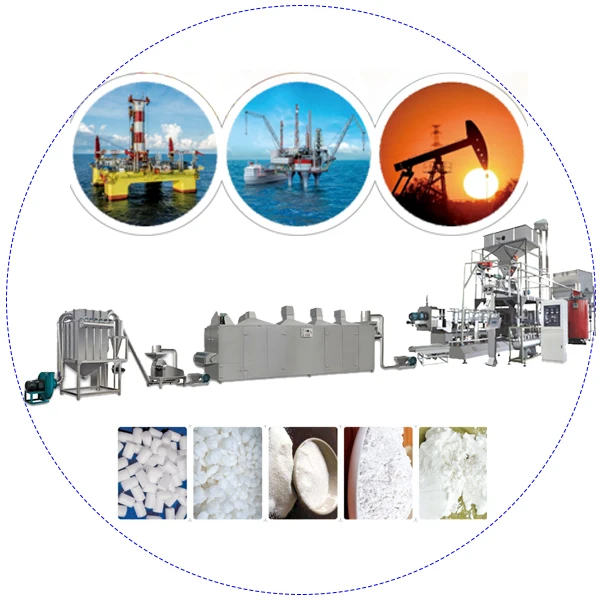
Matched Throughput Across Every Station — a complete modified starch processing line equipment for sale where mixer output, extruder capacity, dryer residence time, and grinder throughput are specified as a system rather than quoted as isolated numbers.
Technical Specifications
| Parameter | Value |
|---|---|
| Product Type | Modified Starch Processing Line |
| Extruder Type | Twin screw extruder |
| Raw Materials | Wheat flour, corn starch, potato starch |
| Output Capacity | 80–500 kg/h (basis not stated in source — confirm raw material type, moisture content, and specific starch variant) |
| Voltage & Frequency | Three phases 380V/50Hz; Single phase 220V/50Hz (customizable to local voltage per country) |
| Energy Source Options | Electricity, gas, diesel, or steam |
| Electrical Power (Electricity) | ~100 kW (rated or peak not specified in source) |
| Electrical Power (Gas/Diesel) | ~50–60 kW (rated or peak not specified in source) |
| Contact Material | Food grade stainless steel 304 |
| Frame Material | Stainless steel 201 |
| Control System | PLC and MCC control |
| Mixer Main Motor | 4.0 kW |
| Mixer Output | 3.0–4.0 kg/time (basis not stated in source — confirm batch composition and moisture addition) |
| Mixer Dimensions | 1.2 × 0.9 × 1.4 m |
| Screw Conveyor Main Motor | 1.1 kW |
| Screw Conveyor Output | 0–150 kg/h (basis not stated in source — confirm material bulk density and moisture) |
| Screw Conveyor Dimensions | 2.5 × 0.6 × 2.3 m |
| Process Flow | Mixer → Screw conveyor → Twin screw extruder → Shift → Air conveyor → Dryer → Air conveyor → Conditioning → Conveyor → Grind |
Application Suitability
| Application | Material or Output |
|---|---|
| Pregelatinized starch for bakery and instant food formulations | Corn starch, potato starch |
| Modified starch for paper and textile sizing | Wheat flour, corn starch |
| Pre-gelatinized adhesive starch for corrugated board | Wheat flour, corn starch |
| Nutritional starch base for infant formula blending | Potato starch, corn starch |
| Industrial binder starch for foundry and drilling mud | Wheat flour, corn starch |
Why the Stated Capacity Means Nothing Without Your Raw Material
The 80–500 kg/h range printed on a modified starch processing line equipment for sale only becomes real once the extruder runs your specific starch variant at your target moisture level.
I learned this the hard way last year. A Middle Eastern customer ordered a pregelatinized starch line, and we ran trials on corn starch at the factory. Everything looked smooth — expansion ratio, gelatinization temperature, final moisture all within spec. Then the line arrived on site and they fed in cassava starch instead. The gelatinization window shifted, the barrel temperature profile was wrong, and we spent two extra weeks rebuilding parameters from scratch. Since then, I do not sign off on shipment until the buyer’s actual raw material has run through the extruder in our testing workshop. [NEED_CITE: starch gelatinization temperature variation across botanical sources]
How Each Station’s Catalogue Data Helps You Survey Before You Commit
When you are evaluating a modified starch processing line equipment for sale, the first question is not what the extruder can do in isolation but whether every upstream and downstream station can keep pace. The mixer batches at a defined kg-per-cycle rate, the screw conveyor meters material into the extruder barrel at a controlled feed rate, and the dryer must have sufficient belt length and airflow to bring extrudate moisture down before grinding. Each piece of equipment in this catalogue is listed with its own motor rating, dimensions, and throughput reference so that you can cross-check balance before a line layout is drawn.
Matching Energy Source to Your Site Conditions
Starch modification through twin-screw extrusion demands consistent thermal input, and the choice between electric, gas, diesel, or steam heating changes more than just the utility bill. Electric heating offers precise temperature zoning across barrel sections but requires a dedicated high-capacity circuit. Gas or diesel firing suits sites where electrical infrastructure is limited but introduces flame management and exhaust routing requirements. Steam heating integrates well if the facility already operates a boiler for other process lines. The extruder and dryer on this modified starch processing line equipment for sale are configurable across all four energy sources, so the decision can be made around your actual utility availability rather than forced by equipment limitation. [NEED_CITE: industrial energy cost comparison for food processing thermal systems]
Reading the Specs That Actually Matter for Starch Modification
The twin-screw extruder is the core of this line, and its screw configuration determines the shear profile that the starch granules experience inside the barrel. Different starch sources — wheat, corn, potato — have distinct granule sizes, amylose-to-amylopectin ratios, and gelatinization onsets, so the screw element arrangement and die geometry must be selected to match. A configuration that produces the correct degree of modification on corn starch may under-process potato starch or over-shear wheat flour, resulting in inconsistent viscosity in the final product.
Food-grade stainless steel 304 contact surfaces prevent iron contamination that could catalyze starch degradation during storage, while the stainless steel 201 frame provides structural rigidity without unnecessary cost in non-contact zones. The PLC and MCC control system records barrel temperature, screw speed, and feed rate for each production run, which matters when you need to reproduce a specific modification grade across batches separated by weeks or months.
What Happens When Stations Are Mismatched
An extruder that pushes out modified starch faster than the dryer can handle creates a backlog of wet extrudate sitting on conveyor belts, absorbing ambient moisture and clumping before it reaches the grinder. The grinder then chokes on material that is too moist, producing uneven particle size and forcing the operator to slow the entire line back down to match the dryer. This kind of bottleneck is invisible when you only look at the extruder’s nameplate capacity. I have seen lines where the extruder was rated for a certain output but the dryer belt was too short to bring moisture below the grinding threshold, and the buyer spent months running at half speed while waiting for a longer dryer to be fabricated and shipped. [NEED_CITE: effects of moisture content on starch grinding efficiency]
Why Procurement from a Single Equipment Catalogue Reduces Risk
Every station on this modified starch processing line equipment for sale comes from one manufacturing source, so throughput matching is calculated before the line leaves the factory rather than discovered during commissioning. Screw configuration and die design are specified against the buyer’s raw material sample and target starch grade, not copied from a generic build. The in-house testing workshop runs the buyer’s actual starch through the extruder before shipment, generating a trial run report that documents barrel temperatures, screw speed, moisture levels, and product characteristics. Voltage, frequency, and control panel language are confirmed against the destination country’s electrical standards before the electrical cabinet is wired. Spare screws, dies, and wear parts are listed and packed with the initial shipment so the first replacement does not trigger an emergency international order. [NEED_CITE: machinery export voltage and frequency standards by region]
Documentation & Verification
- Line layout showing capacity calculation and throughput balance across mixer, extruder, dryer, and grinder
- Screw and die configuration record matched to your starch variant and target modification degree
- Trial run report on your raw material documenting temperature, moisture, and expansion data before dispatch
- Electrical schematic with confirmed voltage, frequency, and control language for your destination country
- CE declaration of conformity and ISO certificate for customs and regulatory submission
Installation, Commissioning & Support
- Foundation must support mixer and extruder vibration loads across the 1.2 m × 2.5 m footprint of primary stations
- Dedicated three-phase 380V/50Hz circuit sized for ~100 kW peak draw on electric-heating configuration
- Line arrives as individual stations requiring on-site mechanical assembly and electrical interconnection
- Commissioning includes barrel temperature profiling and screw speed calibration against your starch sample
- Operator training covers PLC parameter recall for switching between starch grades on the same line
- Wear parts list identifies screws, dies, and seals with recommended replacement intervals
What We Need to Specify Your Line
To match the right extruder model and supporting equipment to your production target, we need to know which starch variant you will be processing and the modification grade or functional property you are aiming for. Share your daily or hourly output requirement, the moisture content of your raw material as received, and the electrical voltage and frequency at your facility. If you can send a raw material sample to our testing workshop, we will run it through the extruder and provide a trial report with the line configuration before you commit to an order.
Frequently Asked Questions
Q: How do I verify the stated capacity against my specific starch raw material?
A: The published range is a reference bracket. Actual throughput depends on your starch botanical source, incoming moisture, and target modification degree. We run your raw material sample in our testing workshop and document the achievable output with the corresponding screw configuration and barrel temperature profile before quotation.
Q: Which extruder model fits my target output and starch grade?
A: Model selection depends on the combination of hourly output, raw material type, and the degree of gelatinization or modification required. We cross-reference your capacity target with screw diameter, length-to-diameter ratio, and motor power to recommend a configuration, then validate it through a physical trial run on your sample.
Q: Can voltage, frequency, and control language be confirmed before I place the order?
A: Yes. We confirm your site’s electrical supply standard and preferred HMI language during the specification phase. The electrical schematic is reviewed and signed off before the MCC and PLC cabinet is assembled, preventing commissioning delays caused by mismatched voltage or unreadable interface text.
Q: What supporting equipment capacity is needed to avoid bottlenecking the extruder?
A: Dryer belt length, airflow volume, and grinder throughput must all be calculated against the extruder’s actual output on your material. Our line layout document shows the capacity match at every station so you can verify there is no single point that constrains the rest of the line.
Q: Are spare screws, dies, and wear parts available when replacements are needed?
A: A wear parts list is included with every shipment, identifying consumable components and recommended replacement intervals. Initial spare sets can be packed with the line, and subsequent orders are fulfilled from the same manufacturing source to ensure dimensional compatibility.