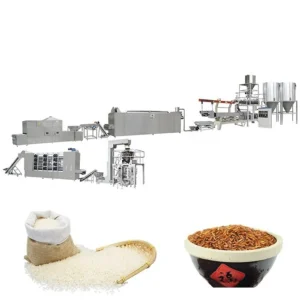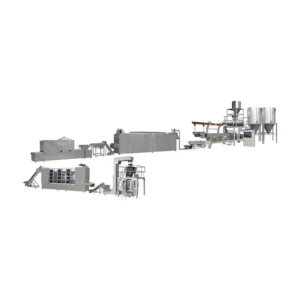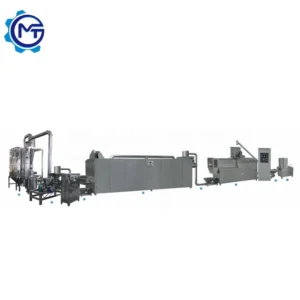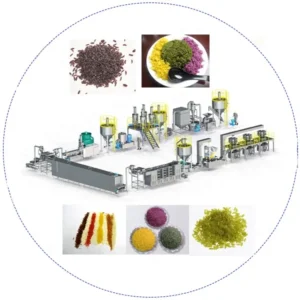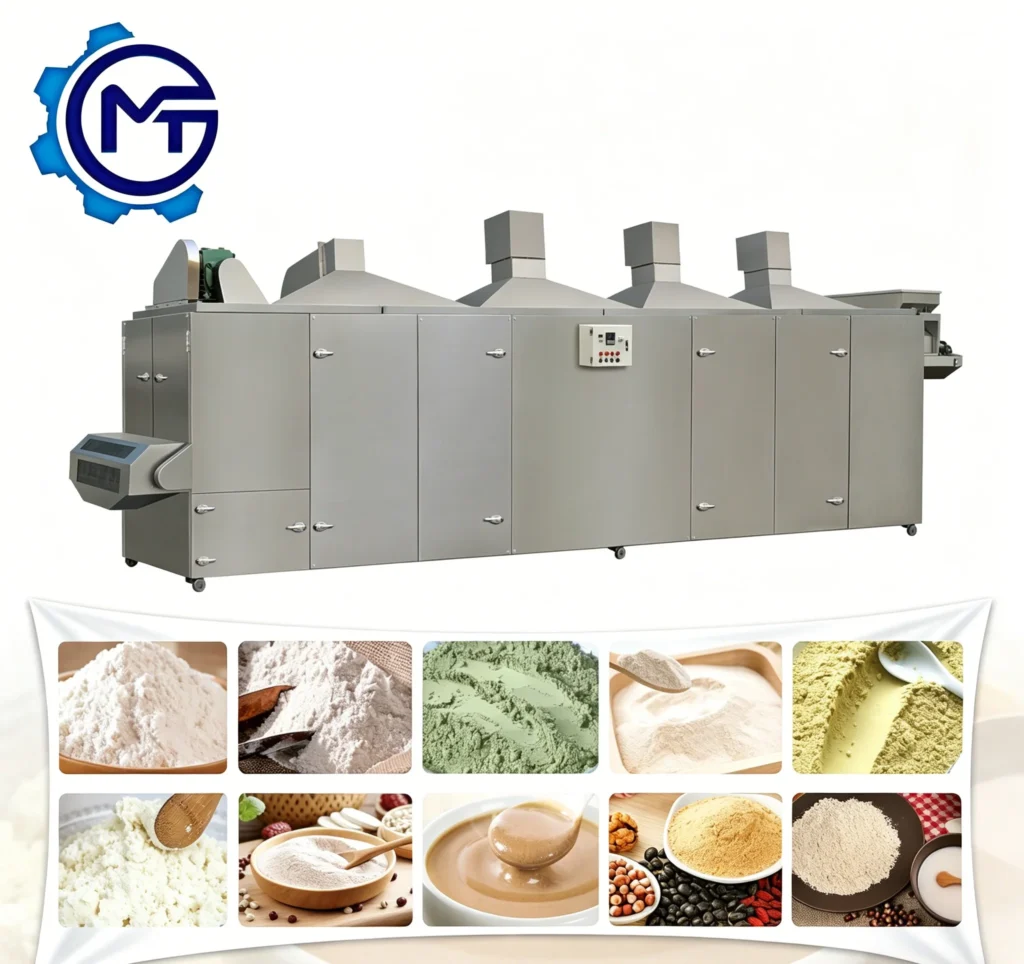
Full-equipment-range coverage — Every station from batching through packing is throughput-matched under one supplier, so your 200–500 kg/h nutritional powder line never bottlenecks at the dryer.
Technical Specifications
| Parameter | Value |
|---|---|
| Product Type | Baby Food Nutrition Powder Processing Line |
| Output Capacity | 200–500 kg/h (basis not stated in source — confirm raw material type, moisture content, formulation) |
| Construction Material | Food-grade 304 stainless steel |
| Heat Source Options | Electric / Gas / Steam |
| Control System | Touch control panel with digital system |
| Automation Level | Full automatic |
| Energy Profile | Low energy consumption design (specific consumption rate to be confirmed) |
| Warranty | 1 year |
| After-Sales Service | Overseas engineer service available |
| Key Features | CE-marked, full-line integration from mixing to packing |
Application Suitability
| Application | Material or Output |
|---|---|
| Infant formula and baby food powder | Rice flour, corn starch, oat flour, blended grain formulations |
| Fortified nutrition programme powders | Multi-grain porridge blends with added micronutrients |
| Cereal-based weaning food | Rice, corn, beans, sorghum, and custom grain ratios |
| Value-added nutritional powder lines | Pre-gelatinised starch bases, protein-fortified grain blends |
What a Capacity Number Without a Formulation Leaves Out
A nutritional powder processing line rated at 500 kg/h on standard rice flour may deliver half that on a 30% legume blend if the screw profile was never adjusted.
I learned this the hard way commissioning a baby food extrusion line in Southeast Asia. The line was configured and quoted on pure rice flour at a set moisture level. When the customer ran their actual recipe — rice cut with mung bean and millet at different hydration — the gelatinisation window shifted entirely. Expansion dropped, the powder clumped downstream at the drying station, and we spent four days on-site re-tuning barrel temperatures and screw elements before output stabilised. [NEED_CITE: gelatinisation temperature variation across grain and legume blends]
That is why the capacity figure on any nutritional powder processing line equipment datasheet only matters when tied to your specific raw material blend and target moisture content. Without that link, you are buying a number, not a production outcome.
Matching Every Station to the Same Throughput Target
A nutritional powder processing line is only as fast as its slowest station. If the extruder pushes 400 kg/h but the dryer is sized for 250 kg/h, product backs up, residence time in the drying chamber stretches beyond specification, and moisture content drifts batch to batch. This line is specified so that mixer capacity, extruder output, drying surface area, and packing speed all align to the same target — eliminating the hidden bottleneck that separate-vendor assemblies routinely create.
Heat Source Selection and Its Impact on Drying Uniformity
The line supports electric, gas, or steam heating for the baking and drying stages. Steam-heated dryers tend to deliver more uniform temperature distribution across large belt surfaces, which matters when you are drying fine nutritional powder where hot spots cause localised over-browning or residual moisture pockets. The choice depends on your factory’s existing utility infrastructure and local energy cost structure [NEED_CITE: industrial dryer heat source comparison for food powder applications]. Selecting the right option early avoids costly retrofit work after installation.
Reading the Specs That Actually Affect Your Powder
The food-grade 304 stainless steel construction covers all product-contact surfaces, which is a baseline requirement for infant food production in most regulatory jurisdictions. The touch control panel with digital system lets operators store and recall recipe parameters — barrel zone temperatures, screw speed, feeder rate — so that a changeover from a rice-dominant blend to a multi-grain formulation does not depend on one technician’s memory. Heat source flexibility across electric, gas, and steam means the dryer and oven can integrate with whatever utility your plant already has, rather than forcing a new boiler installation. Automation level is listed as full automatic, meaning the line handles material transfer between stations without manual scooping or belt-feeding — a factor that directly influences contamination risk and labour headcount on the floor.
The Cost of Skipping the Trial Run
When a nutritional powder processing line ships without a trial run on the buyer’s actual grain blend, the first real test happens on the customer’s factory floor — with installation crews still on-site, production schedules waiting, and raw material already staged. Screw configurations that work on the builder’s standard test flour often produce incorrect particle density or incomplete gelatinisation on blends with higher fibre or protein content. [NEED_CITE: extrusion screw configuration impact on non-standard grain blends] The downstream consequence is a powder that fails to meet the instant-dispersibility or mouthfeel specifications your market expects, requiring weeks of on-site adjustment that could have been resolved in your supplier’s testing workshop before the crate was sealed.
Why This Line Is Specified Differently
Every station — mixer, extruder, dryer, flavouring drum, cooler, packing — is selected and throughput-matched by one engineering team rather than assembled from separate equipment vendors. Screw configuration and die design are specified to your raw material formulation and target powder particle size, not copied from a generic build. An in-house testing workshop allows trial runs on your actual grain blend before shipment, so product development happens before the line arrives, not after. The digital control system stores complete recipe profiles for repeatable output across shifts and operators. Pre-sales consultation covers line layout, utility planning, and phased installation scheduling, so commissioning starts from a documented baseline rather than an improvised one.
Documentation & Verification
- Line layout drawing showing throughput matching across every station from mixer to packing
- Screw and die configuration record matched to your grain blend and target powder density
- Trial run report on your actual raw material conducted in the testing workshop before dispatch
- Electrical schematic with voltage, frequency, and control language confirmed to your factory standard
- CE declaration of conformity and ISO certificate for the complete line
- Operation and maintenance manual with wear parts list specific to your line configuration
Installation, Commissioning & Support
- Floor plan review to confirm dryer and oven footprint fit within your available workshop space
- Dedicated power circuit sizing based on the confirmed electric or steam heat source selection
- Extruder barrel and screw assembly verification on-site after transport to ensure alignment integrity
- First-run parameter logging on your grain formulation to establish baseline digital recipe profiles
- Operator training covering recipe changeover, cleaning cycles, and touch panel navigation
- Wear parts list covering screws, dies, and dryer belt sections with recommended stocking quantities
What We Need to Configure Your Line
To move from a general capacity range to a specific line configuration, we need your target raw material blend with ratios, expected incoming moisture content, and the final powder specification your market requires. Share your factory’s available voltage and frequency, preferred heat source for the drying stage, and the control panel language your operators need. If you have existing upstream batching or downstream packing equipment, let us know the interface points so the line layout accounts for them. Sending a sample of your actual grain blend allows us to run a trial in the testing workshop and include the results with the quotation.
Frequently Asked Questions
Q: How is the 200–500 kg/h output capacity verified, and on which raw material formulation?
A: The stated range depends entirely on your grain blend, moisture content, and target powder density. We verify actual throughput by running your specific raw material in our testing workshop before shipment and documenting the result. The trial report includes measured output rate, powder particle size distribution, and moisture content at the dryer exit so you know what to expect on your floor.
Q: Which supporting stations are included, and how is throughput matched across the line?
A: The line integrates mixing, extrusion, drying, cooling, and packing stations under one supplier. Each station is sized so its maximum throughput aligns with the others — an oversized extruder paired with an undersized dryer would cause product backlog and inconsistent drying. We provide a line layout document showing the capacity calculation at every station for your review before production begins.
Q: What screw and die configuration is selected for my specific grain blend?
A: Screw element arrangement and die geometry are chosen based on your raw material composition and the powder characteristics your market requires. A rice-dominant blend gelatinises at a different temperature and shear level than one with significant legume or fibre content. We document the selected configuration and include it in the trial run report so you have a repeatable baseline.
Q: Can a trial run be performed on my raw material before shipment?
A: Yes — we require a sample of your actual grain blend and run it through the extruder and dryer in our testing workshop. The trial report covers output rate, expansion behaviour, powder texture, and moisture content. This allows us to adjust screw configuration and temperature profiles before the line ships, reducing on-site commissioning time.
Q: What voltage, frequency, and control panel language options are available?
A: Electrical specifications are confirmed during the quotation stage to match your factory’s local power supply and operator language requirements. We provide a complete electrical schematic and voltage confirmation document before production starts, so there are no surprises when the line arrives and needs to connect to your existing power infrastructure.