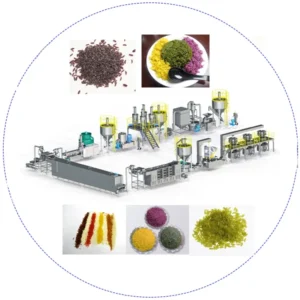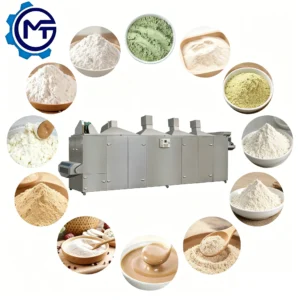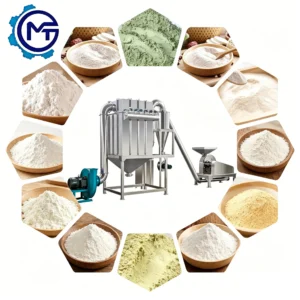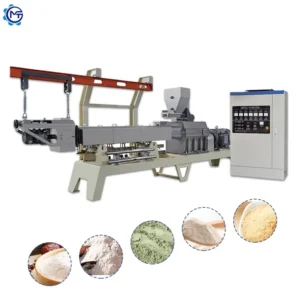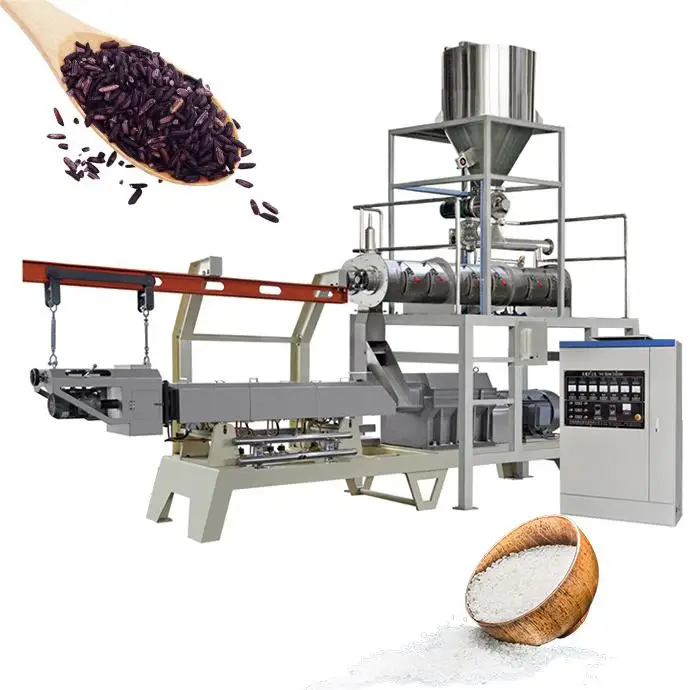
Matched Station Throughput — Every unit in the MT95 nutritional rice production line, from mixer to packer, is sized together so no single machine holds up the rest.
Technical Specifications
| Parameter | Value |
|---|---|
| Product Type | Nutritional Rice Production Line |
| Model Range | MT65 / MT70 / MT85 / MT75 / MT95 |
| Screw Type | Twin-screw |
| Installed Power | 85 kW (MT65) / 120 kW (MT70) / 235 kW (MT85) / 180 kW (MT75) / 260 kW (MT95) |
| Power Consumption | 60 kW (MT65) / 85 kW (MT70) / 165 kW (MT85) / 135 kW (MT75) / 195 kW (MT95) |
| Output Capacity | 80–100 kg/h (MT65) / 100–120 kg/h (MT70) / 200–300 kg/h (MT85) / 300–500 kg/h (MT75) / 800–1000 kg/h (MT95) (basis not stated in source — confirm raw material, moisture content and rice kernel format) |
| Overall Dimensions (L×W×H) | 28 × 1.2 × 2.2 m (MT65) / 30 × 1.5 × 2.2 m (MT70) / 34 × 3.5 × 4.3 m (MT85) / 32 × 3.5 × 4.3 m (MT75) / 36 × 3.5 × 4.3 m (MT95) |
| Control System | Frequency speed controlling with high automation |
| Feeding System | Single or double screw feeding, selected by material characteristics |
| Screw Material | Special wear-resistant alloy |
| Lubrication | Automatic lubricating and cooling system |
| Line Stations | Mixing → Extruding → Vibrating → Low temperature drying → Cooling → High temperature roasting → Cooling → Packing |
| Dryer Heating Source | Electric or gas |
| Dryer Control | Frequency motor controls mesh belt speed |
| Certification | CE, ISO |
Application Suitability
| Application | Material or Output |
|---|---|
| Fortified rice kernel production | Broken rice, rice bran with added vitamins and minerals |
| Artificial rice from mixed grains | Corn, millet, wheat, oats, buckwheat, starch blends |
| Nutritional rice for food programmes | Bean flour, starch and micronutrient premix |
| Instant rice kernel processing | Rice and corn meal with controlled gelatinisation |
Why a Nutritional Rice Production Line Full Equipment Range Matters More Than Extruder Capacity Alone
An extruder rated at a headline output means nothing when the dryer cannot remove moisture fast enough to keep the line moving.
I once watched a buyer in Southeast Asia commission a nutritional rice line where the extruder pushed out product faster than the downstream dryer could handle. Wet kernels piled up on the conveyor, sticking together and deforming before they ever reached the cooling stage. The rated capacity of the extruder was never the problem — the mismatch between stations was [NEED_CITE: throughput balancing principles in food extrusion lines]. When sourcing a nutritional rice production line full equipment range, every machine between the mixer and the packer must be calculated against the same throughput target.
Every Station Sized to the Same Target
The MT95 line sequence runs from mixing through extruding, vibrating, low temperature drying, cooling, high temperature roasting, a second cooling stage, and finally packing. Each station in this nutritional rice production line full equipment range is selected so that the output of one machine becomes the input of the next without queuing or starvation. The dryer belt width and length are matched to the extruder output, and the cooling conveyor is sized to bring kernels to packing temperature at the same rate they leave the roaster.
Dryer Configuration and Moisture Control
Low temperature drying preserves the kernel structure formed during extrusion, preventing case hardening that traps internal moisture. The frequency-controlled mesh belt allows operators to adjust residence time based on the incoming moisture level of the extrudate. When producing fortified rice from high-starch formulations, the drying curve must be gentle enough to avoid cracking yet sufficient to bring moisture down before roasting [NEED_CITE: drying curve requirements for extruded rice kernels]. The option of electric or gas heating lets buyers align the dryer with local utility costs and available infrastructure.
Reading the Specification Sheet for Real Output
The twin-screw extruder range spans from the MT65 at 85 kW installed power up to the MT95 at 260 kW, covering output tiers from 80 kg/h to 1000 kg/h. These capacity figures depend on the raw material blend, moisture content, and target rice kernel format — they are not universal constants. The screw material, a wear-resistant alloy, determines how long the screw profile maintains its shear geometry before refurbishment is needed. Automatic lubricating and cooling on the extruder barrel reduces unplanned stops during continuous shifts. The feeding system is available in single or double screw configuration, chosen according to whether the raw blend is free-flowing or tends to bridge in the hopper. Overall line dimensions reach up to 36 m in length for the MT95 configuration, which shapes factory layout planning and utility routing from the start.
The Cost of Ignoring Downstream Equipment
Buyers who focus on extruder specifications and treat the dryer, cooler, and packer as commodity add-ons often discover the bottleneck only after installation. Kernels that leave the extruder at a high moisture content need sufficient drying length and airflow; undersizing the dryer forces the operator to slow the extruder, negating the higher capacity they paid for. A vibrating station that cannot spread kernels evenly across the dryer belt creates wet spots that lead to inconsistent texture and shelf-life variation downstream [NEED_CITE: common causes of uneven drying in extruded food lines]. These are not equipment failures — they are line design failures that no amount of operator adjustment can correct.
Why Source the Complete Equipment Range from One Supplier
Every station on this line — mixer, twin-screw extruder, vibrating conveyor, multi-pass dryer, cooler, roaster, and packer — is engineered as one system rather than assembled from separate purchase orders. Screw configuration and die design are specified against the buyer’s raw material blend and target kernel dimensions before production begins. The in-house testing workshop allows trial runs on the buyer’s actual ingredients, so product development happens before the machines ship rather than after installation. Frequency-controlled drives across the dryer and extruder allow fine adjustment during commissioning. Pre-sales consultation through on-site installation, operator training, and ongoing wear parts supply keeps the line running through its first year of production.
Documentation & Verification
- Line layout drawing showing matched throughput at every station from mixer to packer
- Machine specification sheet for each individual unit in the nutritional rice line
- Screw and die configuration record matched to your grain blend and kernel shape
- Electrical schematic with voltage and frequency confirmed for your facility
- Factory trial run report produced on your supplied raw material before dispatch
- CE declaration of conformity covering the complete assembled line
Installation, Commissioning & Support
- Floor space of up to 36 × 3.5 m requires level concrete slab with drainage for the MT95 layout
- Power supply must accommodate up to 260 kW installed load with dedicated circuit breaker
- Line arrives in modular sections; extruder barrel segments and dryer panels assembled on site
- First run includes screw speed, barrel temperature, and dryer belt speed calibration on your material
- Operator training covers frequency drive adjustment and automatic lubrication system monitoring
- Wear parts list details screw segments, die plates, and mesh belt sections for first-year stocking
Preparing Your Inquiry
To receive a line configuration that reflects your actual production environment, share the raw material formulation you plan to use, including the ratio of broken rice or corn to starch and micronutrient premix. Specify the target kernel size and shape, your daily output requirement in kilograms, and the available floor space with ceiling height in your production hall. Confirm the local voltage and frequency supply, the preferred control language for the operator interface, and whether gas or electric heating is more practical for the dryer.
Frequently Asked Questions
Q: What machines are included in the full nutritional rice production line and how are they sequenced?
A: The line starts with a mixing station, feeds into a twin-screw extruder, then passes through a vibrating conveyor, low temperature dryer, first cooler, high temperature roaster, second cooler, and packing station. Each unit is selected so its throughput matches the extruder output, preventing material buildup or idle time between stages.
Q: How is throughput matched between the extruder, dryer and packing station to avoid bottlenecks?
A: The dryer belt length, airflow volume, and residence time are calculated against the extruder’s output rate and the moisture content of the extruded kernels. The packing station speed is then set to the dried and cooled output rate, so no single machine forces the others to slow down.
Q: What dryer heating source options are available and how do they affect line footprint?
A: Both electric and gas heating are available for the dryer. Gas-heated dryers typically require external venting and gas supply piping, which influences the line placement within the factory. Electric dryers need sufficient amperage on the facility’s power supply but may fit into tighter spaces.
Q: Which spare wear parts should be stocked for the first year of operation?
A: Screw segments and die plates experience the most wear during extrusion of abrasive grain blends. Mesh belt sections for the dryer and vibrating screen panels are also recommended. A wear parts list specific to your model is provided with the line documentation.
Q: Can individual stations be specified or upgraded independently within the line?
A: Individual stations can be configured with different options — for example, choosing gas or electric heating for the dryer, or selecting single versus double screw feeding. However, any change to one station’s capacity must be recalculated against the rest of the line to maintain matched throughput.